CyberArk Certification Exams Pack
Everything from Basic, plus:
- Exam Name: CyberArk Guardian Exam
- 60 Questions

Students Passed
Average Score
Questions came word for word
Years Teaching
Explore other related CyberArk exams to broaden your certification path. These certifications complement your skills and open new opportunities for career growth.
Know how you can make it happen
If you're looking to secure Guardian (GUARD) certification, remember there's no royal path to it. It's your prep for this exam that can make the difference. Stay away from those low-quality exam PDFs and unreliable dumps that have no credibility. What you need is a simulated practice exam with practice questions that mirror the actual GUARD test environment.
To save you from frustration, Dumpstech comes with a comprehensive prep system that is clear, effective, and built to help you succeed without the least chance of failure. Whether you're looking for sample test questions or full exam practice questions for the CyberArk Guardian Exam, our system delivers.
It's overwhelmingly recommended by thousands of Dumpstech's loyal customers as practical, relevant and intuitively crafted to match the candidates' actual exam needs. Our prep questions are designed to build real confidence for the SY0-701 test.
Dumpstech's CyberArk exam GUARD questions are designed to deliver you the essence of the entire syllabus. Each question mirrors the real exam format and comes with an accurate and verified answer. These exam questions and answers give you the clarity you need. Dumpstech's prep system is not mere cramming; it is crafted to add real information and impart deep conceptual understanding to the exam candidates. After each test, review the practice exam answers to identify your weak spots.
Dumpstech's smart testing engine generates multiple mock tests to develop familiarity with the real exam format and learn thoroughly the most significant from the perspective of CyberArk GUARD real exam. They also support you to revise the syllabus and enhance your efficiency to answer all exam practice questions within the time limit.
Dumpstech offers you the most authentic, accurate, and current information that liberates you from the hassle of searching for any other study resource. If you're looking for a free practice test with answers to evaluate our quality before you commit, download our free demo and see for yourself. This comprehensive resource equips you perfectly to develop confidence and clarity to answer exam queries.
Dumpstech's authentic and up-to-date content guarantees you success in the CyberArk Guardian Exam certification exam. If you perchance you lose your exam despite your reliance on Dumpstech's exam questions PDF, Dumpstech doesn't leave you alone. You have the option of taking back refund of your money or try a different exam paying no additional amount.
If you want to crack the CyberArk Guardian Exam (GUARD) exam in one go, your journey starts here. Dumpstech is your real ally that gets you certified fast with the least possibility of losing your chance.
A financial institution uses CyberArk Privileged Session Manager (PSM) to monitor privileged access to production servers.
The security team requires authorized auditors to terminate suspicious privileged sessions immediately when potentially malicious administrative activity is detected.
An auditor can view active sessions in PVWA but cannot terminate them. The administrator confirms that session monitoring is enabled and the PSM infrastructure is functioning correctly.
What configuration should be implemented to allow the auditor to terminate active privileged sessions?
|
C
|
|---|
|
Explanation
CyberArk Privileged Session Manager provides real-time monitoring and control of privileged sessions, enabling security teams to investigate potentially dangerous activity and intervene when necessary. Session monitoring and session termination are distinct authorization capabilities. Being able to view an active privileged session does not automatically grant permission to terminate it. In CyberArk PAM Self-Hosted, the PSMLiveSessionTerminators group provides the authorization framework for terminating active PSM sessions. To enable this capability, the administrator must add the designated auditor to the PSMLiveSessionTerminators group. Additionally, this group must have the necessary membership in the Safes containing the account objects associated with the sessions that the auditor is authorized to terminate. Both requirements are important because session termination authorization must respect the organization's privileged-account access boundaries. Where PSM uses RDP over SSL, additional connection-component configuration may be required for the monitoring and termination functions to operate correctly. Granting broad Vault Administrator privileges would violate least-privilege principles. Dual Control regulates password-access approvals rather than active-session termination. Similarly, credential retrieval and password reconciliation permissions do not independently authorize session termination. This configuration enables controlled security intervention without unnecessarily exposing privileged credentials or granting unrestricted Vault administration. [Reference: CyberArk Knowledge Base — How to Configure Live Session Termination for Audit Users; PSM Live Session Monitoring; PSMLiveSessionTerminators Group and Safe Authorizations., community.cyberark.com]
|
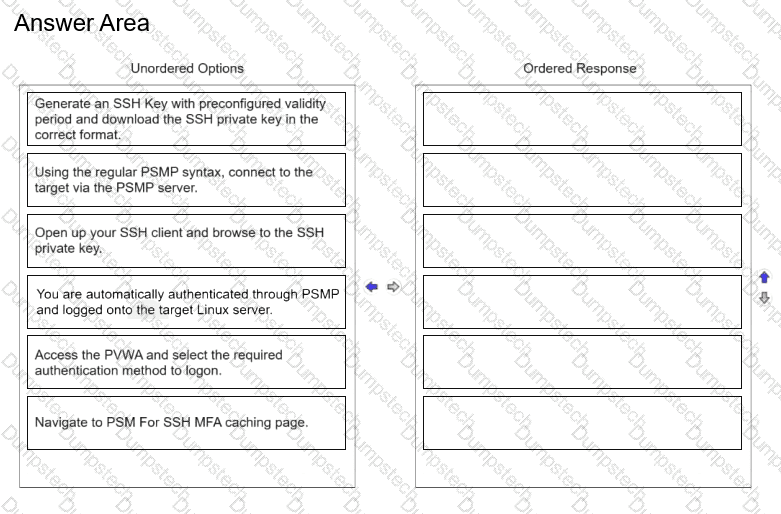
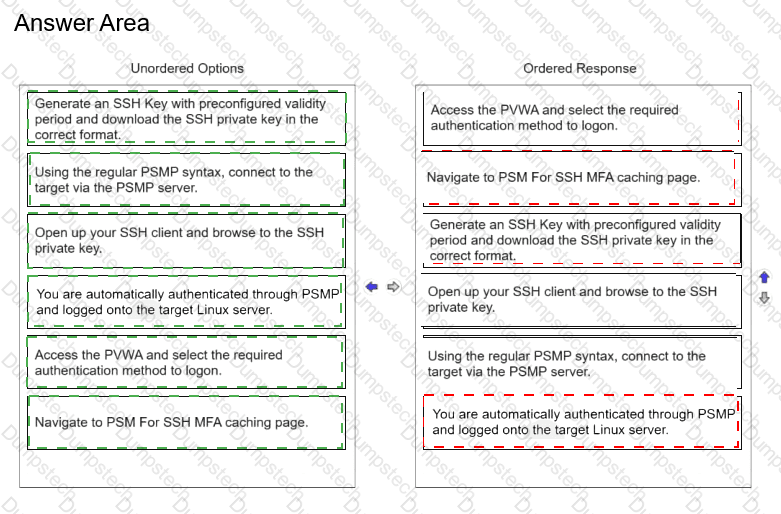
Put the events in the correct order for the PSM for SSH MFA Caching authentication workflow, available beginning with v12.1.
|
Answer:
 |
|---|
|
Explanation
See correct matching / sequence below. Original description / order Correct match 1 Access the PVWA and select the required authentication method to logon. 2 Navigate to PSM for SSH MFA caching page. 3 Generate an SSH key with preconfigured validity period download the SSH private key in the correct format. 4 Open up your SSH client and browse to the SSH private key. 5 Using the regular PSMP syntax, connect to the target via the PSMP server. 6 You are automatically authenticated through PSMP and logged onto the target Linux server. CyberArk PSM for SSH MFA Caching enables administrators to authenticate through supported PVWA authentication mechanisms and subsequently establish SSH sessions without repeating the complete multifactor authentication process for every connection. The workflow begins when the user authenticates to PVWA using the required authentication method. After successful authentication, the user navigates to the PSM for SSH MFA Caching interface and generates a temporary SSH authentication key. The key is issued with a configured validity period and downloaded in a format supported by the user's SSH client. The administrator then configures the SSH client to use the generated private key. Using the standard PSM for SSH connection syntax, the user establishes an SSH connection through the PSMP server. PSM for SSH validates the presented authentication material and applicable cached authentication context before initiating the authorized target connection. This architecture allows organizations to retain multifactor authentication requirements while improving usability for administrators who establish frequent SSH sessions. The private key must remain protected because it represents temporary authentication material. Expiration, revocation, and endpoint security controls remain essential. [Reference:CyberArk PSM for SSH — MFA Caching, SSH Key Authentication, PVWA Authentication Integration and PSMP Connection Syntax.]
|
A new Vault is to be deployed in a highly regulated environment. Regulations require that every operating system on the network be updated regularly.
How does CyberArk recommend automatically updating hardened Vaults?
|
A
|
|---|
|
Explanation
CyberArk Digital Vault servers operate within a hardened security boundary designed to minimize their operating-system attack surface. Standard hardening restricts unnecessary Windows services, network connections, administrative access, and operating-system functionality. Despite these protections, Vault servers still require supported operating-system security updates to address vulnerabilities and maintain compliance. CyberArk documents a controlled patching procedure using Windows Server Update Services (WSUS). A dedicated, appropriately secured WSUS server distributes approved Microsoft updates without requiring the Vault to connect directly to public Windows Update services. The process involves configuring the Vault for the internal WSUS service, temporarily enabling the services and network connectivity needed to obtain updates, installing approved patches, and restoring the hardened configuration. CyberArk supplies PowerShell utilities for these operations, including ConfigureWSUS.ps1 , OpeningServices.ps1 , DownloadUpdatesFromWSUS.ps1 , and InstallUpdates.ps1 . Updates should be tested, approved, and applied during coordinated maintenance windows. Reboots must be planned according to the Vault's availability architecture. Joining the Vault to Active Directory merely to support patch distribution would introduce unnecessary dependencies and weaken its security isolation. Technical warning / qualification: Option A identifies the supported mechanism. It should not be interpreted as authorization for uncontrolled, unattended patch installation. [Reference:CyberArk PAM Self-Hosted — Integrate the Digital Vault with a Windows Patch Server (WSUS); Vault Server Windows Updates and Hardening.]
|
See how DumpsTech helps candidates pass with confidence.
Stay ahead in your career with the latest certification exams from leading vendors. DumpsTech brings you newly released exams with reliable study resources to help you prepare confidently.
Find answers to the most common questions about the CyberArk GUARD exam, including what it is, how to prepare, and how it can boost your career.