Fortinet Certification Exams Pack
Everything from Basic, plus:
- Exam Name: Fortinet NSE 6 - FortiNAC-F 7.6 Administrator
- 60 Questions


Students Passed
Average Score
Questions came word for word
Years Teaching
Explore other related Fortinet exams to broaden your certification path. These certifications complement your skills and open new opportunities for career growth.
Know how you can make it happen
If you're looking to secure NSE 6 Network Security Specialist (NSE6_FNC_AD-7.6) certification, remember there's no royal path to it. It's your prep for this exam that can make the difference. Stay away from those low-quality exam PDFs and unreliable dumps that have no credibility. What you need is a simulated practice exam with practice questions that mirror the actual NSE6_FNC_AD-7.6 test environment.
To save you from frustration, Dumpstech comes with a comprehensive prep system that is clear, effective, and built to help you succeed without the least chance of failure. Whether you're looking for sample test questions or full exam practice questions for the Fortinet NSE 6 - FortiNAC-F 7.6 Administrator, our system delivers.
It's overwhelmingly recommended by thousands of Dumpstech's loyal customers as practical, relevant and intuitively crafted to match the candidates' actual exam needs. Our prep questions are designed to build real confidence for the SY0-701 test.
Dumpstech's Fortinet exam NSE6_FNC_AD-7.6 questions are designed to deliver you the essence of the entire syllabus. Each question mirrors the real exam format and comes with an accurate and verified answer. These exam questions and answers give you the clarity you need. Dumpstech's prep system is not mere cramming; it is crafted to add real information and impart deep conceptual understanding to the exam candidates. After each test, review the practice exam answers to identify your weak spots.
Dumpstech's smart testing engine generates multiple mock tests to develop familiarity with the real exam format and learn thoroughly the most significant from the perspective of Fortinet NSE6_FNC_AD-7.6 real exam. They also support you to revise the syllabus and enhance your efficiency to answer all exam practice questions within the time limit.
Dumpstech offers you the most authentic, accurate, and current information that liberates you from the hassle of searching for any other study resource. If you're looking for a free practice test with answers to evaluate our quality before you commit, download our free demo and see for yourself. This comprehensive resource equips you perfectly to develop confidence and clarity to answer exam queries.
Dumpstech's authentic and up-to-date content guarantees you success in the Fortinet NSE 6 - FortiNAC-F 7.6 Administrator certification exam. If you perchance you lose your exam despite your reliance on Dumpstech's exam questions PDF, Dumpstech doesn't leave you alone. You have the option of taking back refund of your money or try a different exam paying no additional amount.
If you want to crack the Fortinet NSE 6 - FortiNAC-F 7.6 Administrator (NSE6_FNC_AD-7.6) exam in one go, your journey starts here. Dumpstech is your real ally that gets you certified fast with the least possibility of losing your chance.
An administrator is configuring FortiNAC-F to manage FortiGate VPN users. As part of the configuration, the administrator must configure a few FortiGate firewall policies. What is the purpose of the FortiGate firewall policy that applies to clients not yet authorized by FortiNAC-F? (Choose one answer)
|
C
|
|---|
|
Explanation
The firewall policy for an unauthorized VPN host is an isolation policy. When a remote endpoint first establishes its VPN tunnel, FortiGate assigns the client an IP address plus two DNS servers: the production DNS server as primary and the FortiNAC-F Port2 VPN-context address as secondary . Until FortiNAC-F validates the endpoint, FortiGate firewall policies restrict the client ' s traffic so that it can communicate only with the FortiNAC-F Port2 VPN interface . This restriction deliberately prevents access to the primary production DNS server. Consequently, DNS resolution against the primary server fails and the endpoint falls back to the secondary DNS server—FortiNAC-F. FortiNAC-F then resolves the request toward its VPN isolation interface and presents the VPN captive portal . The user can subsequently run or download the required FortiNAC-F agent, allowing FortiNAC-F to perform identification and endpoint-compliance validation. After successful authorization, FortiNAC-F sends the appropriate group/tag information to FortiGate, causing the host to match a different firewall policy that permits the required production resources and blocks the isolation interface. Study Guide Reference: Advanced Features → FortiGate VPN Integration → VPN Host Isolation and Firewall Policies , pp. 346–354 . |
Refer to the exhibit.
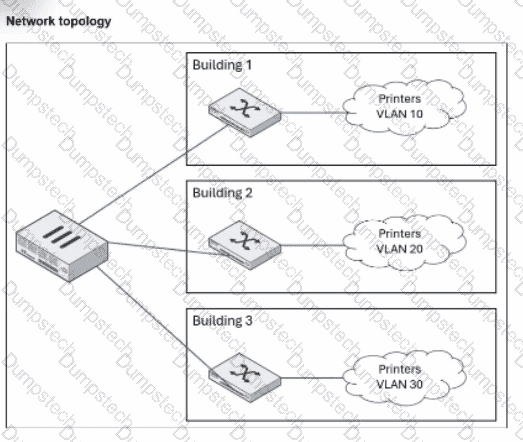
An administrator wants to use FortiNAC-F to automatically provision printers throughout their organization. Each building uses its own local VLAN for printers.
Which FortiNAC-F feature would allow this to be accomplished with a single network access policy?
|
B
|
|---|
|
Explanation
The FortiNAC-FLogical Networkfeature is specifically designed to provide an abstraction layer between high-level security policies and the underlying physical network infrastructure. In large-scale deployments where different physical locations (like Building 1, 2, and 3 in the exhibit) use different local VLAN IDs for the same type of device (e.g., VLAN 10, 20, and 30 for printers), managing separate policies for each building would create significant administrative overhead. By using aLogical Network, an administrator can create a single entity—for example, a logical network named " Printers " —and use it as the " Access Value " in a singleNetwork Access Policy. The mapping of this logical label to a specific physical VLAN occurs at theModel Configurationlevel for each network device. When a printer connects to a switch in Building 1, FortiNAC-F evaluates the policy, identifies that the printer should be in the " Printers " logical network, and checks the Model Configuration for that specific switch to see which VLAN ID is mapped to that label (VLAN 10). If the same printer moves to Building 3, the same single policy applies, but FortiNAC-F provisions it to VLAN 30 based on the local mapping for that building ' s switch. This architectural approach ensures that policies remain consistent and easy to manage regardless of the complexity or variations in the local network topology. " Logical Networks provide a way to define a network access requirement once and apply it across many different network devices that may use different VLAN IDs for that access... Each managed device can usedifferent VLAN IDs for the same Logical Network label. You can define the Logical Networks based on requirements and then associate the network to a VLAN ID when the managed device is configured in theModel Configuration. " —FortiNAC-F IoT Deployment Guide: Define the Logical Networks. |
When configuring isolation networks in the configuration wizard, why does a layer 3 network typo allow for mora than ono DHCP scope for each isolation network typo?
|
C
|
|---|
|
Explanation
In FortiNAC-F, theLayer 3 Network typeis specifically designed for deployments where the isolation networks—such as Registration, Remediation, and Dead End—are separated from the FortiNAC appliance ' s service interface (port2) by one or more routers. This architecture is common in large, distributed enterprise environments where endpoints in different physical locations or branches must be isolated into subnets that are local to their respective network equipment. The reason the Configuration Wizard allows for more than one DHCP scope for a single isolation network type (state) is thatthere can be more than one isolation network of each typeacross the infrastructure. For instance, if an organization has three different sites, each site might require its own unique Layer 3 registration subnet to ensure efficient routing and to accommodate local IP address management. By allowing multiple scopes for the " Registration " state, FortiNAC can provide the appropriate IP address, gateway, and DNS settings to a rogue host regardless of which site ' s registration VLAN it is placed into. When an endpoint is isolated, the network infrastructure (via DHCP Relay/IP Helper) directs the DHCP request to the FortiNAC service interface. FortiNAC then identifies which scope to use based on the incoming request ' s gateway information. This flexibility ensures that the system is not limited to a single flat subnet for each isolation state, supporting a scalable, multi-routed network topology. " Multiple scopes are allowed for each isolation state (Registration, Remediation, Dead End, VPN, Authentication, Isolation, and Access Point Management). Within these scopes, multiple ranges in the lease pool are also permitted... This configWizard option is used when Isolation Networks are separated from the FortiNAC Appliance ' s port2 interface by a router. " —FortiNAC-F Configuration Wizard Reference Manual: Layer 3 Network Section. |
See how DumpsTech helps candidates pass with confidence.
Stay ahead in your career with the latest certification exams from leading vendors. DumpsTech brings you newly released exams with reliable study resources to help you prepare confidently.
Find answers to the most common questions about the Fortinet NSE6_FNC_AD-7.6 exam, including what it is, how to prepare, and how it can boost your career.