
75only - Ends in 0d 00h 00m 00s - Coupon code = 75only
Pass the Fortinet NSE 5 Network Security Analyst NSE5_FWB_AD-8.0 Questions and answers with Dumpstech
Exam NSE5_FWB_AD-8.0 Premium Access
View all detail and faqs for the NSE5_FWB_AD-8.0 exam
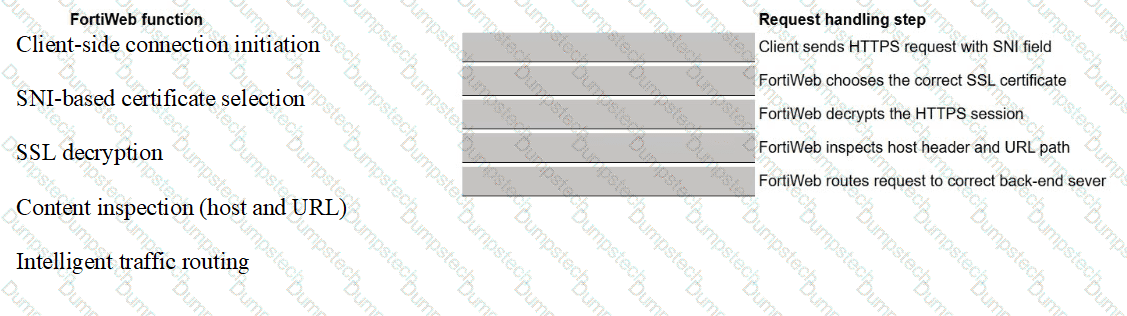
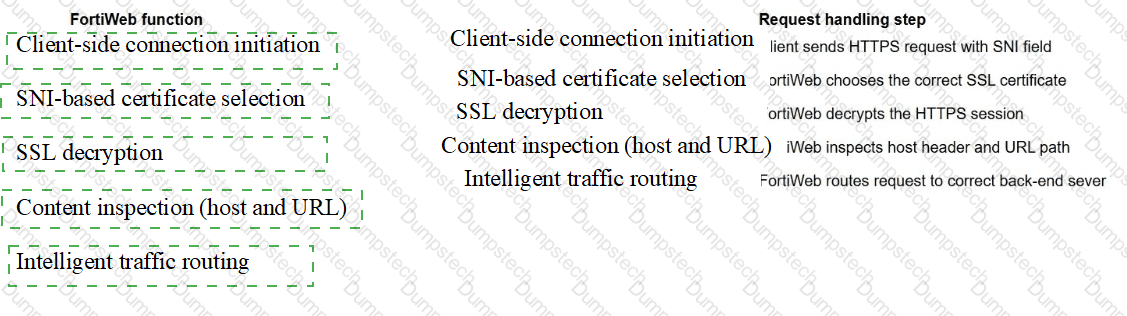
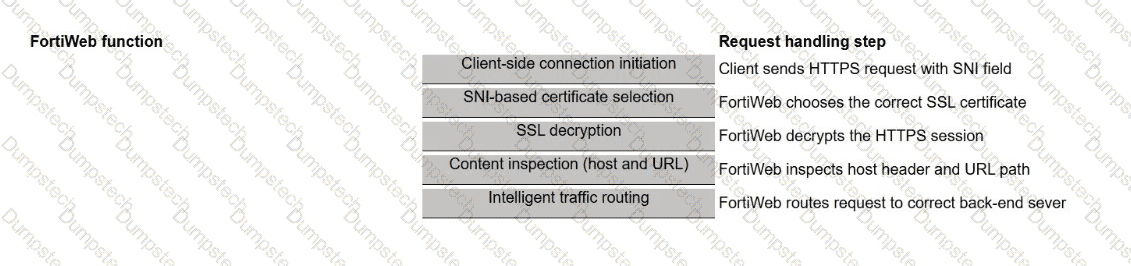
You are hosting multiple secure web applications behind a single public IP address on FortiWeb.
When a client connects to a service, FortiWeb needs to:
Identify the correct SSL certificate.
Decrypt the request.
Route the request to the correct back-end server.
Match each FortiWeb function to the request handling step that performs the function.
A third-party penetration test reveals that users can bypass login controls through a mobile API. Your current FortiWeb configuration includes zero trust network access (ZTNA) profiles and cookie security, but API protection and client management are not enabled. The security team asks you to recommend the most effective way to close this gap.
Which FortiWeb adjustment would best prevent future unauthorized API access?
A large enterprise has an existing web infrastructure with complex routing rules and static IP address assignments. The network administrators cannot modify the current IP address scheme, but they need FortiWeb to inspect and block threats like SQL injection and cross-site scripting (XSS) without changing the client-server communication flow.
In this situation, which FortiWeb operation mode is the most suitable?
Which situation best explains when a FortiWeb administrator should enable automatic HTTP-to-HTTPS redirection?
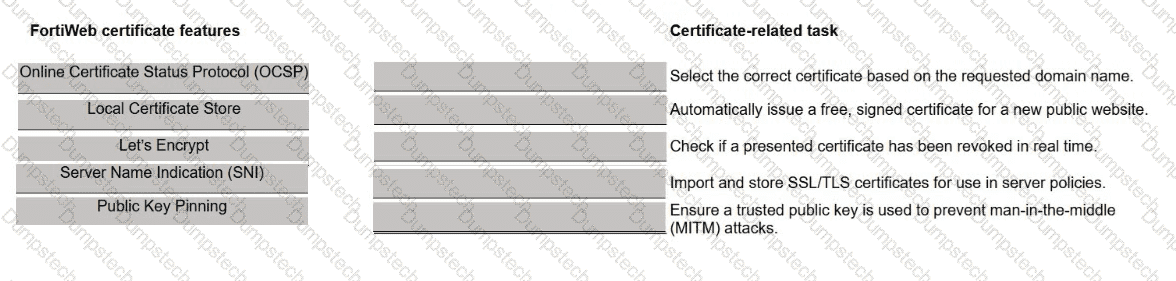
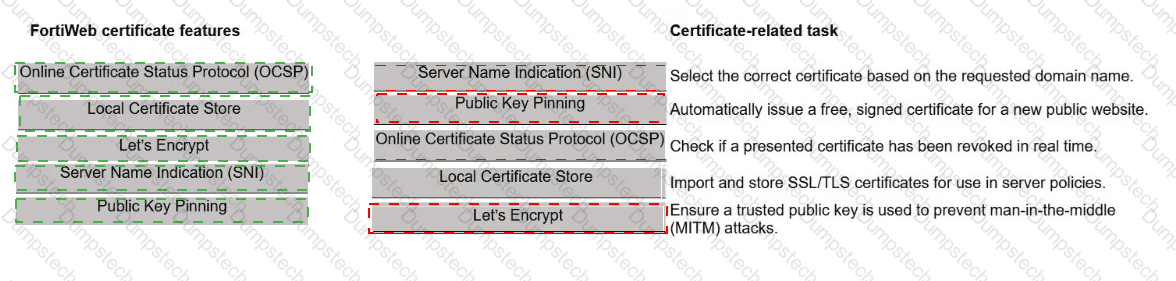
You are working on securing HTTPS communication across different services using FortiWeb. Your task is to configure and validate digital certificates for various traffic and communication needs.
Match each FortiWeb certificate feature to the certificate-related task that supports the feature.
FortiWeb is blocking groups of users behind your load balancer. In the logs, all users show the same source IP address.
Which action should you take to restore proper client identification?
Refer to the exhibit.
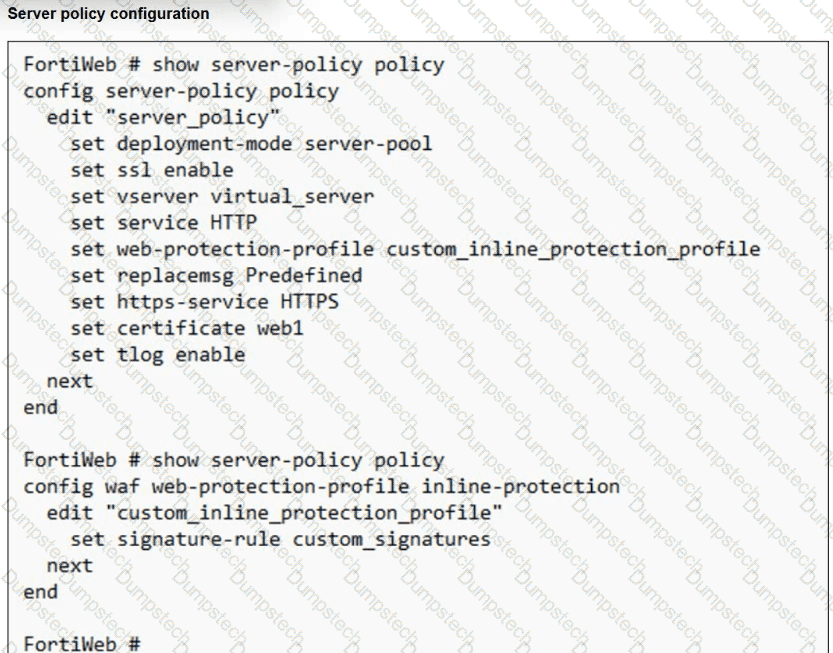
You have deployed FortiWeb behind a FortiGate that is configured as a reverse proxy and inserts the X-Forwarded-For HTTP header when forwarding HTTP and HTTPS traffic.
FortiWeb is using a custom inline protection profile, and logging is enabled, as shown in the exhibit.
You notice that FortiWeb is blocking legitimate users, and all requests in the attack logs appear to come from the FortiGate IP address, not the original client IP address.
Which action should you take to fix this issue?
While reviewing FortiWeb logs, you notice a suspicious login request that failed authentication. You suspect it may be part of an injection attack targeting the login form.
Which input pattern is an example of a typical SQL injection attempt that could bypass authentication checks?
You are reviewing SSL-related issues on FortiWeb. An administrator reports that they receive a certificate warning when they access the FortiWeb GUI over HTTPS. Separately, your FortiWeb device also makes outbound HTTPS requests to a back-end API server.
In which two situations would FortiWeb use its own certificates to establish or secure the connection? (Choose two.)
Refer to the exhibit.
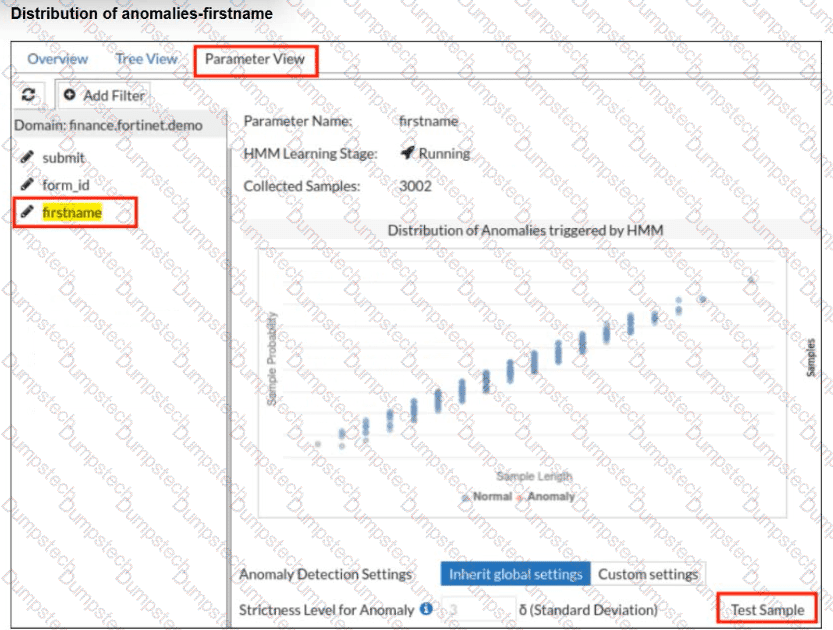
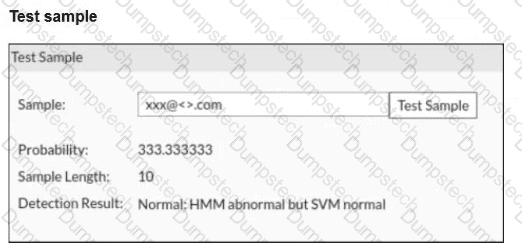
A FortiWeb administrator tests a new form input value after training the machine learning (ML) anomaly detection system.
The hidden Markov model (HMM) flags the input as abnormal, while the support vector machine (SVM) model classifies it as normal. FortiWeb allows the request.
What does this result indicate about the FortiWeb ML anomaly detection behavior?
