Huawei Certification Exams Pack
Everything from Basic, plus:
- Exam Name: HCIP-WLAN V2.0
- 55 Questions


Students Passed
Average Score
Questions came word for word
Years Teaching
Explore other related Huawei exams to broaden your certification path. These certifications complement your skills and open new opportunities for career growth.
Know how you can make it happen
If you're looking to secure HCIP-WLAN (H12-323_V2.0) certification, remember there's no royal path to it. It's your prep for this exam that can make the difference. Stay away from those low-quality exam PDFs and unreliable dumps that have no credibility. What you need is a simulated practice exam with practice questions that mirror the actual H12-323_V2.0 test environment.
To save you from frustration, Dumpstech comes with a comprehensive prep system that is clear, effective, and built to help you succeed without the least chance of failure. Whether you're looking for sample test questions or full exam practice questions for the HCIP-WLAN V2.0, our system delivers.
It's overwhelmingly recommended by thousands of Dumpstech's loyal customers as practical, relevant and intuitively crafted to match the candidates' actual exam needs. Our prep questions are designed to build real confidence for the SY0-701 test.
Dumpstech's Huawei exam H12-323_V2.0 questions are designed to deliver you the essence of the entire syllabus. Each question mirrors the real exam format and comes with an accurate and verified answer. These exam questions and answers give you the clarity you need. Dumpstech's prep system is not mere cramming; it is crafted to add real information and impart deep conceptual understanding to the exam candidates. After each test, review the practice exam answers to identify your weak spots.
Dumpstech's smart testing engine generates multiple mock tests to develop familiarity with the real exam format and learn thoroughly the most significant from the perspective of Huawei H12-323_V2.0 real exam. They also support you to revise the syllabus and enhance your efficiency to answer all exam practice questions within the time limit.
Dumpstech offers you the most authentic, accurate, and current information that liberates you from the hassle of searching for any other study resource. If you're looking for a free practice test with answers to evaluate our quality before you commit, download our free demo and see for yourself. This comprehensive resource equips you perfectly to develop confidence and clarity to answer exam queries.
Dumpstech's authentic and up-to-date content guarantees you success in the HCIP-WLAN V2.0 certification exam. If you perchance you lose your exam despite your reliance on Dumpstech's exam questions PDF, Dumpstech doesn't leave you alone. You have the option of taking back refund of your money or try a different exam paying no additional amount.
If you want to crack the HCIP-WLAN V2.0 (H12-323_V2.0) exam in one go, your journey starts here. Dumpstech is your real ally that gets you certified fast with the least possibility of losing your chance.
The CloudCampus APP’s AP calculator incorporates a variety of scenarios and network-construction standards. Which of the following scenarios is not included?
|
A
|
|---|
|
Explanation
Huawei's CloudCampus APP includes an AP Calculator designed to estimate the quantity of wireless access points required for different deployment environments. The calculator evaluates scenario characteristics and capacity requirements to generate preliminary AP quantity recommendations. The HCIP-WLAN V2.0 Training Material identifies five supported scenario groups: Office/Supermarket, Hotel/Dormitory/Hospital, Electronic Learning Classroom, Wireless Positioning, and High-Density Coverage. Option C is directly supported because Hotel is explicitly included in Huawei's scenario list. Option B can be associated with the High-Density Coverage category, although the exact expression High-density stadium is not listed in the course. Option D describes a retail environment, which has similarities to the Office/Supermarket category, but the exact term Shopping mall is also absent. Option A, Mine, is not listed among the supported AP Calculator scenario groups. Mining environments present specialized wireless deployment requirements involving industrial infrastructure, challenging propagation conditions, and potentially hazardous operating environments. Therefore, Mine is the intended answer. However, this question cannot be classified as unconditionally verified from the course's exact list because the names High-density stadium and Shopping mall are not explicitly listed either. Training Material reference: WLAN Planning Tools → CloudCampus APP → AP Calculator, PDF p. 432, slide 55. Lab Guide reference: Lab 9 — Indoor WLAN Planning → WLAN Planning Tool Usage. ──────────────────────────────────────────────────────── |
During acceptance testing of a customer’s wireless network, an engineer discovers that a terminal has a poor service experience. The engineer uses CampusInsight’s user journey function to check the terminal’s service experience, as shown below. Which of the following could cause the poor service experience?
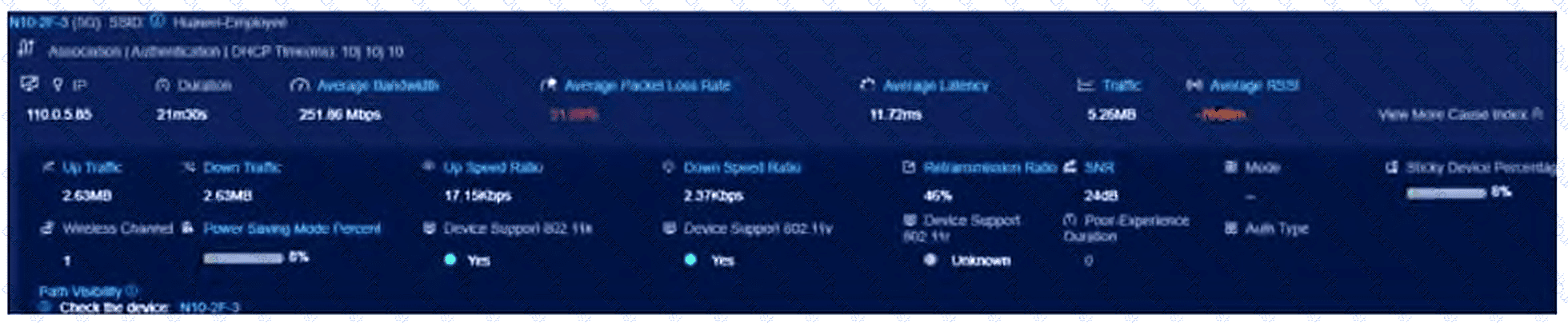
Original exhibit: Q48 Enlarged Exhibit
|
A
|
|---|
|
Explanation
Huawei CampusInsight provides user journey analysis to identify the causes of poor wireless experience by correlating individual user metrics with network events. The exhibit displays terminal measurements including average bandwidth, average packet loss rate, average latency, average received signal strength indicator (RSSI), and wireless protocol capabilities. The most significant indicators are the weak RSSI measurement and elevated average packet loss rate. Poor RSSI indicates that the station is receiving a weak wireless signal. This may result from excessive distance from the AP, physical obstacles, signal attenuation, or an unsuitable AP installation position. Weak signal conditions can increase frame errors and retransmissions, reducing throughput and degrading the user's application experience. Option B is incorrect because the exhibit indicates that the terminal supports IEEE 802.11r. Option C is not established because the screenshot does not provide sufficient evidence that the terminal's hardware performance is responsible for its experience problems. Option D is also unsupported because the displayed power-saving information does not establish a causal relationship with the observed packet loss. Huawei's Training Material presents the same diagnostic approach, identifying low RSSI and elevated packet loss as indicators of weak-signal coverage. Therefore, option A is the supported answer. Training Material reference: WLAN O and M → CampusInsight → Individual Issue Analysis: Journey Analysis, PDF p. 931, slide 43. Lab Guide reference: Lab 11 — CampusInsight O & M → Monitoring and Experience Analysis. ──────────────────────────────────────────────────────── |
Provided WLAN network coverage is ensured, AP transmit power can be reduced to lessen co-channel interference.
|
A
|
|---|
|
Explanation
AP transmit power directly affects the effective coverage area of a wireless radio. Increasing transmit power may extend signal coverage, but excessive power can also increase interference with neighboring APs operating on the same channel. Co-channel interference occurs when multiple APs using an identical frequency channel operate within overlapping RF coverage areas. Because IEEE 802.11 uses a contention-based medium-access mechanism, these APs compete for the same available channel airtime. Excessive overlap can increase channel utilization, reduce transmission opportunities, and degrade aggregate WLAN throughput. Huawei recommends reducing AP transmit power when coverage requirements can still be satisfied. This limits unnecessary signal propagation beyond the intended service area and can improve spatial reuse of available radio channels. However, transmit-power reduction must be performed carefully. Excessive reduction may create coverage holes, weaken signal levels at cell boundaries, and degrade roaming performance. Huawei's radio calibration mechanism uses Transmit Power Control (TPC) to dynamically adjust transmit power according to RF conditions and coverage requirements. Power optimization should therefore be coordinated with channel planning, AP placement, and validation of received signal strength throughout the coverage area. Since the statement explicitly assumes that WLAN coverage remains adequate, reducing AP transmit power is an appropriate measure for limiting co-channel interference. Therefore, the answer is TRUE. Training Material reference: WLAN Planning Basics → Channel Design Rules, PDF p. 473; WLAN Radio Resource Management → Power Adjustment, p. 302. ──────────────────────────────────────────────────────── |
See how DumpsTech helps candidates pass with confidence.
Stay ahead in your career with the latest certification exams from leading vendors. DumpsTech brings you newly released exams with reliable study resources to help you prepare confidently.
Find answers to the most common questions about the Huawei H12-323_V2.0 exam, including what it is, how to prepare, and how it can boost your career.