Cisco Certification Exams Pack
Everything from Basic, plus:
- Exam Name: Implementing Cisco Wireless Advanced Solutions (300-120 WLSI) v1.2
- 105 Questions


Students Passed
Average Score
Questions came word for word
Years Teaching
Explore other related Cisco exams to broaden your certification path. These certifications complement your skills and open new opportunities for career growth.
Know how you can make it happen
If you're looking to secure CCNP Wireless (300-120) certification, remember there's no royal path to it. It's your prep for this exam that can make the difference. Stay away from those low-quality exam PDFs and unreliable dumps that have no credibility. What you need is a simulated practice exam with practice questions that mirror the actual 300-120 test environment.
To save you from frustration, Dumpstech comes with a comprehensive prep system that is clear, effective, and built to help you succeed without the least chance of failure. Whether you're looking for sample test questions or full exam practice questions for the Implementing Cisco Wireless Advanced Solutions (300-120 WLSI) v1.2, our system delivers.
It's overwhelmingly recommended by thousands of Dumpstech's loyal customers as practical, relevant and intuitively crafted to match the candidates' actual exam needs. Our prep questions are designed to build real confidence for the SY0-701 test.
Dumpstech's Cisco exam 300-120 questions are designed to deliver you the essence of the entire syllabus. Each question mirrors the real exam format and comes with an accurate and verified answer. These exam questions and answers give you the clarity you need. Dumpstech's prep system is not mere cramming; it is crafted to add real information and impart deep conceptual understanding to the exam candidates. After each test, review the practice exam answers to identify your weak spots.
Dumpstech's smart testing engine generates multiple mock tests to develop familiarity with the real exam format and learn thoroughly the most significant from the perspective of Cisco 300-120 real exam. They also support you to revise the syllabus and enhance your efficiency to answer all exam practice questions within the time limit.
Dumpstech offers you the most authentic, accurate, and current information that liberates you from the hassle of searching for any other study resource. If you're looking for a free practice test with answers to evaluate our quality before you commit, download our free demo and see for yourself. This comprehensive resource equips you perfectly to develop confidence and clarity to answer exam queries.
Dumpstech's authentic and up-to-date content guarantees you success in the Implementing Cisco Wireless Advanced Solutions (300-120 WLSI) v1.2 certification exam. If you perchance you lose your exam despite your reliance on Dumpstech's exam questions PDF, Dumpstech doesn't leave you alone. You have the option of taking back refund of your money or try a different exam paying no additional amount.
If you want to crack the Implementing Cisco Wireless Advanced Solutions (300-120 WLSI) v1.2 (300-120) exam in one go, your journey starts here. Dumpstech is your real ally that gets you certified fast with the least possibility of losing your chance.
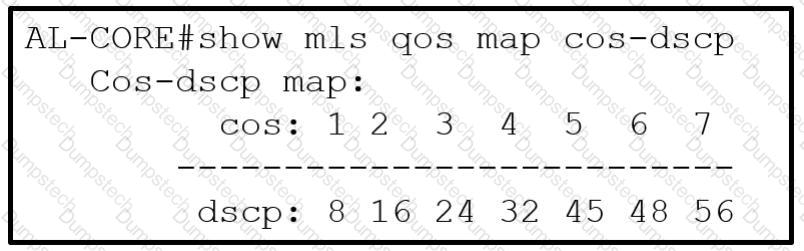
Refer to the exhibit.
Which COS to DSCP map must be modified to ensure that voice traffic is tagged correctly as it traverses the network?
|
D
|
|---|
|
Explanation
The exhibit shows the CoS-to-DSCP map of a switch. Reading the output, CoS 1 maps to DSCP 8, CoS 2 to 16, CoS 3 to 24, CoS 4 to 32, CoS 5 to 45, CoS 6 to 48 and CoS 7 to 56. Voice traffic is carried with CoS 5 on Layer 2, and the standard Layer 3 equivalent is DSCP 46, Expedited Forwarding. The entry shown for CoS 5 is 45, not 46. Queueing and priority treatment in the network is defined for DSCP 46 (EF), so voice frames that cross this switch are remarked to a value that no voice class matches and lose priority. The map entry that must be corrected is therefore CoS 5 to DSCP 46. The values for CoS 3 (24), CoS 6 (48) and CoS 7 (56) are the defaults and are not wrong, and the option that proposes CoS 6 to 46 or CoS 7 to 48 would distort control-plane markings instead of fixing voice. [Reference:Blueprint 2.1 (QoS schemes and wired-to-wireless mapping); Cisco enterprise QoS marking recommendations., ]
|
An organization is concerned about site-specific 802.1X authentication in the event of a WAN outage in their Cisco FlexConnect deployment. Which data is needed to accomplish this authentication?
|
D
|
|---|
|
Explanation
For 802.1X to keep working at a branch during a WAN outage, the APs must be able to reach a RADIUS server that is located at the site. In a FlexConnect group the administrator defines the local, primary and optionally secondary, RADIUS server together with the shared secret that the APs use to communicate with it, and enables local authentication for the WLAN. When the CAPWAP tunnel is lost, the APs authenticate clients directly against that server. The information needed is therefore the shared secret of the local RADIUS server, together with its address. The central RADIUS secret is used by the controller and would be of no use if the WAN is down and the central server is unreachable. TACACS+ is a device administration protocol and plays no role in client 802.1X authentication. The local RADIUS shared secret is the required data. The FlexConnect group configuration therefore needs the RADIUS server address and its shared secret, entered for the local authentication server, before the WAN failure takes place. [Reference:Blueprint 1.2.a (FlexConnect groups) and 1.1 (operating modes); Cisco Catalyst 9800 FlexConnect Branch Deployment Guide, backup RADIUS and local authentication., ]
|
Company XYZ recently migrated from legacy WLCs to Cisco Catalyst 9800 WLCs. According to the global standard, Internet bandwidth must be limited to 5 Mbps for each guest client. To which Cisco Catalyst 9800 WLC configuration component must the QoS requirement be added?
|
D
|
|---|
|
Explanation
Option D is correct because Cisco Catalyst 9800 Wireless Controllers use the Modular QoS CLI (MQC) framework, in which policy maps define traffic-management actions, including bandwidth policing. To enforce a maximum bandwidth of 5 Mbps per guest client, the administrator configures a QoS policy map containing the appropriate policing action. The committed information rate (CIR) is configured as 5,000,000 bits per second, with traffic exceeding the permitted rate handled according to the configured policing action. The policy must subsequently be associated with the appropriate wireless client policy in the WLAN Policy Profile. Configuring the policer within the policy map defines the bandwidth restriction, while applying it at the client level ensures individual users receive separate bandwidth limits rather than sharing one aggregate SSID limit. Incorrect options: A, table map, translates QoS markings such as CoS and DSCP values rather than defining bandwidth policing. B, service policy, attaches an existing QoS policy to an interface, WLAN, or client in a specified direction; it does not independently define the policing rate. C, class map, identifies traffic through classification criteria but does not specify the required bandwidth action. Cisco's QoS implementation separates traffic classification, policy enforcement, and policy attachment. For this scenario, the rate restriction belongs in the policy map and must be applied using a per-client QoS policy assignment. Cisco Study Guide References: WLSI v1.2 — QoS on a Wireless Network; Modular QoS CLI; Class Maps and Policy Maps; Per-Client Bidirectional Rate Limiting; Catalyst 9800 QoS Policy Configuration. |
See how DumpsTech helps candidates pass with confidence.
Stay ahead in your career with the latest certification exams from leading vendors. DumpsTech brings you newly released exams with reliable study resources to help you prepare confidently.
Find answers to the most common questions about the Cisco 300-120 exam, including what it is, how to prepare, and how it can boost your career.