Cisco Certification Exams Pack
Everything from Basic, plus:
- Exam Name: Cisco AI Technical Practitioner (810-110 AITECH)
- 98 Questions


Students Passed
Average Score
Questions came word for word
Years Teaching
Explore other related Cisco exams to broaden your certification path. These certifications complement your skills and open new opportunities for career growth.
Know how you can make it happen
If you're looking to secure Cisco AI Technical Practitioner (AITECH) (810-110) certification, remember there's no royal path to it. It's your prep for this exam that can make the difference. Stay away from those low-quality exam PDFs and unreliable dumps that have no credibility. What you need is a simulated practice exam with practice questions that mirror the actual 810-110 test environment.
To save you from frustration, Dumpstech comes with a comprehensive prep system that is clear, effective, and built to help you succeed without the least chance of failure. Whether you're looking for sample test questions or full exam practice questions for the Cisco AI Technical Practitioner (810-110 AITECH), our system delivers.
It's overwhelmingly recommended by thousands of Dumpstech's loyal customers as practical, relevant and intuitively crafted to match the candidates' actual exam needs. Our prep questions are designed to build real confidence for the SY0-701 test.
Dumpstech's Cisco exam 810-110 questions are designed to deliver you the essence of the entire syllabus. Each question mirrors the real exam format and comes with an accurate and verified answer. These exam questions and answers give you the clarity you need. Dumpstech's prep system is not mere cramming; it is crafted to add real information and impart deep conceptual understanding to the exam candidates. After each test, review the practice exam answers to identify your weak spots.
Dumpstech's smart testing engine generates multiple mock tests to develop familiarity with the real exam format and learn thoroughly the most significant from the perspective of Cisco 810-110 real exam. They also support you to revise the syllabus and enhance your efficiency to answer all exam practice questions within the time limit.
Dumpstech offers you the most authentic, accurate, and current information that liberates you from the hassle of searching for any other study resource. If you're looking for a free practice test with answers to evaluate our quality before you commit, download our free demo and see for yourself. This comprehensive resource equips you perfectly to develop confidence and clarity to answer exam queries.
Dumpstech's authentic and up-to-date content guarantees you success in the Cisco AI Technical Practitioner (810-110 AITECH) certification exam. If you perchance you lose your exam despite your reliance on Dumpstech's exam questions PDF, Dumpstech doesn't leave you alone. You have the option of taking back refund of your money or try a different exam paying no additional amount.
If you want to crack the Cisco AI Technical Practitioner (810-110 AITECH) (810-110) exam in one go, your journey starts here. Dumpstech is your real ally that gets you certified fast with the least possibility of losing your chance.
Which family of generative AI models is best suited for identifying and summarizing technical themes found across thousands of unstructured network incident reports?
|
C
|
|---|
|
Explanation
Large language models (LLMs) are generative AI systems trained to process and generate natural language, making them particularly suitable for extracting themes and summarizing large collections of text-based information. Option C is correct because network incident reports typically contain unstructured descriptions, diagnostic notes, error messages, and operational observations. An LLM can analyze incident narratives to identify recurring failure conditions, common root causes, affected infrastructure components, and repeated remediation procedures. For example, thousands of network support tickets may contain different descriptions of intermittent connectivity problems. AI-assisted semantic analysis can group related incidents and generate concise summaries of recurring technical issues. For very large document collections, the application may use document chunking, embeddings, hierarchical summarization, or retrieval pipelines to accommodate context-window limitations. Option A is incorrect because variational autoencoders are primarily probabilistic generative models used for representation learning, latent-variable modeling, and data generation. Option B is incorrect because diffusion models are primarily associated with iterative denoising and generation tasks, particularly image synthesis. Option D is incorrect because generative adversarial networks use competing neural networks to learn data distributions rather than being the standard choice for technical text summarization. LLMs provide useful language understanding and synthesis capabilities, but their conclusions should be checked against the underlying incident records. Specific Cisco AITECH Course Guide References: Generative AI Ecosystem; AI-Powered Discovery and Synthesis; Exam Objective 1.1 — Generative AI model families and text summarization use cases. Cisco Learning Content =================== |
A practitioner is tackling a complex architectural problem by dividing it into four prompts that run in sequence, where the output of each prompt becomes the input for the next prompt in the chain. Which prompt engineering technique does this describe?
|
C
|
|---|
|
Explanation
Prompt chaining is an advanced prompt engineering technique in which a complex task is decomposed into smaller, sequential operations, with the output of one prompt serving as the input or contextual foundation for the next. Option C is correct because the scenario explicitly describes four interconnected prompts executing in a defined sequence. In an AI-assisted architectural design workflow, the first prompt might analyze business requirements, the second generate a proposed architecture, the third evaluate security and scalability constraints, and the fourth produce a final technical design specification. Each stage depends on information generated during the preceding stage. This approach improves task decomposition, supports intermediate validation, and makes complex reasoning workflows easier to manage. Option A is incorrect because few-shot prompting provides examples demonstrating the desired input-output relationship rather than chaining multiple prompts. Option B is incorrect because meta-prompting focuses on generating, evaluating, or refining prompts themselves. Option D is incorrect because chain-of-thought prompting encourages intermediate reasoning steps within a model's problem-solving process. It does not necessarily require separate prompts connected through explicit output-to-input dependencies. Prompt chaining is especially valuable for architectural evaluation, technical documentation, automated research, and AI-assisted software engineering. Specific Cisco AITECH Course Guide References: Advanced Prompting Strategies Prompt Engineering for Technical Precision Exam Objective 2.2: Iterative, sequential, chained, and few-shot prompting techniques Cisco's official examination blueprint explicitly includes chained prompting under Objective 2.2. =================== |
Drag each analytical bias from the left to the scenario it describes on the right. Not all options will be used.
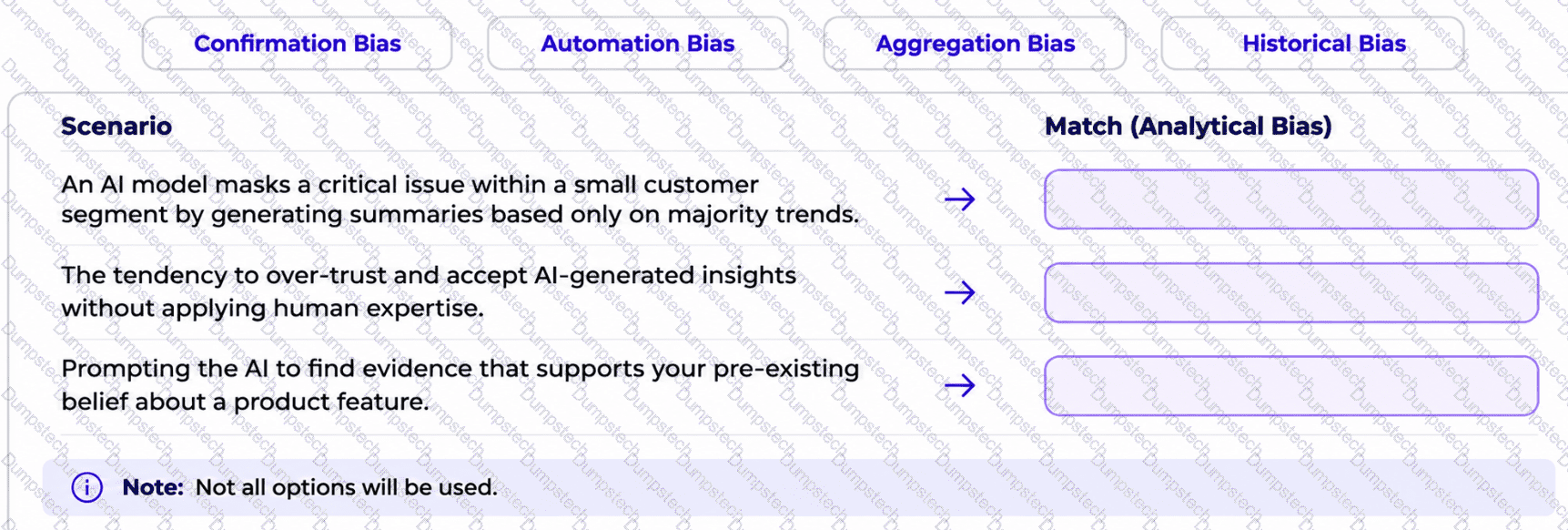
|
Answer:
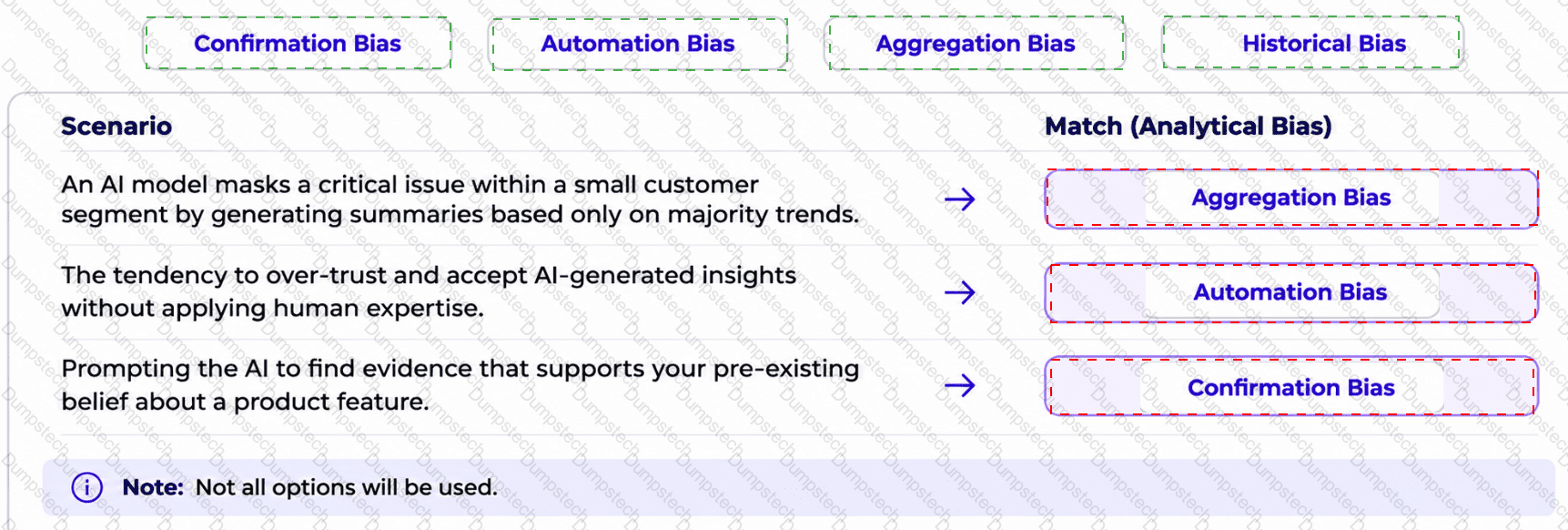 |
|---|
|
Explanation
Analytical biases can compromise the reliability, fairness, and interpretation of AI-generated insights. The three scenarios demonstrate distinct mechanisms through which analytical conclusions become distorted. 1. Aggregation Bias: This occurs when combining data into broad summaries conceals meaningful differences across subgroups. In the first scenario, the AI emphasizes majority customer trends while overlooking a significant issue affecting a smaller customer segment. Segment-level analysis helps identify these hidden patterns. 2. Automation Bias: This describes the tendency to over-rely on automated recommendations while neglecting independent evaluation. The second scenario demonstrates automation bias because users accept AI-generated conclusions without applying professional judgment or validating the evidence. 3. Confirmation Bias: This occurs when individuals preferentially seek, interpret, or select information supporting their existing beliefs. In the third scenario, the practitioner directs the AI to collect evidence supporting a predetermined opinion rather than objectively evaluating competing explanations. Historical Bias (unused): This arises when datasets reflect existing inequalities, outdated practices, or historical patterns that can produce distorted or unfair outcomes. Mitigation strategies include subgroup analysis, independent verification, balanced research questions, human oversight, and representative datasets. Specific Cisco AITECH Course Guide References: AI for Data Engineering and Exploration Generative AI Security and Privacy Fundamentals Exploratory Data Analysis and Bias Identification Responsible AI: Fairness and Bias Mitigation |
See how DumpsTech helps candidates pass with confidence.
Stay ahead in your career with the latest certification exams from leading vendors. DumpsTech brings you newly released exams with reliable study resources to help you prepare confidently.
Find answers to the most common questions about the Cisco 810-110 exam, including what it is, how to prepare, and how it can boost your career.