CompTIA Certification Exams Pack
Everything from Basic, plus:
- Exam Name: CompTIA Cybersecurity Analyst CySA+ V4 (New Version)
- 82 Questions


Students Passed
Average Score
Questions came word for word
Years Teaching
Explore other related CompTIA exams to broaden your certification path. These certifications complement your skills and open new opportunities for career growth.
Know how you can make it happen
If you're looking to secure CompTIA CySA+ (CS0-004) certification, remember there's no royal path to it. It's your prep for this exam that can make the difference. Stay away from those low-quality exam PDFs and unreliable dumps that have no credibility. What you need is a simulated practice exam with practice questions that mirror the actual CS0-004 test environment.
To save you from frustration, Dumpstech comes with a comprehensive prep system that is clear, effective, and built to help you succeed without the least chance of failure. Whether you're looking for sample test questions or full exam practice questions for the CompTIA Cybersecurity Analyst CySA+ V4 (New Version), our system delivers.
It's overwhelmingly recommended by thousands of Dumpstech's loyal customers as practical, relevant and intuitively crafted to match the candidates' actual exam needs. Our prep questions are designed to build real confidence for the SY0-701 test.
Dumpstech's CompTIA exam CS0-004 questions are designed to deliver you the essence of the entire syllabus. Each question mirrors the real exam format and comes with an accurate and verified answer. These exam questions and answers give you the clarity you need. Dumpstech's prep system is not mere cramming; it is crafted to add real information and impart deep conceptual understanding to the exam candidates. After each test, review the practice exam answers to identify your weak spots.
Dumpstech's smart testing engine generates multiple mock tests to develop familiarity with the real exam format and learn thoroughly the most significant from the perspective of CompTIA CS0-004 real exam. They also support you to revise the syllabus and enhance your efficiency to answer all exam practice questions within the time limit.
Dumpstech offers you the most authentic, accurate, and current information that liberates you from the hassle of searching for any other study resource. If you're looking for a free practice test with answers to evaluate our quality before you commit, download our free demo and see for yourself. This comprehensive resource equips you perfectly to develop confidence and clarity to answer exam queries.
Dumpstech's authentic and up-to-date content guarantees you success in the CompTIA Cybersecurity Analyst CySA+ V4 (New Version) certification exam. If you perchance you lose your exam despite your reliance on Dumpstech's exam questions PDF, Dumpstech doesn't leave you alone. You have the option of taking back refund of your money or try a different exam paying no additional amount.
If you want to crack the CompTIA Cybersecurity Analyst CySA+ V4 (New Version) (CS0-004) exam in one go, your journey starts here. Dumpstech is your real ally that gets you certified fast with the least possibility of losing your chance.
Which of the following best explains the purpose of the Pyramid of Pain in threat intelligence?
|
A
|
|---|
|
Explanation
The Pyramid of Pain illustrates the increasing operational difficulty imposed on an adversary when defenders successfully detect and deny progressively more behavioral indicators. At the lower levels are artifacts that attackers can replace relatively easily, such as hash values and IP addresses. Higher levels include domain names, network or host artifacts, tools, and ultimately tactics, techniques, and procedures (TTPs) . Its central defensive lesson is that not all indicators impose equal cost on an attacker. Blocking one IP address may require the attacker only to obtain another server. Detecting a specific malware hash can often be defeated by recompiling or modifying the file. Detecting the attacker's established behaviors and operational methods creates substantially greater difficulty because the adversary may need to redesign procedures, change tooling, retrain operators, or alter an established intrusion methodology. The Pyramid of Pain was developed specifically to describe this relationship between indicators and the amount of operational “pain” defenders impose when those indicators are denied. Option B describes impact measurement, not indicator durability. Option C concerns intelligence-source classification. Option D resembles threat-modeling approaches such as STRIDE rather than the Pyramid of Pain. Study Guide Reference: Security Operations → Threat Intelligence → Pyramid of Pain → Indicators of Compromise → Tools → TTPs → Behavioral Detection. |
A cybersecurity analyst is reviewing static application security testing scan results and notices a finding for hard-coded credentials.
Which of the following should the analyst recommend to the application team to resolve this concern?
|
D
|
|---|
|
Explanation
The correct remediation is to integrate a secrets-management solution and remove credentials from application source code. Hard-coded passwords, API keys, access tokens, certificates, and similar secrets create serious exposure because anyone who obtains the source repository, package, build artifact, backup, or configuration may recover the credential. OWASP specifically identifies hard-coded secrets in source code and configuration files as a secrets-management problem and recommends centralized controls for securely storing, retrieving, rotating, auditing, and managing secrets throughout their lifecycle. A secrets-management platform allows applications to retrieve sensitive values securely during execution instead of embedding them directly in code. Proper implementation also supports rotation and revocation when credentials are exposed. PAM primarily governs privileged human or service access and is not the most direct application-code remediation. Single sign-on reduces repeated user authentication but does not remove embedded application credentials. Obfuscation is inadequate because an application that needs an API key must ultimately be capable of recovering and using it; attackers can often reverse that transformation. The correct secure-development principle is therefore separation of secrets from application code . Study Guide Reference: Vulnerability Management → SAST → Hard-Coded Credentials → Secrets Management → API Keys → Credential Rotation → Secure Software Development. |
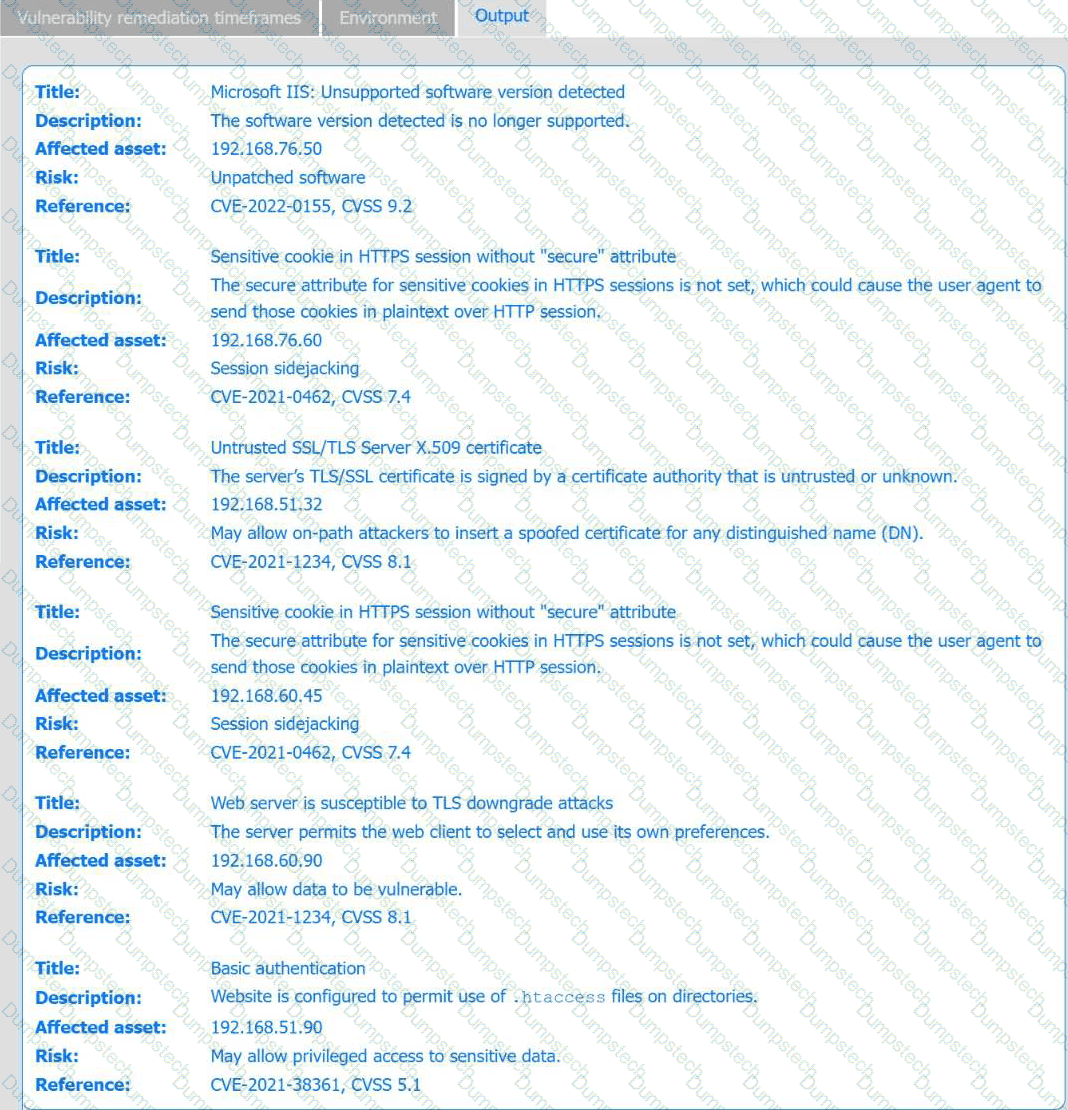
A systems administrator is reviewing the output of a vulnerability scan.
INSTRUCTIONS -
Review the information in each tab.
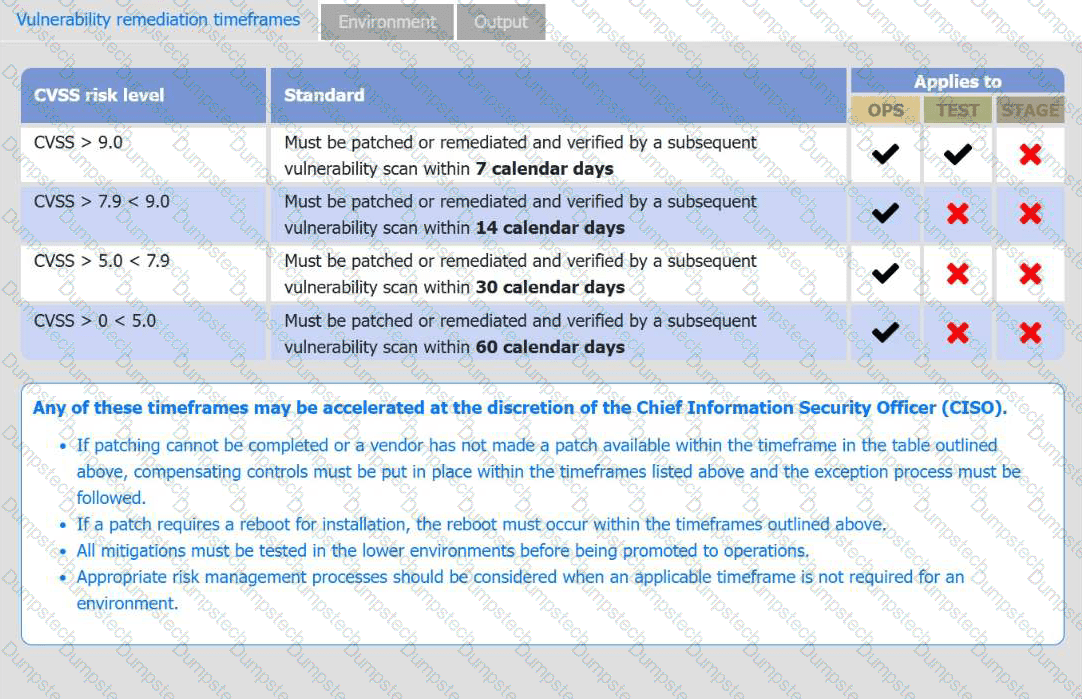
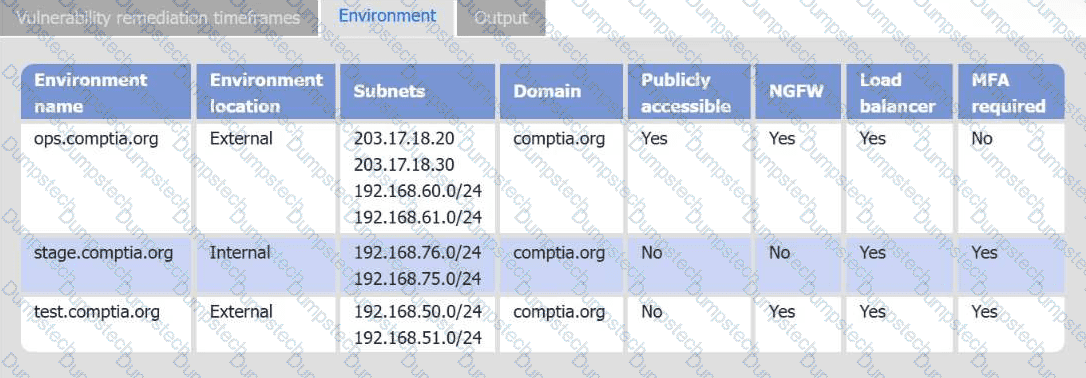
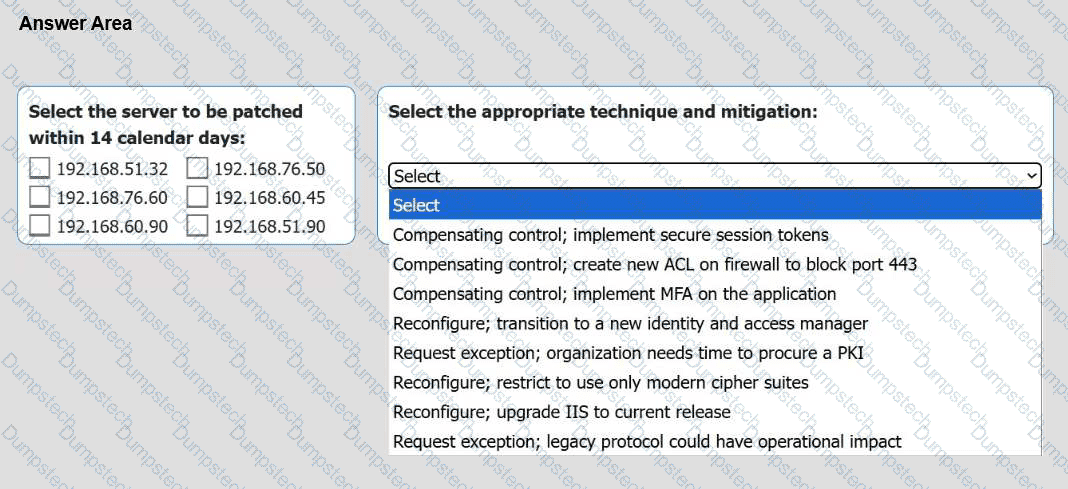
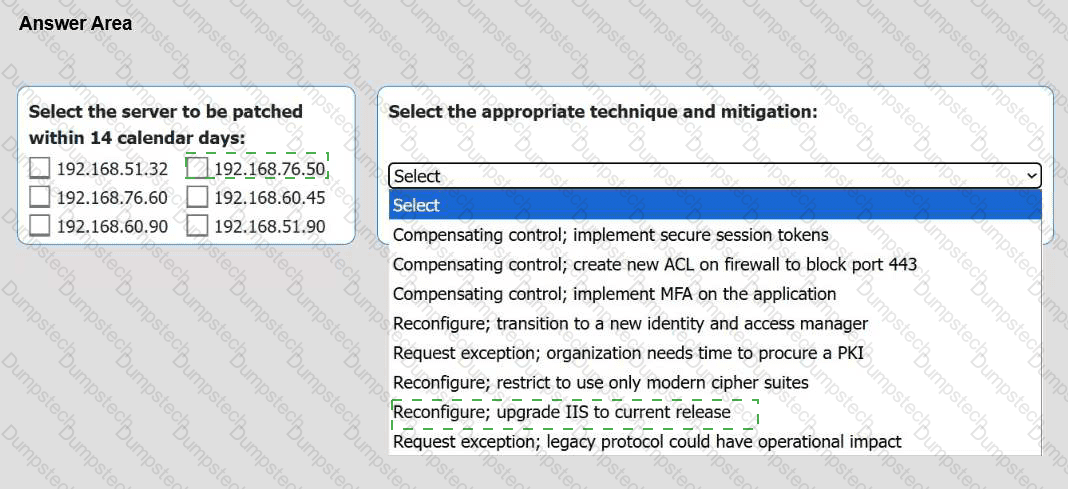
Based on the organization’s environment architecture and remediation standards, select the server to be patched within 14 days and select the appropriate technique and mitigation.
If at any time you would like to bring back the initial state of the simulation, please click the Reset All button.
|
Answer:
 |
|---|
|
Explanation
192.168.76.5 — Patch; upgrade IIS to the current release The correct remediation target is 192.168.76.5 , which is associated with an unsupported Microsoft IIS version and a CVSS score of 9.2 in the matching hotspot data. The remediation standard assigns vulnerabilities above 9.0 to the shortest remediation window, meaning the system requires action in seven days and therefore necessarily falls within the requested fourteen-day maximum. The corresponding remediation is to patch or upgrade IIS to a currently supported release . The key vulnerability-management principle is that remediation priority is not determined exclusively by the existence of a vulnerability. Analysts must consider severity, asset context, exposure, business importance, exploitability, available remediation, and organizational service-level requirements. A product that has reached an unsupported state represents additional risk because standard security updates may no longer be supplied. Upgrading the affected IIS installation directly removes the unsupported software condition rather than merely reducing exposure around it. A compensating control would be appropriate when remediation cannot immediately be performed, but it would not supersede a supported upgrade when that upgrade is operationally available. Study Guide Reference: Vulnerability Management → Vulnerability Prioritization → CVSS → Remediation Timeframes → End-of-Life/Unsupported Software → Patching and Upgrading. |
See how DumpsTech helps candidates pass with confidence.
Stay ahead in your career with the latest certification exams from leading vendors. DumpsTech brings you newly released exams with reliable study resources to help you prepare confidently.
Find answers to the most common questions about the CompTIA CS0-004 exam, including what it is, how to prepare, and how it can boost your career.