
75only - Ends in 0d 00h 00m 00s - Coupon code = 75only

Pass the Adobe Real-Time CDP AD0-E615 Questions and answers with Dumpstech

Exam AD0-E615 Premium Access

View all detail and faqs for the AD0-E615 exam

Practice at least 50% of the questions to maximize your chances of passing.
Viewing page 1 out of 2 pages
Viewing questions 1-10 out of questions
Questions # 1:

A pamphlet is designed for an offer on the website to be instantly activated when a customer scans a QR code and completes a form.

Which type of data ingestion is used to ingest the data shared by customers after scanning the QR code?

Options:

A.

The form data is stored in a CSV file in cloud storage and ingested every 15 minutes.

B.

The form data is stored as JSON and ingested using Batch API.

C.

The form data is ingested through HTTP API connector during form submission.

D.

The form data is ingested in batches every day at midnight.

Questions # 2:

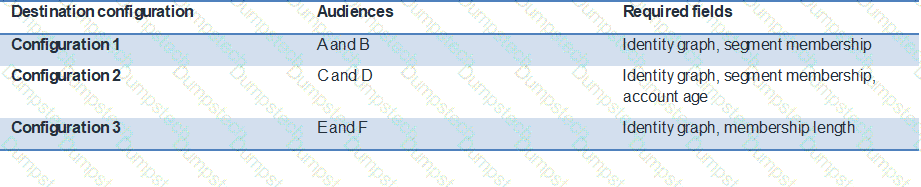
A Developer is tasked with creating six audiences and activating them to the same cloud storage destination.

• Audiences A and B require identity graph and segment membership.

• Audiences C and D require identity graph, segment membership, and account age.

• Audiences E and F require identity graph and membership length.

What is the correct way of activating all three audience groups to the same destination while maintaining their different activation requirements?
Options:

A.

Create a unique destination configuration for each audience activation requirement.

B.

Create multiple folders within the cloud storage location to map each audience to during destination configuration.

C.

Activate all audiences to the same destination and select which fields to activate on a per-audience basis.

Questions # 3:

An enterprise Adobe Experience Platform customer is significantly over their licensed Addressable Audience entitlement. An audit reveals that 85% of profiles consist of ECID-only anonymous web visitors, most of whom have not returned to the site in over 60 days. The team wants to remediate this quickly.

Which combination of actions will have an immediate and lasting impact on license compliance?

Options:

A.

Enable dataset expiration on all datasets that are enabled for Profile and set it to 30 days, then configure TTL for data lake datasets to 60 days.

B.

Increase the merge policy priority to prevent ECID profiles from being created to avoid a spike in the count of Addressable Audience, then configure TTL for data lake datasets to 30 days.

C.

Enable Pseudonymous Profile expiration with a 30-day TTL on ECID, and separately configure Experience Event expiration on web datasets to remove stale events from known profiles.

Questions # 4:

An online retail company is implementing Adobe Real-Time CDP to unify and manage their customer, purchase, and product data. As part of the implementation, the company wants to store the following information in the platform data model:

• Customer information (customer ID, customer name, email, phone number)

• Product catalog information (such as product ID, product name, category, price, SKU)

• Store detail information (such as store location, store ID, operating hours)

• Purchase information (customer ID, order date, order value, ordered product ID, store ID)

Which schemas would be used for the data model in this use case?

Options:

A.

• Customer information – Individual Profile schema

• Product catalog information – Custom schema

• Store detail information – Custom schema

• Purchase information – Event schema

B.

• Customer information – Individual Profile schema

• Product catalog information – Individual Profile schema

• Store detail information – Custom schema

• Purchase information – Event schema

C.

• Customer information – Individual Profile schema

• Product catalog information – Event schema

• Store detail information – Custom schema

• Purchase information – Event schema

Questions # 5:

A destination in Adobe Real-Time CDP requires a specific identity namespace, GAID. However, some of the profiles in an audience do not include GAID.

What will happen to the audience during activation?

Options:

A.

The audience will get activated successfully for all the profiles during activation.

B.

Activation skips the profiles where GAID is missing and activates the rest of the profiles.

C.

The audience is activated using a secondary identity for profiles missing GAID.

Questions # 6:

A Developer is troubleshooting a customer profile where the first name is incorrect. The unified profile currently displays the first name as “Thomaas”. The Developer believes this is a typographical error and that the correct name should be “Thomas”.

Upon investigation, it is confirmed that profile fragments exist in three datasets:

Question # 6

Assuming a default merge policy, why is the Real-Time Customer Profile displaying “Thomaas” instead of “Thomas”?

Options:

A.

The Loyalty dataset is automatically treated as a higher-priority data source in the active merge policy.

B.

The CRM dataset was ingested earlier, and the merge policy prioritizes the earliest ingested attribute value.

C.

The e-commerce dataset contains the most recent attribute timestamp, and the merge policy prioritizes the latest updated value.

Questions # 7:

The profile schema “Customer Key Data Schema” is created by an Adobe Experience Platform Developer. The Developer has added the custom field group “Customer Details” in this schema.

The field group “Customer Details” contains three fields:

• Customer ID

• Customer Login ID

• Customer Type

This same field group “Customer Details” is also used in other schemas, but the Developer realizes that only two fields—Customer ID and Customer Login ID—from this field group are required in the profile schema “Customer Key Data Schema”.

How would the Developer remove the Customer Type field in the “Customer Key Data Schema” to avoid impacting other schemas that are using the “Customer Details” field group?

Options:

A.

Use “Remove field” option on “Customer Key Data Schema” and delete “Customer Type” field.

B.

Use “Manage related fields” option on “Customer Key Data Schema” and uncheck “Customer Type” field.

C.

Use “Deprecate field” option on “Customer Key Data Schema” and mark “Customer Type” field as deprecated.

Questions # 8:

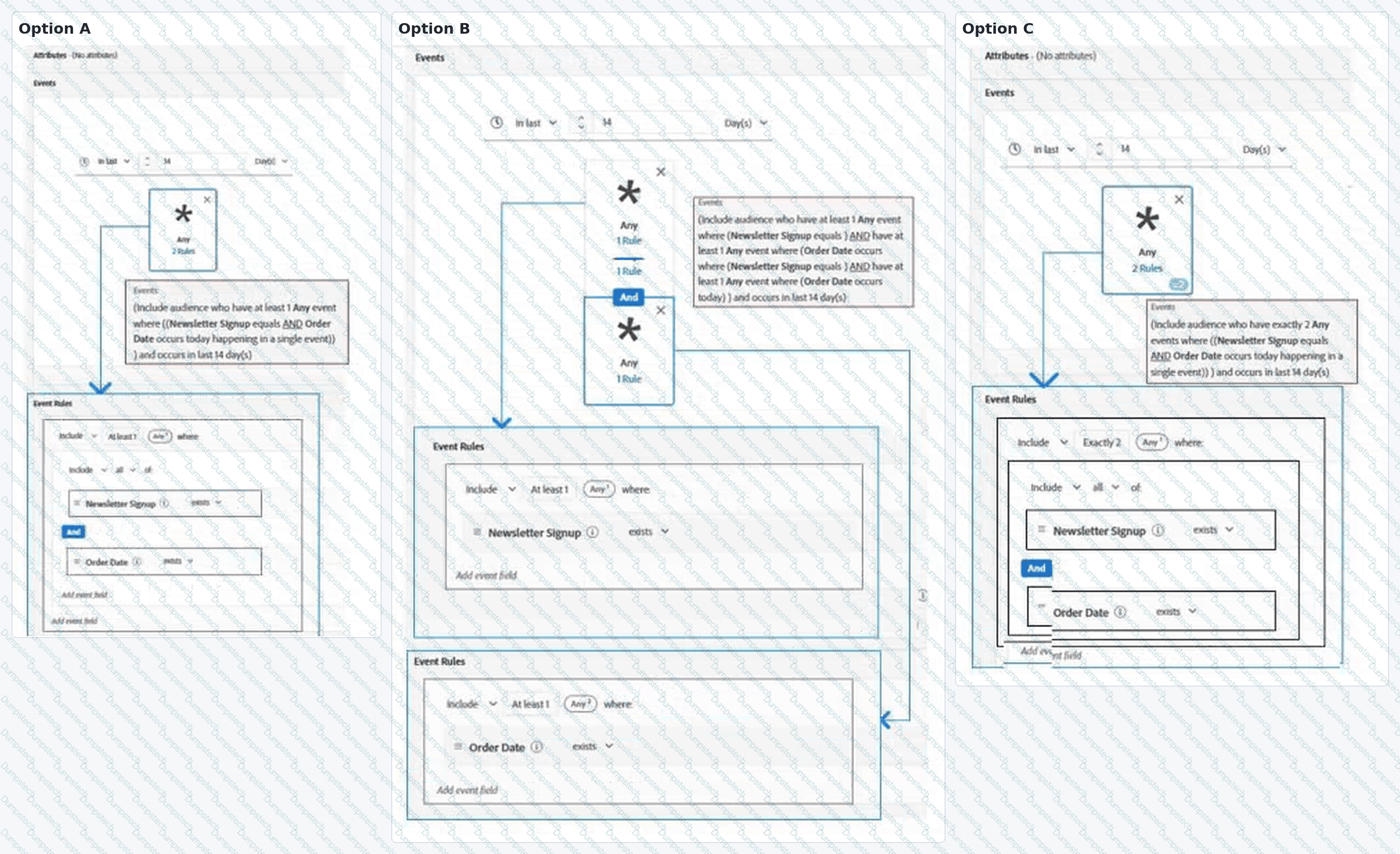
An organization wants to target its users who have signed up to its newsletter and made a purchase in the last 14 days.

What would be an appropriate way to create this audience segment?
Question # 8

Options:

A.

Configure a single event container with at least one event containing both the Newsletter Signup AND Order Date conditions within the last 14 days.

B.

Configure two separate event containers connected using AND, with at least one Newsletter Signup event and at least one Order Date event within the last 14 days.

C.

Configure a single event container requiring exactly two events containing both the Newsletter Signup AND Order Date conditions within the last 14 days.

Questions # 9:

A Developer is tasked with exporting profile data to a streaming destination on the basis of audience qualification to the following composite audience:

Customers who have visited a product page in the last 24 hours (streaming sub-audience) and customers who do not own that product (batch sub-audience).

Which activity would trigger the export behavior?

Options:

A.

A change in the schedule of the batch sub-audience.

B.

A change in the value of the mapped profile attributes.

C.

A change in the audience name.

Questions # 10:

An Adobe Experience Platform Developer is modeling a schema for collecting data sent through Web SDK.

Which suggestion helps the Developer maintain data integrity when creating the schema?

Options:

A.

Mark a schema field as a mandatory primary identity for ingesting data via Web SDK.

B.

Avoid designating additional fields as primary identities for that schema other than identityMap .

C.

Use the _id field in ExperienceEvent schemas as an identity because it is meant for record uniqueness.

Viewing page 1 out of 2 pages
Viewing questions 1-10 out of questions