Spring Sale Limited Time 70% Discount Offer - Ends in 0d 00h 00m 00s - Coupon code = simple70

Pass the Amazon Web Services AWS Certified Associate DVA-C02 Questions and answers with Dumpstech

Exam DVA-C02 Premium Access

View all detail and faqs for the DVA-C02 exam

Practice at least 50% of the questions to maximize your chances of passing.
Viewing page 1 out of 11 pages
Viewing questions 1-15 out of questions
Questions # 1:

A company has built an AWS Lambda function to convert large image files into output files that can be used in a third-party viewer application The company recently added a new module to the function to improve the output of the generated files However, the new module has increased the bundle size and has increased the time that is needed to deploy changes to the function code.

How can a developer increase the speed of the Lambda function deployment?

Options:

A.

Use AWS CodeDeploy to deploy the function code

B.

Use Lambda layers to package and load dependencies.

C.

Increase the memory size of the function.

D.

Use Amazon S3 to host the function dependencies

Questions # 2:

A company is using AWS SAM to develop a social media application. A developer needs a quick way to test AWS Lambda functions locally by using test event payloads. The developer needs the structure of these test event payloads to match the actual events that AWS services create.

Which solution will meet these requirements with the LEAST development effort?

Options:

A.

Create shareable test Lambda events. Use these test Lambda events for local testing.

B.

Store manually created test event payloads locally. Use the sam local invoke command with the file path to the payloads.

C.

Store manually created test event payloads in an Amazon S3 bucket. Use the sam local invoke command with the S3 path to the payloads.

D.

Use the sam local generate-event command to create test payloads for local testing.

Questions # 3:

A company's application has an AWS Lambda function that processes messages from loT devices. The company wants to monitor the Lambda function to ensure that the Lambda function is meeting its required service level agreement (SLA).

A developer must implement a solution to determine the application's throughput in near real time. The throughput must be based on the number of messages that the Lambda function receives and processes in a given time period. The Lambda function performs initialization and post-processing steps that must not factor into the throughput measurement.

What should the developer do to meet these requirements?

Options:

A.

Use the Lambda function's ConcurrentExecutions metric in Amazon CloudWatch to measure the throughput.

B.

Modify the application to log the calculated throughput to Amazon CloudWatch Logs. Use Amazon EventBridge to invoke a separate Lambda function to process the logs on a schedule.

C.

Modify the application to publish custom Amazon CloudWatch metrics when the Lambda function receives and processes each message. Use the metrics to calculate the throughput.

D.

Use the Lambda function's Invocations metric and Duration metric to calculate the throughput in Amazon CloudWatch.

Questions # 4:

A developer registered an AWS Lambda function as a target for an Application Load Balancer (ALB) using a CLI command. However, the Lambda function is not being invoked when the client sends requests through the ALB.

Why is the Lambda function not being invoked?

Options:

A.

A Lambda function cannot be registered as a target for an ALB.

B.

A Lambda function can be registered with an ALB using AWS Management Console only.

C.

The permissions to invoke the Lambda function are missing.

D.

Cross-zone is not enabled on the ALB.

Questions # 5:

An application uses an Amazon EC2 Auto Scaling group. A developer notices that EC2 instances are taking a long time to become available during scale-out events. The UserData script is taking a long time to run.

The developer must implement a solution to decrease the time that elapses before an EC2 instance becomes available. The solution must make the most recent version of the application available at all times and must apply all available security updates. The solution also must minimize the number of images that are created. The images must be validated.

Which combination of steps should the developer take to meet these requirements? (Choose two.)

Options:

A.

Use EC2 Image Builder to create an Amazon Machine Image (AMI). Install all the patches and agents that are needed to manage and run the application. Update the Auto Scaling group launch configuration to use the AMI.

B.

Use EC2 Image Builder to create an Amazon Machine Image (AMI). Install the latest version of the application and all the patches and agents that are needed to manage and run the application. Update the Auto Scaling group launch configuration to use the AMI.

C.

Set up AWS CodeDeploy to deploy the most recent version of the application at runtime.

D.

Set up AWS CodePipeline to deploy the most recent version of the application at runtime.

E.

Remove any commands that perform operating system patching from the UserData script.

Questions # 6:

An application is processing clickstream data using Amazon Kinesis. The clickstream data feed into Kinesis experiences periodic spikes. The PutRecords API call occasionally fails and the logs show that the failed call returns the response shown below:
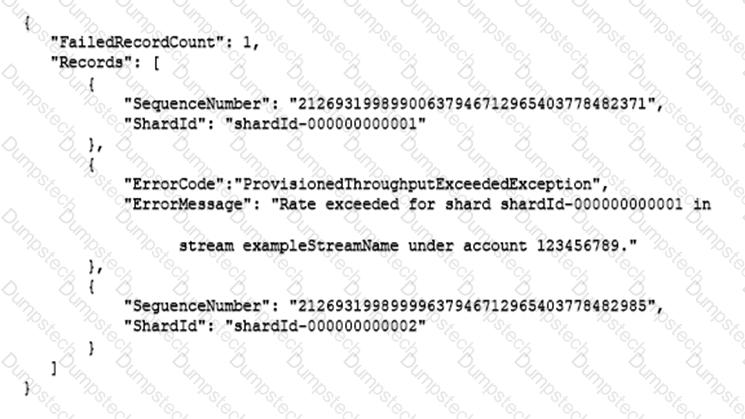
Question # 6

Which techniques will help mitigate this exception? (Choose two.)

Options:

A.

Implement retries with exponential backoff.

B.

Use a PutRecord API instead of PutRecords.

C.

Reduce the frequency and/or size of the requests.

D.

Use Amazon SNS instead of Kinesis.

E.

Reduce the number of KCL consumers.

Questions # 7:

A developer needs to migrate an online retail application to AWS to handle an anticipated increase in traffic. The application currently runs on two servers: one server for the web application and another server for the database. The web server renders webpages and manages session state in memory. The database server hosts a MySQL database that contains order details. When traffic to the application is heavy, the memory usage for the web server approaches 100% and the application slows down considerably.

The developer has found that most of the memory increase and performance decrease is related to the load of managing additional user sessions. For the web server migration, the developer will use Amazon EC2 instances with an Auto Scaling group behind an Application Load Balancer.

Which additional set of changes should the developer make to the application to improve the application's performance?

Options:

A.

Use an EC2 instance to host the MySQL database. Store the session data and the application data in the MySQL database.

B.

Use Amazon ElastiCache for Memcached to store and manage the session data. Use an Amazon RDS for MySQL DB instance to store the application data.

C.

Use Amazon ElastiCache for Memcached to store and manage the session data and the application data.

D.

Use the EC2 instance store to manage the session data. Use an Amazon RDS for MySQL DB instance to store the application data.

Questions # 8:

A developer is trying get data from an Amazon DynamoDB table called demoman-table. The developer configured the AWS CLI to use a specific IAM use's credentials and ran the following command.

The command returned errors and no rows were returned.

What is the MOST likely cause of these issues?

Options:

A.

The command is incorrect; it should be rewritten to use put-item with a string argument

B.

The developer needs to log a ticket with AWS Support to enable access to the demoman-table

C.

Amazon DynamoOB cannot be accessed from the AWS CLI and needs to called via the REST API

D.

The IAM user needs an associated policy with read access to demoman-table

Questions # 9:

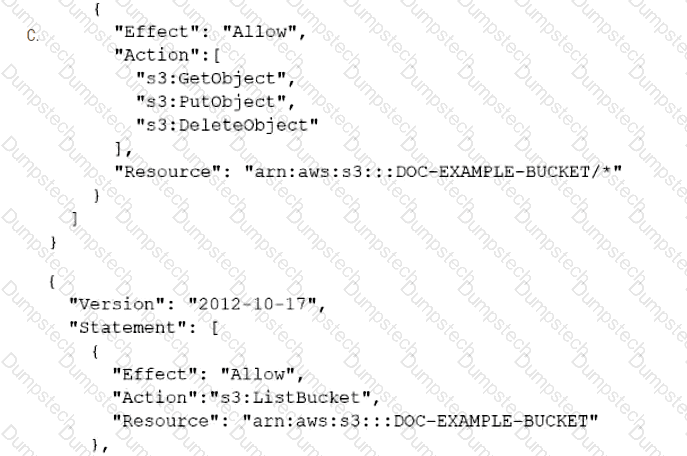
A company has an online web application that includes a product catalog. The catalog is stored in an Amazon S3 bucket that is named DOC-EXAMPLE-BUCKET. The application must be able to list the objects in the S3 bucket and must be able to download objects through an 1AM policy.

Which policy allows MINIMUM access to meet these requirements?
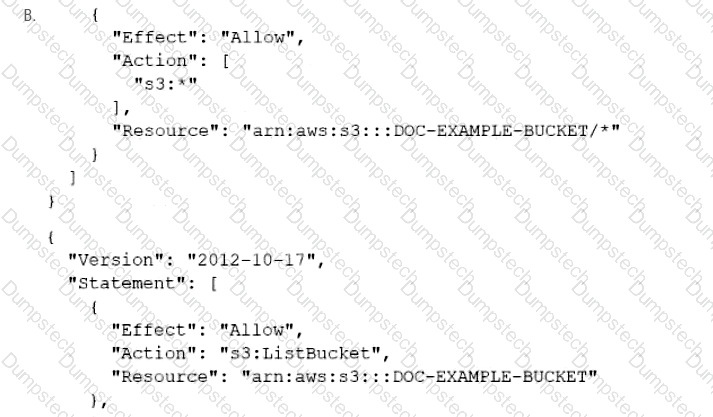
Question # 9

Question # 9

Options:

A.

Option A

B.

Option B

C.

Option C

D.

Option D

Questions # 10:

A developer is troubleshooting a three-tier application, which is deployed on Amazon EC2 instances. There is a connectivity problem between the application servers and the database servers.

Which AWS services or tools should be used to identify the faulty component? (Select TWO.)

Options:

A.

AWS CloudTrail

B.

AWS Trusted Advisor

C.

Amazon VPC Flow Logs

D.

Network access control lists

E.

AWS Config rules

Questions # 11:

A developer has an application that is composed of many different AWS Lambda functions. The Lambda functions all use some of the same dependencies. To avoid security issues the developer is constantly updating the dependencies of all of the Lambda functions. The result is duplicated effort to reach function.

How can the developer keep the dependencies of the Lambda functions up to date with the LEAST additional complexity?

Options:

A.

Define a maintenance window for the Lambda functions to ensure that the functions get updated copies of the dependencies.

B.

Upgrade the Lambda functions to the most recent runtime version.

C.

Define a Lambda layer that contains all of the shared dependencies.

D.

Use an AWS CodeCommit repository to host the dependencies in a centralized location.

Questions # 12:

A developer created a Node.js-based AWS Lambda function by using a container image of an AWS OS-only base image. There is a new security patch for Node.js that must be patched to the new Lambda function.

Which solution will meet this requirement?

Options:

A.

Set the runtime update mode of the Lambda function to Auto.

B.

Patch the runtime version by redeploying the same version of the Lambda function.

C.

Rebuild the Lambda container code with the latest version of the AWS OS base image. Publish a new version of the Lambda function.

D.

Rebuild the Lambda container code with the latest Node.js patch version. Publish a new version of the Lambda function.

Questions # 13:

A developer is creating an AWS Lambda function that needs network access to private resources in a VPC.

Options:

A.

Attach the Lambda function to the VPC through private subnets. Create a security group that allows network access to the private resources. Associate the security group with the Lambda function.

B.

Configure the Lambda function to route traffic through a VPN connection. Create a security group that allows network access to the private resources. Associate the security group with the Lambda function.

C.

Configure a VPC endpoint connection for the Lambda function. Set up the VPC endpoint to route traffic through a NAT gateway.

D.

Configure an AWS PrivateLink endpoint for the private resources. Configure the Lambda function to reference the PrivateLink endpoint.

Questions # 14:

A developer is working on a web application that runs on Amazon ECS and uses an Amazon DynamoDB table to store data. The application performs a large number of read requests against a small set of the table data.

How can the developer improve the performance of these requests? (Select TWO.)

Options:

A.

Create an Amazon ElastiCache cluster. Configure the application to cache data in the cluster.

B.

Create a DynamoDB Accelerator (DAX) cluster. Configure the application to use the DAX cluster for DynamoDB requests.

C.

Configure the application to make strongly consistent read requests against the DynamoDB table.

D.

Increase the read capacity of the DynamoDB table.

E.

Enable DynamoDB adaptive capacity.

Questions # 15:

A developer is creating an AWS Lambda function that searches for Items from an Amazon DynamoDQ table that contains customer contact information. The DynamoDB table items have the customers as the partition and additional properties such as customer -type, name, and job_title.

The Lambda function runs whenever a user types a new character into the customer_type text Input. The developer wants to search to return partial matches of all tne email_address property of a particular customer type. The developer does not want to recreate the DynamoDB table.

What should the developer do to meet these requirements?

Options:

A.

Add a global secondary index (GSI) to the DynamoDB table with customer-type input, as the partition key and email_address as the sort key. Perform a query operation on the GSI by using the begins with key condition expression with the email_address property.

B.

Add a global secondary index (GSI) to the DynamoDB table with email_address as the partition key and customer_type as the sort key. Perform a query operation on the GSI by using the begine_with key condition expresses with the email. Address property.

C.

Add a local secondary index (LSI) to the DynemoOB table with customer_type as the partition Key and email_address as the sort Key. Perform a quick operation on the LSI by using the begine_with Key condition expression with the email-address property.

D.

Add a local secondary index (LSI) to the DynamoDB table with job-title as the partition key and email_address as the sort key. Perform a query operation on the LSI by using the begins_with key condition expression with the email_address property.

Viewing page 1 out of 11 pages
Viewing questions 1-15 out of questions