
Spring Sale Limited Time 70% Discount Offer - Ends in 0d 00h 00m 00s - Coupon code = simple70

Pass the Cisco CyberOps Professional 300-215 Questions and answers with Dumpstech

Exam 300-215 Premium Access

View all detail and faqs for the 300-215 exam

Practice at least 50% of the questions to maximize your chances of passing.
Viewing page 1 out of 4 pages
Viewing questions 1-10 out of questions
Questions # 1:

What are two features of Cisco Secure Endpoint? (Choose two.)

Options:

A.

file trajectory

B.

rogue wireless detection

C.

Orbital Advanced Search

D.

web content filtering

E.

full disk encryption

Questions # 2:

A cybersecurity analyst is analyzing a complex set of threat intelligence data from internal and external sources. Among the data, they discover a series of indicators, including patterns of unusual network traffic, a sudden increase in failed login attempts, and multiple instances of suspicious file access on the company's internal servers. Additionally, an external threat feed highlights that threat actors are actively targeting organizations in the same industry using ransomware. Which action should the analyst recommend?

Options:

A.

Advise on monitoring the situation passively because network traffic anomalies are coincidental and unrelated to the ransomware threat.

B.

Propose isolation of affected systems and activating the incident response plan because the organization is likely under attack by the new ransomware strain.

C.

Advocate providing additional training on secure login practices because the increase in failed login attempts is likely a result of employee error.

D.

Notify of no requirement for immediate action because the suspicious file access incidents are normal operational activities and do not indicate an ongoing threat.

Questions # 3:

A cybersecurity analyst must evaluate files from an endpoint in an enterprise network. The antivirus software on the endpoint flagged a suspicious file during a routine scan On initial evaluation the file did not match any known signatures in the antivirus database, but exhibited unusual network behavior during dynamic analysis Which step should the analyst take next?
Options:

A.

Submit the file to a threat intelligence platform for further analysis and to identify potential lOCs.

B.

Delete the file immediately from the endpoint to prevent the potential spread of malware.

C.

Install different antivirus software on the endpoint and perform another deep scan of affected assets.

D.

Flag the file as a potential false positive due to not matching any known malware signatures

Questions # 4:

Question # 4

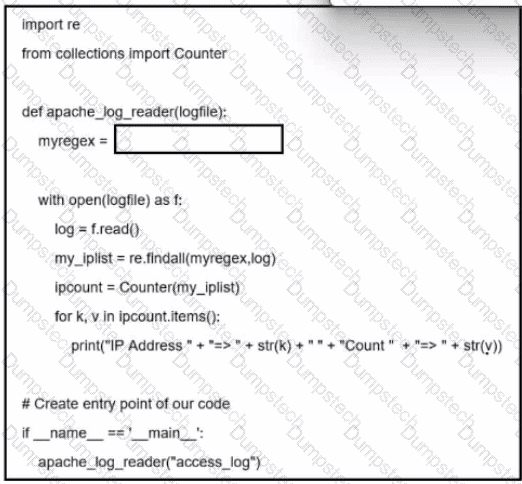
Refer to the exhibit. A network administrator creates an Apache log parser by using Python. What needs to be added in the box where the code is missing to accomplish the requirement?

Options:

A.

r'\d(1,3),\d(1.3),\d{13}.df{1,3}'

B.

r'*\b'

C.

r''\b{1-9}[0-9}\b'

D.

r'\d{1,3}.\d{1,3}.\d{1,3}.\d{1,3}'

Questions # 5:

A network host is infected with malware by an attacker who uses the host to make calls for files and shuttle traffic to bots. This attack went undetected and resulted in a significant loss. The organization wants to ensure this does not happen in the future and needs a security solution that will generate alerts when command and control communication from an infected device is detected. Which network security solution should be recommended?

Options:

A.

Cisco Secure Firewall ASA

B.

Cisco Secure Firewall Threat Defense (Firepower)

C.

Cisco Secure Email Gateway (ESA)

D.

Cisco Secure Web Appliance (WSA)

Questions # 6:

An incident response analyst is preparing to scan memory using a YARA rule. How is this task completed?

Options:

A.

deobfuscation

B.

XML injection

C.

string matching

D.

data diddling

Questions # 7:

An attacker modifies a malicious file named TOPSECRET0523619132 by changing its file extension from a .png to a doc in an attempt to evade detection. Which technique is being used to disguise the file?

Options:

A.

steganography

B.

obfuscatiofi

C.

spoofing

D.

hashing

Questions # 8:

What is a concern for gathering forensics evidence in public cloud environments?
Options:

A.

High Cost: Cloud service providers typically charge high fees for allowing cloud forensics.

B.

Configuration: Implementing security zones and proper network segmentation.

C.

Timeliness: Gathering forensics evidence from cloud service providers typically requires substantial time.

D.

Multitenancy: Evidence gathering must avoid exposure of data from other tenants.

Questions # 9:

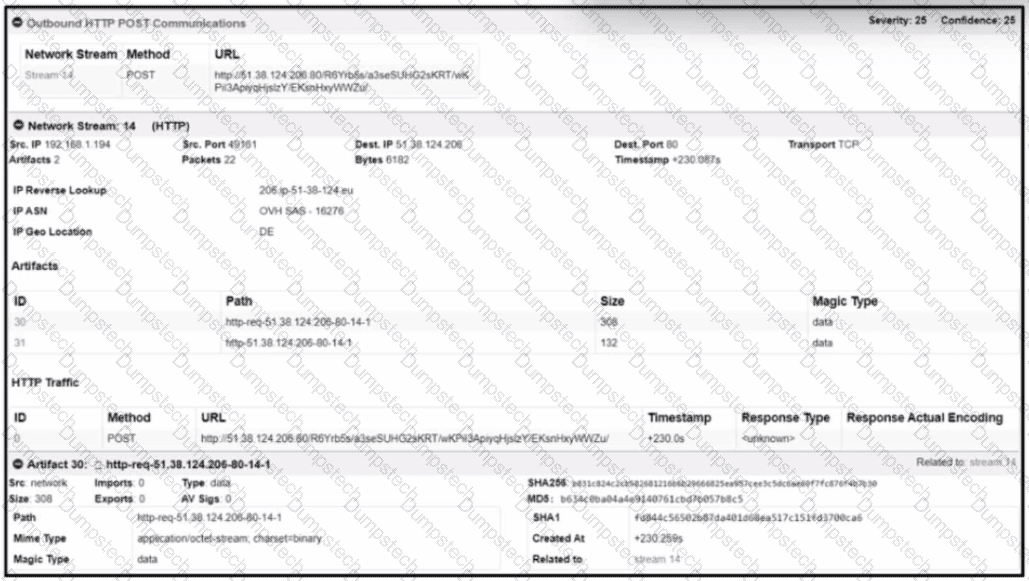
Question # 9

Options:

A.

Destination IP 51.38.124.206 is identified as malicious

B.

MD5 D634c0ba04a4e9140761cbd7b057t>8c5 is identified as malicious

C.

Path http-req-51.38.124.206-80-14-1 is benign

D.

The stream must be analyzed further via the pcap file

Questions # 10:

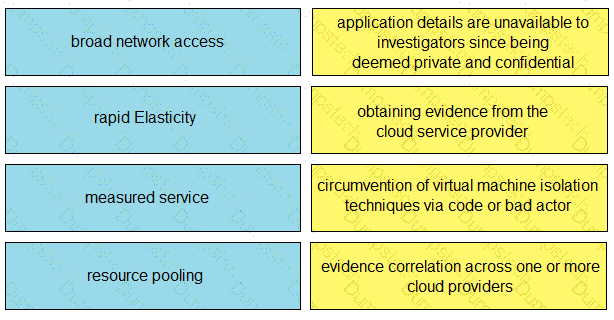
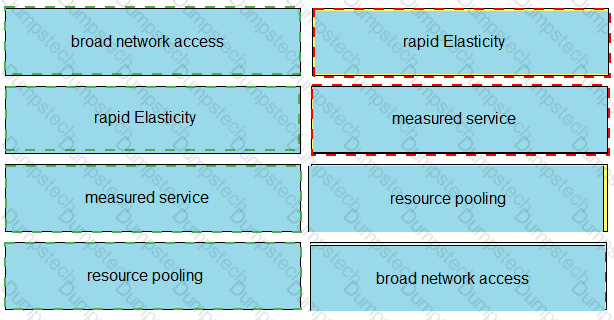
Drag and drop the cloud characteristic from the left onto the challenges presented for gathering evidence on the right.
Question # 10

Options:

Viewing page 1 out of 4 pages
Viewing questions 1-10 out of questions