
75only - Ends in 0d 00h 00m 00s - Coupon code = 75only

Pass the Cisco CCNP Security 300-710 Questions and answers with Dumpstech

Exam 300-710 Premium Access

View all detail and faqs for the 300-710 exam

Practice at least 50% of the questions to maximize your chances of passing.
Viewing page 13 out of 13 pages
Viewing questions 121-130 out of questions
Questions # 121:

Drag and drop the configuration steps from the left into the sequence on the right to enable external authentication on Cisco FMC to a RADIUS server.
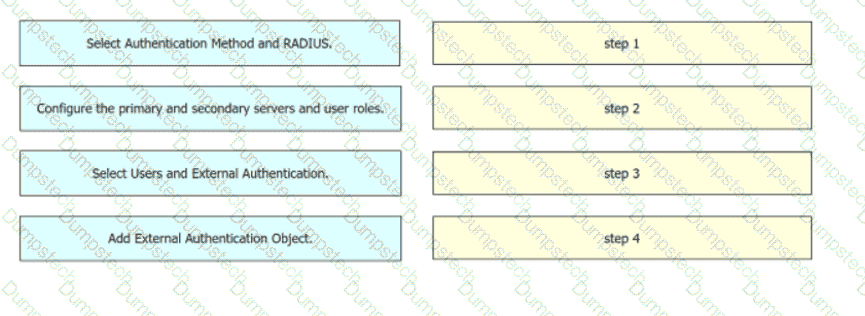
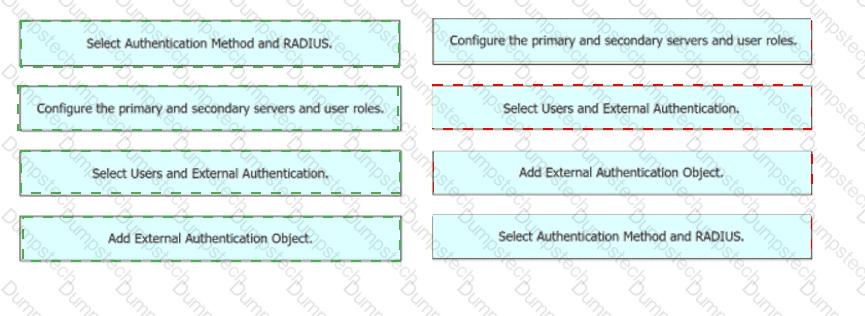
Question # 121

Options:

Questions # 122:

An engineer must investigate a connectivity issue by using Cisco Secure Firewall Management Center to access the Packet Capture feature on a Cisco Secure Firewall Threat Defense

device. The engineer must see a real packet going through the Secure Firewall Threat Defense device and the Snort detection actions. While reviewing the packet capture, the engineer

discovers that the Snort detection actions are missing. Which action must the engineer take to resolve the issue?

Options:

A.

Specify the packet size.

B.

Specify the buffer size.

C.

Enable the Continuous Capture option.

D.

Enable the Trace option.

Questions # 123:

A network administrator configured a NAT policy that translates a public IP address to an internal web server IP address. An access policy has also been created that allows any source to reach the public IP address on port 80. The web server is still not reachable from the Internet on port 80. Which configuration change is needed?

Options:

A.

The intrusion policy must be disabled for port 80.

B.

The access policy rule must be configured for the action trust.

C.

The NAT policy must be modified to translate the source IP address as well as destination IP address.

D.

The access policy must allow traffic to the internal web server IP address.

Questions # 124:

Which two statements about bridge-group interfaces in Cisco FTD are true? (Choose two.)

Options:

A.

The BVI IP address must be in a separate subnet from the connected network.

B.

Bridge groups are supported in both transparent and routed firewall modes.

C.

Bridge groups are supported only in transparent firewall mode.

D.

Bidirectional Forwarding Detection echo packets are allowed through the FTD when using bridge-group members.

E.

Each directly connected network must be on the same subnet.

Questions # 125:

A network administrator notices that remote access VPN users are not reachable from inside the network. It is determined that routing is configured correctly, however return traffic is entering the firewall but not leaving it What is the reason for this issue?

Options:

A.

A manual NAT exemption rule does not exist at the top of the NAT table.

B.

An external NAT IP address is not configured.

C.

An external NAT IP address is configured to match the wrong interface.

D.

An object NAT exemption rule does not exist at the top of the NAT table.

Questions # 126:

An engineer defines a new rule while configuring an Access Control Policy. After deploying the policy, the rule is not working as expected and the hit counters associated with the rule are showing zero. What is causing this error?

Options:

A.

Logging is not enabled for the rule.

B.

The rule was not enabled after being created.

C.

The wrong source interface for Snort was selected in the rule.

D.

An incorrect application signature was used in the rule.

Questions # 127:

Which license type is required on Cisco ISE to integrate with Cisco FMC pxGrid?

Options:

A.

mobility

B.

plus

C.

base

D.

apex

Questions # 128:

A network administrator is troubleshooting access to a website hosted behind a Cisco FTD device External clients cannot access the web server via HTTPS The IP address configured on the web server is 192 168 7.46 The administrator is running the command capture CAP interface outside match ip any 192.168.7.46 255.255.255.255 but cannot see any traffic in the capture Why is this occurring?

Options:

A.

The capture must use the public IP address of the web server.

B.

The FTD has no route to the web server.

C.

Theaccess policy is blocking the traffic.

D.

The packet capture shows only blocked traffic

Questions # 129:

Which firewall design will allow It to forward traffic at layers 2 and 3 for the same subnet?

Options:

A.

Cisco Firepower Threat Defense mode

B.

routed mode

C.

Integrated routing and bridging

D.

transparent mode

Questions # 130:

An engineer is creating an URL object on Cisco FMC How must it be configured so that the object will match for HTTPS traffic in an access control policy?

Options:

A.

Specify the protocol to match (HTTP or HTTPS).

B.

Use the FQDN including the subdomain for the website

C.

Define the path to the individual webpage that uses HTTPS.

D.

Use the subject common name from the website certificate

Viewing page 13 out of 13 pages
Viewing questions 121-130 out of questions