
Weekend Sale Limited Time 75% Discount Offer - Ends in 0d 00h 00m 00s - Coupon code = simple75

Pass the CSI Canadian Securities Course AFP-Exam-1 Questions and answers with Dumpstech

Exam AFP-Exam-1 Premium Access

View all detail and faqs for the AFP-Exam-1 exam

Practice at least 50% of the questions to maximize your chances of passing.
Viewing page 4 out of 4 pages
Viewing questions 31-40 out of questions
Questions # 31:

Ali wishes to retire in five years. His financial planner calculates that he needs to save an additional $40,000 to meet his retirement income objectives. What would Ali’s financial planner advise him to do in order to meet his retirement income objectives?

Options:

A.

Take out a mortgage to invest and fund some of the retirement income shortage.

B.

Reduce current expenses.

C.

Invest more in equity market to achieve a higher return.

D.

Purchase a whole-life insurance and invest within the policy.

Questions # 32:

Consider the following information for a client's portfolio:
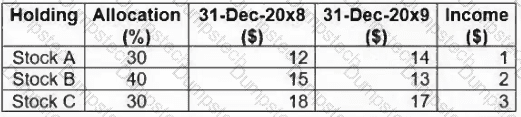
Question # 32

What is the annual rate of return for this portfolio?

Options:

A.

17.8%.

B.

10.8%.

C.

24.8%.

D.

9.94%.

Questions # 33:

Matias is working on estate planning recommendations for his client Cynthia. After a recent meeting, Matias is confident that an estate freeze would be the best option for her. Which factor would have determined that the estate freeze was the best recommendation for him to give Cynthia?

Options:

A.

Her children have higher marginal tax rates than her.

B.

The economy is about to enter a period of hyper-inflation.

C.

She requires flexibility in updating beneficiaries.

D.

She can afford to live on a fixed stream of income.

Questions # 34:

Richard reviewed his divorce settlement from his partner Alex with his advisor Maria. He is deciding between providing a lump sum spousal support payment of $60,000 or making monthly payments. If Richard’s income is $200,000 and Alex’s income is $40,000, what should Maria advise Richard about the tax implications for both Richard and Alex in regard to the lump sum payment?

Options:

A.

Richard will deduct the payment and pay taxes on the remaining $140,000 of income, and Alex will pay taxes on the lump-sum payment of $60,000.

B.

Richard will deduct the payment and pay taxes on the remaining $140,000 of income and Alex will pay taxes only on his earned income of $40,000.

C.

Richard will deduct half of the lump-sum support payment and pay taxes on the remaining $170,000 of income and Alex will claim the other half of the lump-sum support payment in addition to his earned Income of $40,000.

D.

Richard will pay taxes on the entirety of the $200,000 and Alex will pay taxes only on his earned income of $40,000.

Questions # 35:

Keitaro, age 42, and Ruth, age 52, are married and have two children - Maximo, age 20, and Hannah, age 16, both from Keitaro's previous marriage. In the event Keitaro dies, he would like to minimize taxes, provide for Ruth for the remainder of her life, and then after her death leave the residual to his children. What estate planning strategy should his financial planner recommend to help Keitaro achieve his goal?

Options:

A.

Transfer his assets to an inter vivos spousal trust through a will and name his children as income and capital beneficiaries.

B.

Transfer his assets to a testamentary spousal trust through a will and name his children as capital beneficiaries.

C.

Transfer his assets to an inter vivos spousal trust through a will and name his children as capital beneficiaries.

D.

Transfer his assets to a testamentary spousal trust through a will and name his children as income and capital beneficiaries.

Viewing page 4 out of 4 pages
Viewing questions 31-40 out of questions