Pre-Winter Sale Limited Time 75% Discount Offer - Ends in 0d 00h 00m 00s - Coupon code = simple75
Pass the HashiCorp Security Automation Certification HCVA0-003 Questions and answers with Dumpstech
You are using Vault to generate dynamic credentials for a Microsoft SQL server to perform queries for a month-end report. The report seems to be taking much longer than expected due to degradation on the underlying server, and you are afraid that Vault might automatically revoke the credentials. How can you extend the time the credentials are valid to ensure your month-end query is successful?
Your organization uses a CI/CD pipeline to deploy its applications on Azure. During testing, you generate new credentials to validate Vault can create new credentials. The result of this command is below:
text
CollapseWrapCopy
$ vault read azure/creds/bryan-krausen
Key Value
--- -----
lease_id azure/creds/bryan-krausen/9eed0373-ca92-99b6-b914-779b7bb0e1d9
lease_duration 60m
lease_renewable true
client_id 532bf678-ee4e-6be1-116b-4e4221e445dd
client_secret be60395b-4e6b-2b7e-a4b3-c449a5c00973
What commands can be used to revoke this secret after you have finished testing? (Select three)
You have a new team member on the Vault operations team. Their first task is to rotate the encryption key in Vault as part of the organization’s security policy. However, when they log in, they get an access denied error when attempting to rotate the key. The policy being used is below. Why can’t the user rotate the encryption key?
path " auth/* " {
capabilities = [ " create " , " read " , " update " , " delete " , " list " ]
}
path " sys/rotate " {
capabilities = [ " read " , " update " ]
}
You have enabled the Transit secrets engine on your Vault cluster to provide an " encryption as a service " service as your team develops new applications. What is a prime use case for the Transit secrets engine?
What is the primary role of the Vault Security Operator (VSO) in a Kubernetes environment?
Your organization recently suffered a security breach on a specific application, and the security response team believes that MySQL database credentials were likely obtained during the event. The application generated the credentials using the database secrets engine in Vault mounted at the path database/. How can you quickly revoke all of the secrets generated by this secrets engine?
True or False? Performing a rekey operation using the vault operator rekey command creates new unseal/recovery keys as well as a new root key?
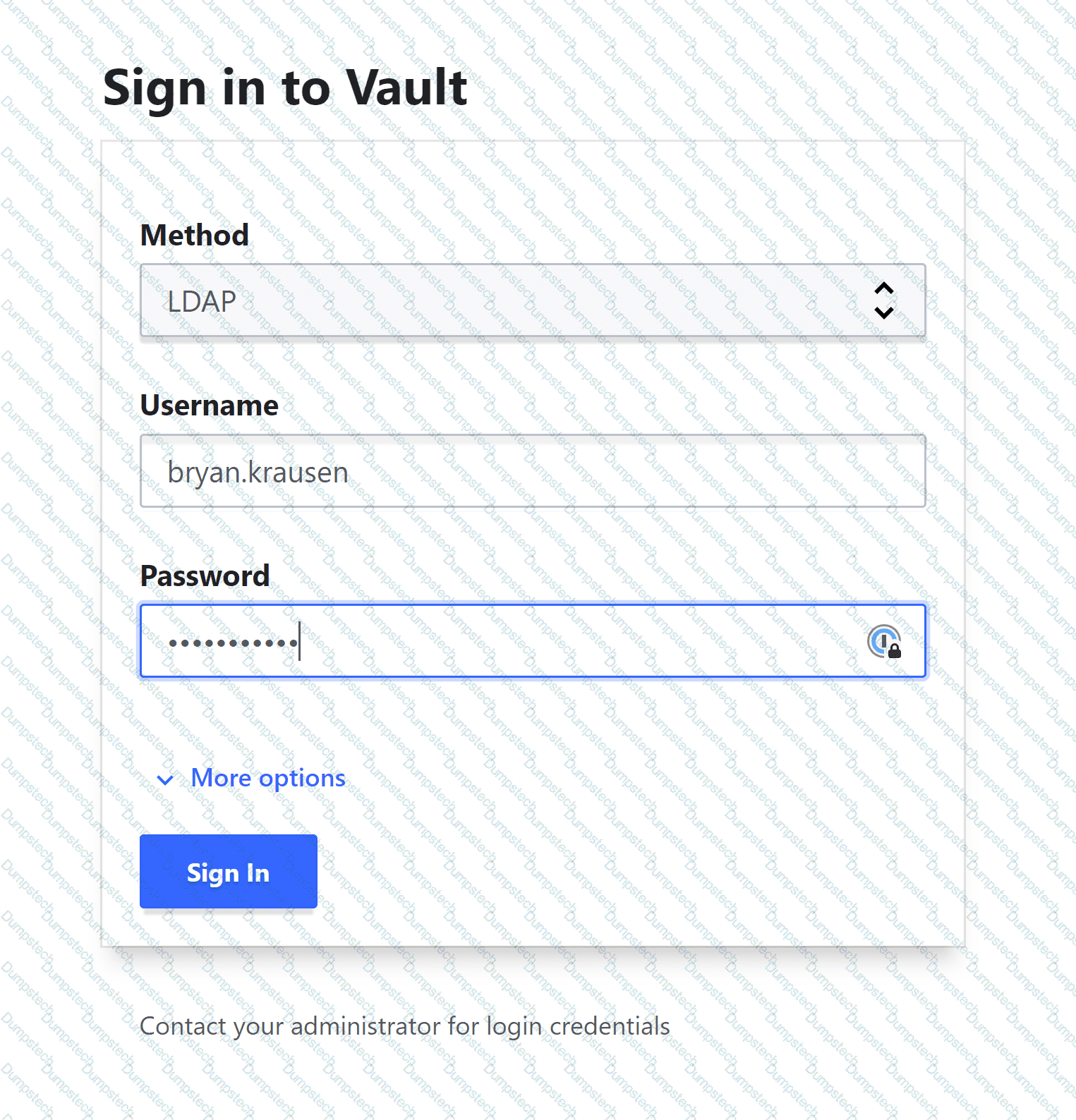
Your organization has enabled the LDAP auth method on the path of corp-auth/. When you access the Vault UI, you cannot log in despite providing the correct credentials. Based on the screenshot below, what action should you take to log in?
Your supervisor has requested that you log into Vault and update a policy for one of the development teams. You successfully authenticated to Vault via OIDC but do not see a way to manage the Vault policies. Why are you unable to manage policies in the Vault UI?
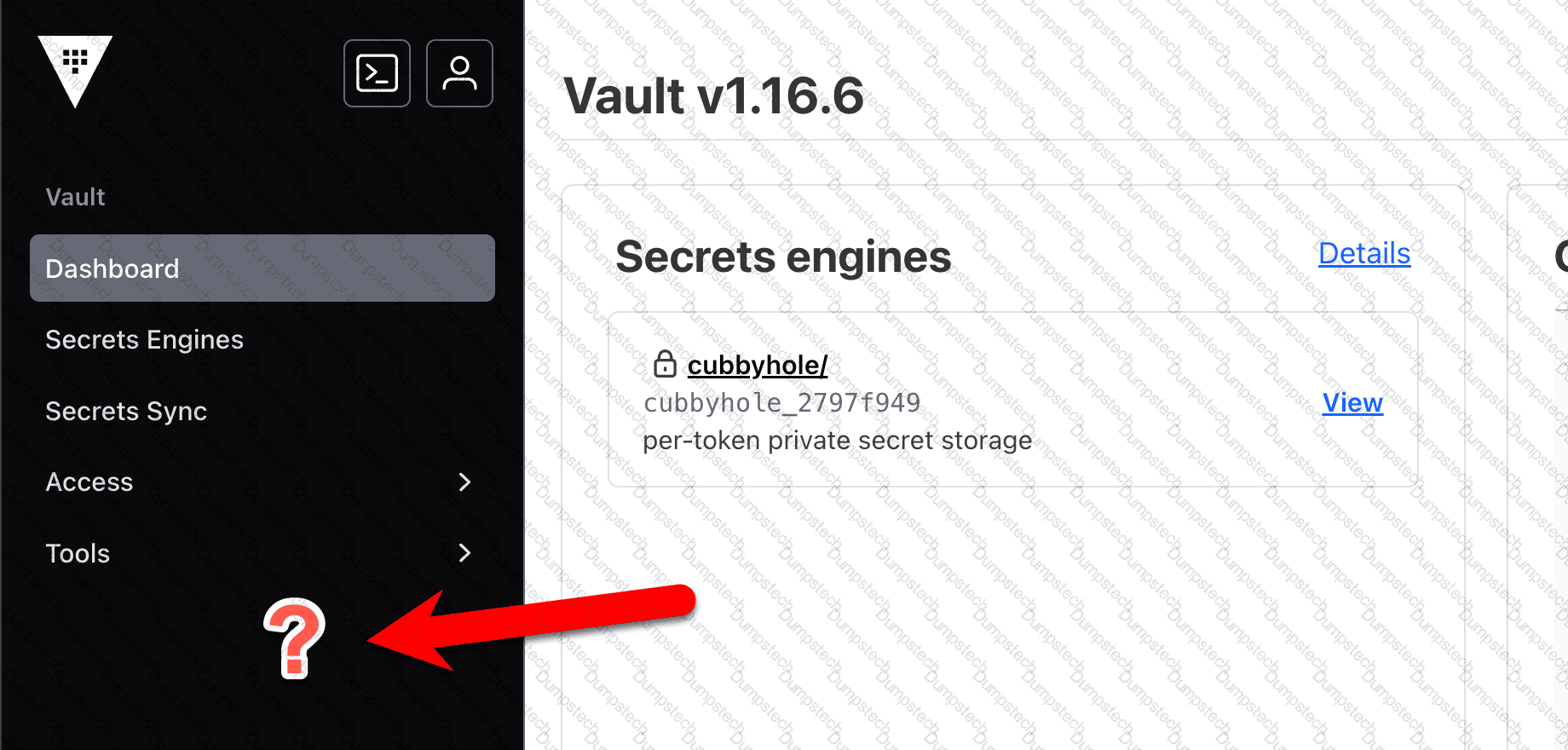
A developer has requested access to manage secrets at the path kv/apps/webapp01. You create the policy below which gives them the proper access:
path " kv/apps/webapp01 " {
capabilities = [ " read " , " create " , " update " , " list " ]
}
However, when the developer logs in to the Vault UI, they see the following screenshot and cannot access the desired secret. Why can’t the developer see the secrets they need?