Spring Sale Limited Time 70% Discount Offer - Ends in 0d 00h 00m 00s - Coupon code = simple70

Pass the HP Aruba Certified Switching Associate (ACSA) V1 HPE6-A86 Questions and answers with Dumpstech

Exam HPE6-A86 Premium Access

View all detail and faqs for the HPE6-A86 exam

Practice at least 50% of the questions to maximize your chances of passing.
Viewing page 1 out of 3 pages
Viewing questions 1-10 out of questions
Questions # 1:

With HPE Aruba Networking CX switches, which key feature is a fundamental concept of Zero Trust Security and SASE frameworks?

Options:

A.

Virtual Switching Framework

B.

Virtual Switching Extension

C.

Network Analytics Engine

D.

Dynamic Segmentation

Questions # 2:

You are trying to verify that your HPE Aruba Networking CX switch has access to the local DNS server through the out-of-band management interface. You have run the following ping command, but there has been no response:

ping 10.1.50.11

What would explain this?

Options:

A.

The out-of-band management interface only supports connectivity to its local subnet.

B.

You need to specify the mgmt VRF at the end of the ping command.

C.

You need to create an out-of-band management VRF first.

D.

The out-of-band management interface does not support ping.

Questions # 3:

You are about to start the initial configuration of an HPE Aruba Networking CX 6200M switch.

How would you connect to the switch to configure the SVI static IP address?

Options:

A.

Connect using the RJ-45 console port.

B.

Connect using the Aruba Discovery mobile app.

C.

Connect using the RJ-45 management port.

D.

Connect using the Bluetooth adapter.

Questions # 4:

A technician installed a new HPE Aruba Networking 550 Series access point, which is cabled back to an HPE Aruba Networking CX 6000 Series switch. However, there are no lights on the access point.

What could cause this?

Options:

A.

STP has not been configured.

B.

PoE is disabled on the interface.

C.

The access point cannot connect to HPE Aruba Networking Central.

D.

The wrong VLAN has been configured.

Questions # 5:

What is the default behavior of a trunked port on an HPE Aruba Networking CX switch?

Options:

A.

By default, all VLAN traffic is tagged to traverse a trunk link.

B.

By default, all VLAN traffic is tagged to traverse a trunk link when the port is part of a LAG.

C.

By default, all VLAN traffic is tagged to traverse a trunk link when the port type is routed.

D.

By default, all VLAN traffic is tagged to traverse a trunk link except the native VLAN.

Questions # 6:

You are planning a 40Gbps link between two sites 35 km apart.

What type of cable will be required?

Options:

A.

ZTP

B.

Single-mode fiber

C.

UTP

D.

Multi-mode fiber

Questions # 7:

You have configured the following on a Core-1 HPE Aruba Networking CX switch for primary and secondary ISP connectivity:

Core-1(config)# ip route 0.0.0.0/0 10.1.251.2

Core-1(config)# ip route 0.0.0.0/0 10.1.252.2 distance 10

The default route via 10.1.251.2 stopped working, and no failover happened. The ISP reported a broken fiber on the path of an upstream device.

In what condition should the route fail over to the 10.1.252.2 router?

Options:

A.

When uplink-failure-detection enables the 10.1.252.2 route.

B.

When the BFD session terminates on 10.1.251.2.

C.

When the default route graceful-restart timer expires.

D.

When 10.1.251.2 is no longer in the routing table.

Questions # 8:

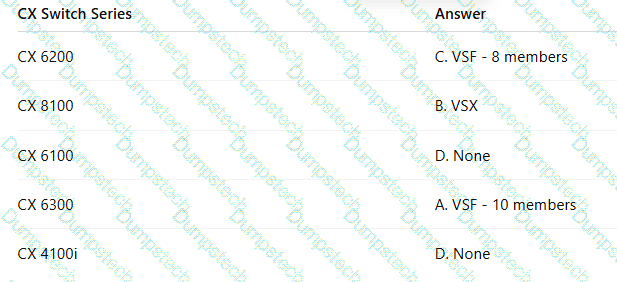
Match the device stacking or clustering feature to the correct HPE Aruba Networking CX switch series when selecting a switch family for a use case where device failure needs to be protected by using HPE Aruba Networking OS capabilities. Matches may be used more than once.
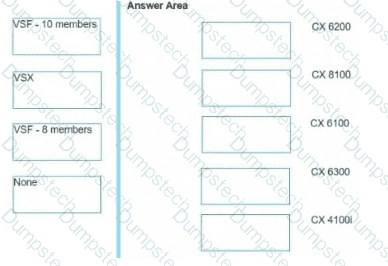
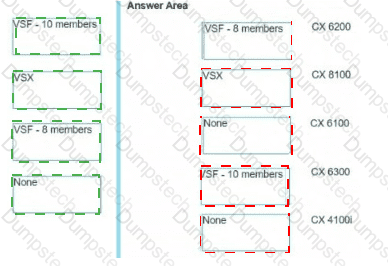
Question # 8

Options:

Questions # 9:

A customer with stacked switches needs PoE+ ports featured with near-zero downtime, continuous packet forwarding, and highly available hardware.

Which is correct for an HPE Aruba Networking CX solution?

Options:

A.

CX 8100 in VSX

B.

CX 6200F in VSF

C.

CX 8320 in VSX

D.

CX 6300M in VSF

Questions # 10:

When a VSF stack is created, how are the VLANs configured for the VSF links?

Options:

A.

The VSF ports automatically forward the traffic for configured VLANs.

B.

The VSF ports must be configured as trunk ports, and VLAN allows all.

C.

The VSF ports will forward VLAN information when vsf-sync is included in the configuration.

D.

The VSF ports need to be configured to allow VLAN 4095.

Viewing page 1 out of 3 pages
Viewing questions 1-10 out of questions