New Year Sale Limited Time 70% Discount Offer - Ends in 0d 00h 00m 00s - Coupon code = simple70

Pass the HP ACNSP HPE7-A02 Questions and answers with Dumpstech

Exam HPE7-A02 Premium Access

View all detail and faqs for the HPE7-A02 exam

Practice at least 50% of the questions to maximize your chances of passing.
Viewing page 1 out of 4 pages
Viewing questions 1-10 out of questions
Questions # 1:

A company has several use cases for using its AOS-CX switches' HPE Aruba Networking Network Analytics Engine (NAE).

What is one guideline to keep in mind as you plan?

Options:

A.

Each switch model has a maximum number of supported monitors, and one agent might have multiple monitors.

B.

You can install multiple scripts on a switch, but you can deploy only one agent per script.

C.

The switch will permit you to deploy as many NAE agents as you want, but they might degrade the switch functionality.

D.

When you use custom scripts, you can create as many agents from each script as you want.

Questions # 2:

A company has a variety of HPE Aruba Networking solutions, including an HPE Aruba Networking infrastructure and HPE Aruba Networking ClearPass Policy Manager (CPPM). The company passes traffic from the corporate LAN destined to the data center through a third-party SRX firewall. The company would like to further protect itself from internal threats. What is one solution that you can recommend?

Options:

A.

Have the third-party firewall send Syslogs to CPPM, which can work with network devices to lock internal attackers out of the network.

B.

Add ClearPass Device Insight (CPDI) to the solution, integrate it with the third-party firewall to develop more complete device profiles.

C.

Configure CPPM to poll the third-party firewall for a broad array of information about internal clients, such as profile and posture.

D.

Use tunnel mode SSIDs and user-based tunneling (UBT) on AOS-CX switches to pass all internal traffic directly through the third-party firewall.

Questions # 3:

A company wants HPE Aruba Networking ClearPass Policy Manager (CPPM) to respond to Syslog messages from its Palo Alto Next Generation Firewall (NGFW)

by quarantining clients involved in security incidents.

Which step must you complete to enable CPPM to process the Syslogs properly?

Options:

A.

Configure the Palo Alto as a context server on CPPM.

B.

Install a Palo Alto Extension through ClearPass Guest.

C.

Enable Insight and ingress event processing on the CPPM server.

D.

Configure CPPM to trust the root CA certificate for the NGFW.

Questions # 4:

A company has a third-party security appliance deployed in its data center. The company wants to pass all traffic for certain clients through that device before forwarding that traffic toward its ultimate destination.

Which AOS-CX switch technology fulfills this use case?

Options:

A.

Virtual Network Based Tunneling (VNBT)

B.

MC-LAG

C.

Network Analytics Engine (NAE)

D.

Device profiles

Questions # 5:

A company has AOS-CX switches. The company wants to make it simpler and faster for admins to detect denial of service (DoS) attacks, such as ping or ARP floods, launched against the switches.

What can you do to support this use case?

Options:

A.

Deploy an NAE agent on the switches to monitor control plane policing (CoPP).

B.

Configure the switches to implement RADIUS accounting to HPE Aruba Networking ClearPass and enable HPE Aruba Networking ClearPass Insight.

C.

Implement ARP inspection on all VLANs that support end-user devices.

D.

Enabling debugging of security functions on the switches.

Questions # 6:

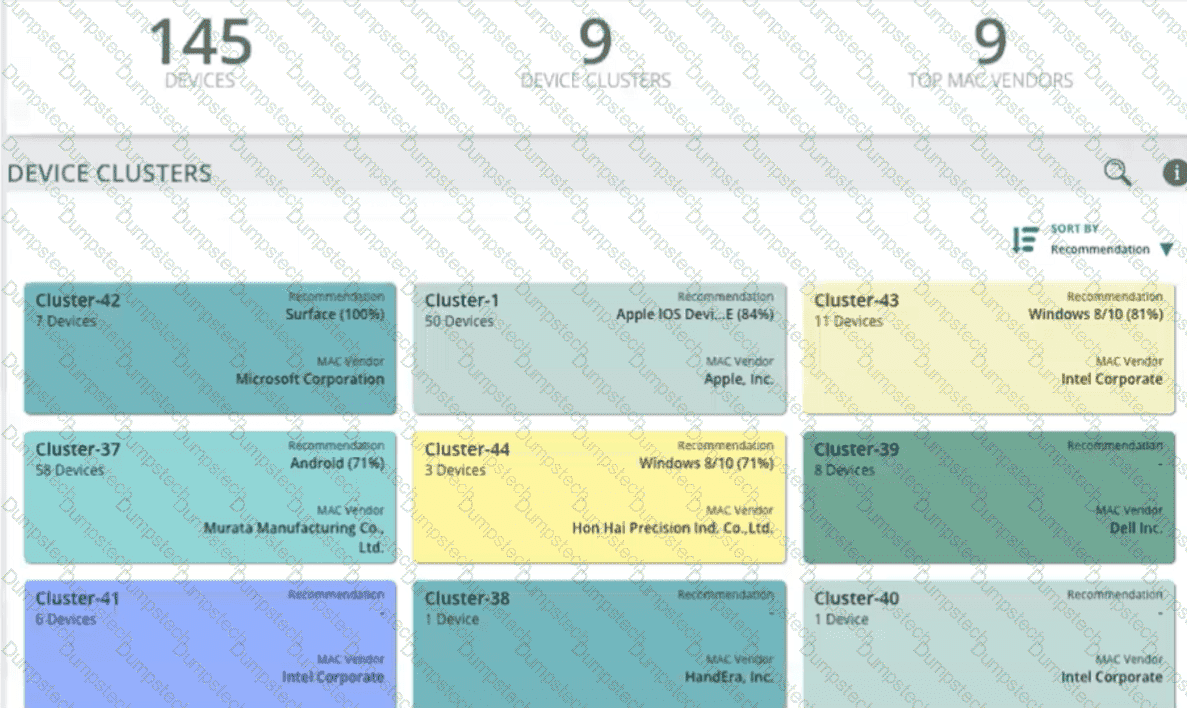
Refer to Exhibit.

Question # 6

A company is using HPE Aruba Networking ClearPass Device Insight (CPDI) (the standalone application). In the CPDI interface, you go to the Generic Devices

page and see the view shown in the exhibit.

What correctly describes what you see?

Options:

A.

Each cluster is a group of unclassified devices that CPDI's machine learning has discovered to have similar attributes.

B.

Each cluster is a group of devices that match one of the tags configured by admins.

C.

Each cluster is all the devices that have been assigned to the same category by one of CPDI's built-in system rules.

D.

Each cluster is a group of devices that have been classified with user rules, but for which CPDI offers different recommendations.

Questions # 7:

A ClearPass Policy Manager (CPPM) service includes these settings:

    Role Mapping Policy:

      Evaluate: Select first

      Rule 1 conditions:

        Authorization:AD:Groups EQUALS Managers

        Authentication:TEAP-Method-1-Status EQUALS Success

        Rule 1 role: manager

Rule 2 conditions:

    Authentication:TEAP-Method-1-Status EQUALS Success

    Rule 2 role: domain-comp

Default role: [Other]

Enforcement Policy:

    Evaluate: Select first

    Rule 1 conditions:

      Tips Role EQUALS manager AND Tips Role EQUALS domain-comp

      Rule 1 profile list: domain-manager

Rule 2 conditions:

    Tips Role EQUALS manager

    Rule 2 profile list: manager-only

Rule 3 conditions:

    Tips Role EQUALS domain-comp

    Rule 3 profile list: domain-only

Default profile: [Deny access]

A client is authenticated by the service. CPPM collects attributes indicating that the user is in the Contractors group, and the client passed both TEAP methods.

Which enforcement policy will be applied?

Options:

A.

[Deny Access Profile]

B.

manager-only

C.

domain-manager

D.

domain-only

Questions # 8:

You have configured an AOS-CX switch to implement 802.1X on edge ports. Assume ports operate in the default auth-mode. VoIP phones are assigned to the "voice" role and need to send traffic that is tagged for VLAN 12. Where should you configure VLAN 12?

Options:

A.

As the trunk native VLAN on edge ports and the trunk native VLAN on the "voice" role.

B.

As the allowed trunk VLAN in the "voice" role (and not in the edge port settings).

C.

As a trunk allowed VLAN on edge ports and the trunk native VLAN in the "voice" role.

D.

As the trunk native VLAN in the "voice" role (and not in the edge port settings).

Questions # 9:

You need to set up HPE Aruba Networking ClearPass Policy Manager (CPPM) to provide certificate-based authentication of 802.1X supplicants. How should you upload the root CA certificate for the supplicants’ certificates?

Options:

A.

As a ClearPass Server certificate with the RADIUS/EAP usage.

B.

As a ClearPass Server certificate with the Database usage.

C.

As a Trusted CA with the AD/LDAP usage.

D.

As a Trusted CA with the EAP usage.

Questions # 10:

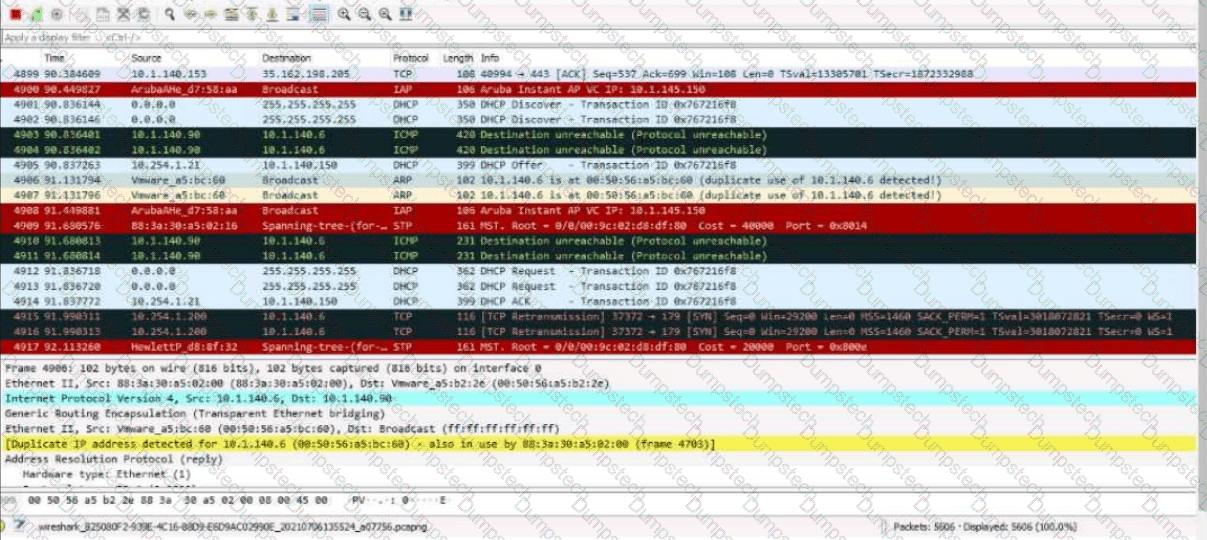
Refer to the Exhibit:

Question # 10

These packets have been captured from VLAN 10. which supports clients that receive their IP addresses with DHCP.

What can you interpret from the packets that you see here?

These packets have been captured from VLAN 10, which supports clients that receive their IP addresses with DHCP. What can you interpret from the packets that you see here?

Options:

A.

Someone is possibly implementing a MAC spoofing attack to gain unauthorized access.

B.

The mirroring session that captured the packets was likely misconfigured and captured duplicate traffic.

C.

An admin has likely misconfigured two clients to use the same DHCP settings.

D.

Someone is possibly implementing an ARP poisoning and MITM attack.

Viewing page 1 out of 4 pages
Viewing questions 1-10 out of questions