
Pre-Winter Sale Limited Time 75% Discount Offer - Ends in 0d 00h 00m 00s - Coupon code = simple75
Pass the Huawei HCIA-Cloud Service H13-811_V3.5 Questions and answers with Dumpstech
Exam H13-811_V3.5 Premium Access
View all detail and faqs for the H13-811_V3.5 exam
A user sets up a service website on Huawei Cloud Elastic Cloud Server (ECS) and uses Huawei Cloud Relational Database Service (RDS) on the backend to store service data. The database configuration is correct, but the website cannot communicate with the database. Which of the following can not be the cause of this issue?
Hybrid cloud is a flexible cloud computing model. It may contain two cloud architectures: public cloud and private cloud, or even more. The infrastructure of a hybrid cloud is owned and operated by a single organization. Therefore, user services can switch between these clouds as required.
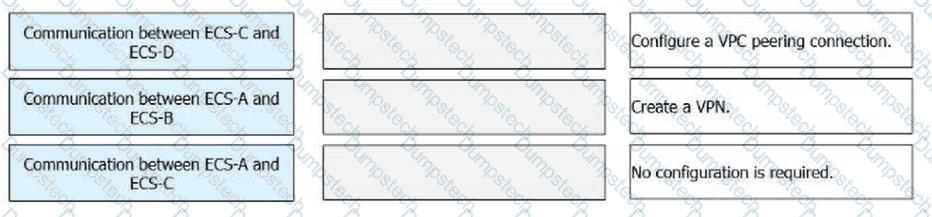
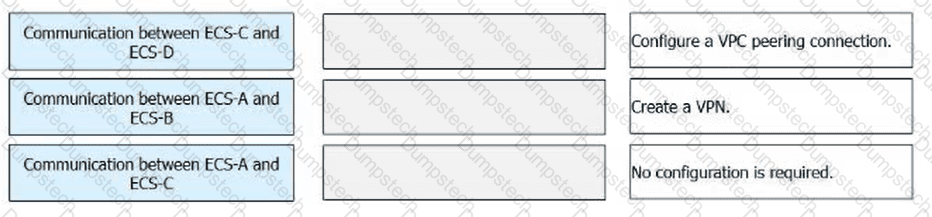
A user creates two Virtual Private Clouds (VPCs) (VPC 1 and VPC 2) in the CN North-Beijing4 region, and two Elastic Cloud Servers (ECSs), ECS-A and ECS-B, respectively, in VPC 1 and VPC 2. The user then creates another VPC in the CN East-Shanghai1 region, and two ECSs (ECS-C and ECS-D) in that VPC as well. The user needs to enable communications between different ECSs, match different scenarios with corresponding solutions:
An ECS can be billed on a pay-per-use, yearly or monthly, or spot price basis. Only pay-per-use billing can reduce costs.
How does Cloud Trace Service (CTS) notify subscribed users when key operations occur?
On HUAWEI CLOUD, if a user wants to enable an Elastic Cloud Server (ECS) to access the Internet, the only way is to bind an Elastic IP (EIP) to the ECS.
A shared Elastic Volume Service (EVS) disk can be attached to multiple servers at the same time. Before you delete a shared EVS disk, it has to be detached from all servers.
On Huawei Cloud, snapshots can be used to save Elastic Volume Service (EVS) disk data at specific points in time. If you delete an EVS disk, its snapshots will not be deleted.
