
75only - Ends in 0d 00h 00m 00s - Coupon code = 75only

Pass the ISTQB Software Testing & Quality CT-SEC Questions and answers with Dumpstech

Exam CT-SEC Premium Access

View all detail and faqs for the CT-SEC exam

Practice at least 50% of the questions to maximize your chances of passing.
Viewing page 1 out of 2 pages
Viewing questions 1-10 out of questions
Questions # 1:

Which ONE of the following statements is NOT CORRECT regarding dynamic and static testing tools in the security-testing context?

Options:

A.

Dynamic testing tools can probe the system rather than the application under test.

B.

A dynamic security test tool may perform a static scan of the configuration files.

C.

Depending on the context, whether the system or only the application is under test, the same tool can be considered as a dynamic or static tool respectively.

D.

There are no static testing tools, only dynamic testing tools exist for security testing.

Questions # 2:

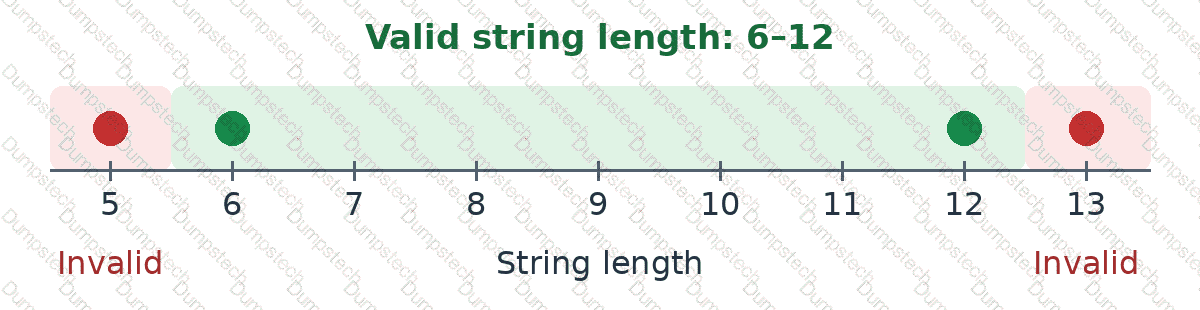
Which ONE of the following input-value sets provides 100% coverage of two boundary values for the string length?
Options:

A.

{aB#@5, aB#@56, bbBb?!B48bb, abCd?!gH48klm}

B.

{aB#@5, aB#@56, bbBb?!bB48bb, abCd?!gH48klm}

C.

{aB#@56, aB#@567, bbBb?!bB48bb, abCd?!gH48klm}

D.

{aB#@5, aB#@567, bbBb?!bB48bb, abCd?!gH489klm}

Questions # 3:

You should evaluate the effectiveness of an “intrusion detection system (IDS)” as part of implementing your organization’s security measures.

Which TWO of the following statements BEST describe a distinctive feature of an IDS?

Choose two.

Options:

A.

An IDS detects violations of the security policy.

B.

An IDS looks outwardly at the traffic to stop intrusions.

C.

An IDS has the same features as a firewall.

D.

An IDS may raise alerts in case of detection of abnormal behaviors.

E.

An IDS is capable of stopping all types of attacks on its own.

Questions # 4:

Given the preceding scenario, which ONE of the following testing types would you perform as part of security testing for the module?

Options:

A.

SQL testing on all input fields for database entries.

B.

Testing for login and privileges of what a doctor can do.

C.

Ensuring that the doctor is able to view but not edit the details of a patient.

D.

Validating that the project goals have been delivered.

Questions # 5:

Which ONE of the following situations is MOST LIKELY to occur when the security testing goal and objectives are not aligned with the organization’s overall security policy?

Options:

A.

It will result in sub-optimized test execution, without legal implications.

B.

Security tests which fall beyond the scope of the policy may be performed.

C.

Security tests may fulfill organizational security goals, but without management imposing proper sanctions.

D.

It can result in severe functional and non-functional issues.

Questions # 6:

Which ONE of the following factors should NOT be taken into account when establishing the return on investment (ROI) calculation for an open-source tool?

Options:

A.

How much time it takes to install, configure and understand the tool.

B.

The support availability.

C.

The scope and customization of the features and functionality.

D.

The cost of the tool.

Questions # 7:

Which ONE of the following actions could give an attacker information during the reconnaissance phase of an attack?

Options:

A.

To hold a public technical discussion regarding the company’s systems in an internal company social network.

B.

To address a colleague using their user ID in a forum on the company’s intranet.

C.

To hold a public technical discussion regarding the company’s systems on social networks.

D.

To publish their professional profile on a professional social network.

Questions # 8:

As part of the planning, monitoring, and control support activities set out in the test plan, Kyle is reviewing every standard applicable to his project. In particular, he must confirm in each instance whether these standards apply for regulatory or contractual reasons.

Which ONE of the following options BEST describes how standards differ in applicability between regulated and contractual circumstances?

Options:

A.

In both regulated and contractual circumstances, stakeholders are compelled to use, know, and comply with standards.

B.

In a contractual circumstance, all stakeholders must be aware of, and compelled to comply with, the established standards. In a regulated activity, standards can be a basis for negotiating the terms of an agreement.

C.

In a regulated activity, all stakeholders must be aware of, and compelled to comply with, the established standards. In a contractual circumstance, standards can be a basis for negotiating the terms of an agreement.

D.

The standards are only applicable to regulated circumstances; in any other case they are unnecessary.

Questions # 9:

Sophie is assessing the security requirements in user stories to confirm that the security-related elements of users’ needs are adequately addressed. She is also determining the most practical approach for developing the application securely.

During which software development life cycle stage should this activity occur?

Options:

A.

Requirement

B.

Design

C.

Implementation

D.

System Testing

Questions # 10:

Which ONE of the following options identifies the type of product described?

Options:

A.

UAMT file, or unified anti-malware test file

B.

EICAR anti-malware test file

C.

UAMT tool, or unified anti-malware test tool

D.

EICAR malware scanning tool

Viewing page 1 out of 2 pages
Viewing questions 1-10 out of questions