Spring Sale Limited Time 70% Discount Offer - Ends in 0d 00h 00m 00s - Coupon code = simple70

Pass the Juniper JNCIS-SP JN0-364 Questions and answers with Dumpstech

Exam JN0-364 Premium Access

View all detail and faqs for the JN0-364 exam

Practice at least 50% of the questions to maximize your chances of passing.
Viewing page 1 out of 2 pages
Viewing questions 1-10 out of questions
Questions # 1:

Exhibit:

Question # 1

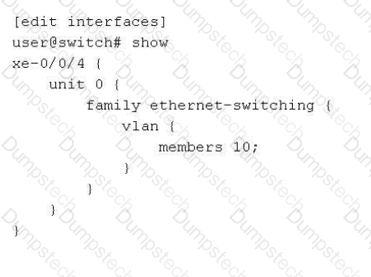
on a Juniper switch. It shows interfacexe-0/0/4withunit 0andfamily ethernet-switching. Under vlan, it lists members 10;`]

Referring to the exhibit, which two statements are true? (Choose two.)

Options:

A.

The interface receives tagged traffic.

B.

The interface is a part of a VLAN that uses VLAN ID 10.

C.

The interface receives untagged traffic.

D.

The interface is a member of the VLAN named 10.

Questions # 2:

In OSPF, which three fields must match between neighbors before forming an adjacency? (Choose three.)

Options:

A.

router priority

B.

hello interval

C.

network mask

D.

dead interval

E.

designated router

Questions # 3:

You are configuring BGP for IPv6 operations. In this scenario, which two statements are correct? (Choose two.)

Options:

A.

The Autonomous System Number (ASN) must be a 64-bit value.

B.

The router ID uses a 128-bit identifier value.

C.

The router ID uses a 32-bit identifier value.

D.

The Autonomous System Number (ASN) can be either a 32-bit or 64-bit value.

Questions # 4:

What prevents routing loops in a single-area OSPF network?

Options:

A.

The Dijkstra algorithm

B.

Routing policies

C.

The Bellman-Ford algorithm

D.

Forwarding policies

Questions # 5:

Which statement about RSVP-signaled LSPs is correct?

Options:

A.

CSPF is not required for LSPs using admin-groups.

B.

CSPF is used to calculate the path for a traffic-engineered LSP.

C.

The paths used by LSPs are always calculated using the SRGB.

D.

The paths used by LSPs are always calculated using the TED.

Questions # 6:

Which IPv6 extension header is used to specify intermediate nodes for a packet's path?

Options:

A.

hop-by-hop options

B.

routing

C.

fragment

D.

destination options

Questions # 7:

How are routing loops prevented in external BGP networks?

Options:

A.

By default, a router receiving a route with its own AS in the AS Path attribute will use the route.

B.

Routing policies must be used to drop looped routes.

C.

Routing policies must be used to accept valid routes.

D.

By default, a router receiving a route with its own AS in the AS Path attribute will not use the route.

Questions # 8:

You are asked to add next-hop redundancy using VRRP for an IPv6 enabled service. The configured primary router must always be active when available, and the servers connected to the network must be able to ping their gateway. Which VRRP element is required to accomplish this requirement?

Options:

A.

The backup router requires the track parameter to track the primary router's interface.

B.

The preempt parameter must be added to the VRRP configuration.

C.

Both routers running VRRP will require a static ARP entry to be configured for the VRRP VIP.

D.

The accept-data parameter must be added to the VRRP configuration.

Questions # 9:

Exhibit:

Question # 9

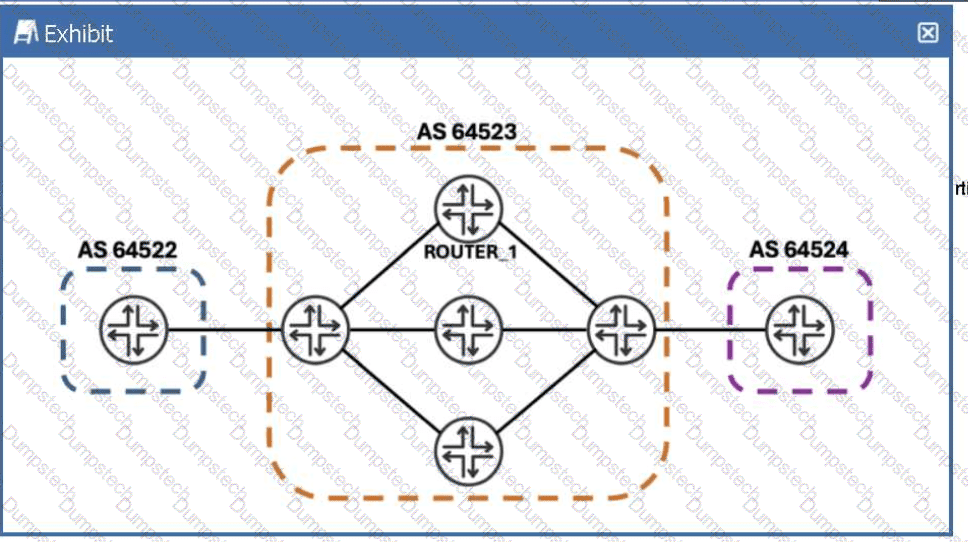
You must configure the router called ROUTER_1 to take all valid prefixes learned from internal BGP peers in AS 64523, and then re-advertise them to other internal BGP peers in the same autonomous system.

Referring to the exhibit, which configuration must you deploy on ROUTER_1 to accomplish this task?

Options:

A.

Configure ROUTER_1's internal BGP group with a routing policy that exports prefixes learned from internal BGP.

B.

Configure ROUTER_1's internal BGP group with the keyword cluster, followed by a unique 32-bit number.

C.

Configure a routing policy on ROUTER_1 that removes the no-export BGP community from all received prefixes.

D.

Configure ROUTER_1 to belong to a different autonomous system than the other BGP routers in your network.

Questions # 10:

What happens if an IS-IS router receives a link-state PDU with a higher sequence number than the one in its database?

Options:

A.

It ignores the link-state PDU.

B.

It updates its database and floods the link-state PDU.

C.

It sends a CSNP to request confirmation from the source of the link-state PDU.

D.

It resets the adjacency with the source of the link-state PDU.

Viewing page 1 out of 2 pages
Viewing questions 1-10 out of questions