
Pre-Winter Sale Limited Time 75% Discount Offer - Ends in 0d 00h 00m 00s - Coupon code = simple75
Pass the Microsoft Certified: Azure AI Cloud Developer Associate AI-200 Questions and answers with Dumpstech
You are troubleshooting a production Azure OpenAI service that is experiencing intermittent connectivity issues. All telemetry is sent to a Log Analytics workspace.
You must write a KQL query that analyzes the AppRequests table. The query must filter for requests that occurred within the last 30 minutes and have a failed status.
The final output must display the total number of failures for each unique operation.
You need to select the KQL operators required to filter the time range and aggregate the failure counts.
Which two operators should you use? Each correct answer presents part of the solution. Choose two.
NOTE: Each correct selection is worth one point.
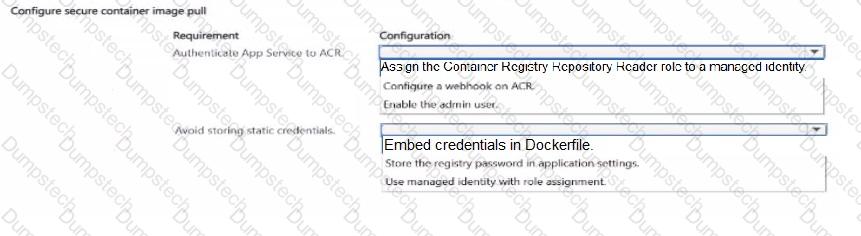
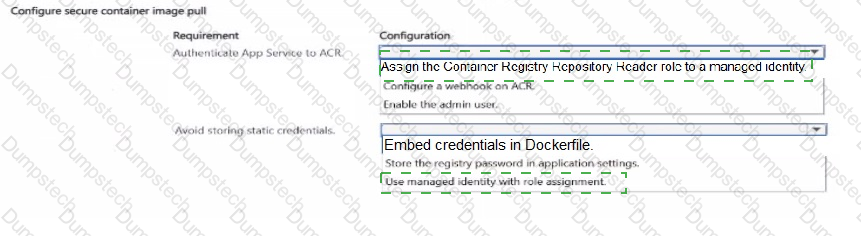
You deploy a private container image from Azure Container Registry (ACR) to App Service.
App Service must authenticate to ACR to pull the image.
The solution must NOT store static registry credentials.
You need to configure the secure image pull authentication.
Which configurations should you use? To answer, select the appropriate options in the answer area.
NOTE: Each correct selection is worth one point.

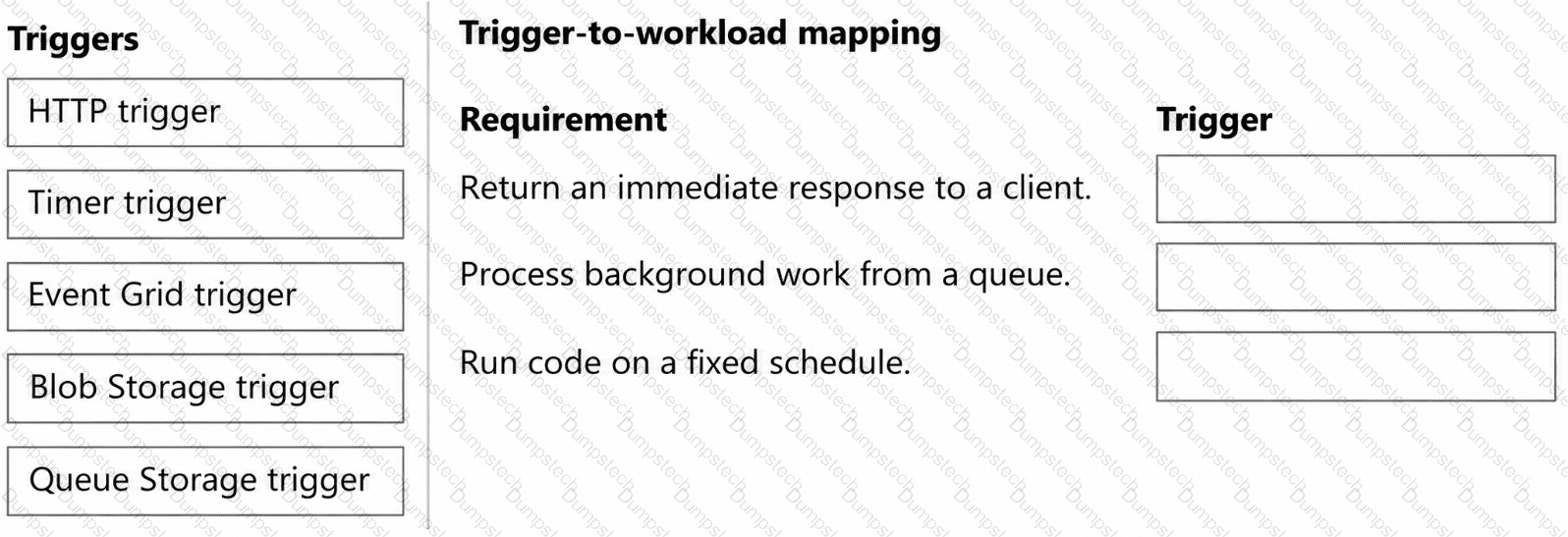
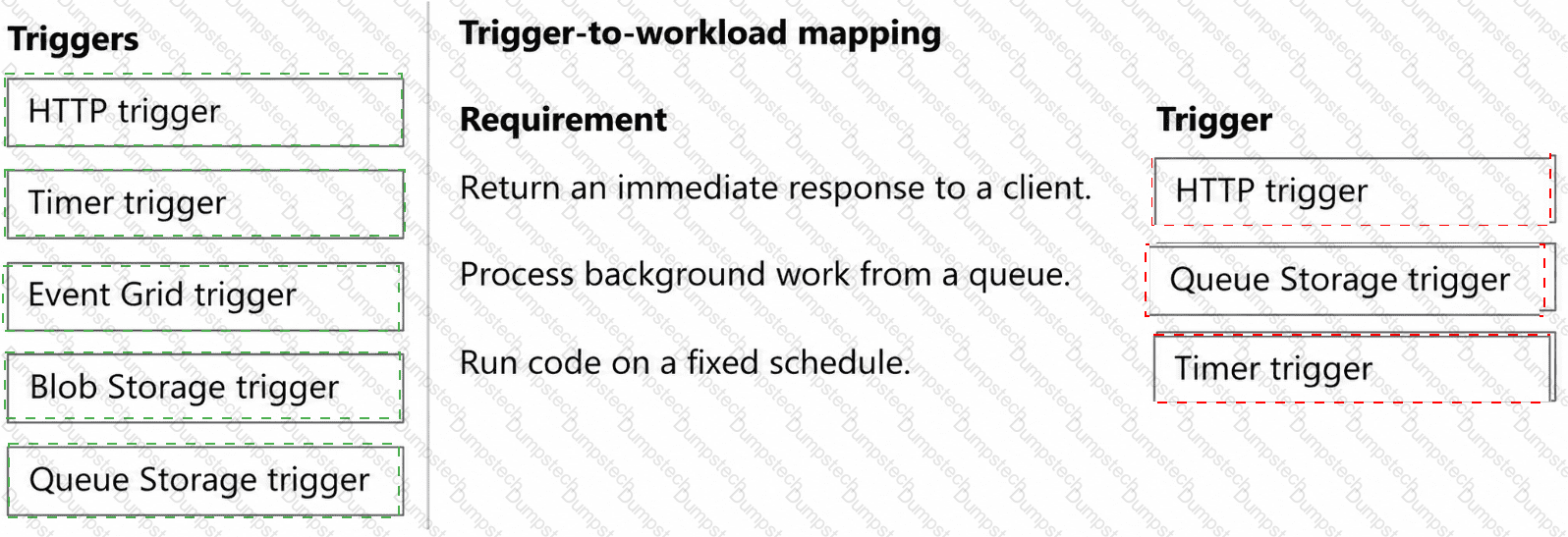
You are designing Azure Functions for three different backend workloads.
Each workload requires one of the following dispatching models:
- Return an immediate response to a client.
- Process background work from a queue.
- Run code on a fixed schedule.
You need to select the trigger for each requirement.
Which triggers should you select? To answer, move the appropriate triggers to the correct requirements. You may use each trigger once, more than once, or not at all. You may need to move the split bar between panes or scroll to view content.
NOTE: Each correct selection is worth one point.
You manage an Azure Cosmos DB for a NoSQL API account named account1. The account contains a database named db1, which contains a container named container1. You configure account1 with a session consistency level.
You plan to develop an application named App1 that will access container1. Individual instances of App1 must perform reads and writes. App1 must allow multiple nodes to participate in the same session.
You need to configure an object to share the session token between the nodes.
Which object should you use?
You maintain multiple versions of a container image in Azure Container Registry.
The production deployment must always run the exact same image build even if tags are changed later.
You need to ensure predictable and immutable image selection during deployment.
What should you do?
You are developing a Java application to be deployed in Azure. The application stores sensitive data in Azure Cosmos DB.
You need to configure Always Encrypted to encrypt the sensitive data inside the application.
What should you do first?
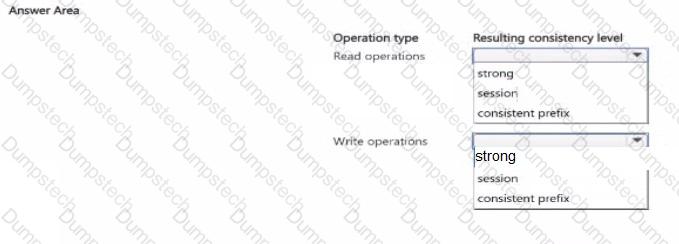
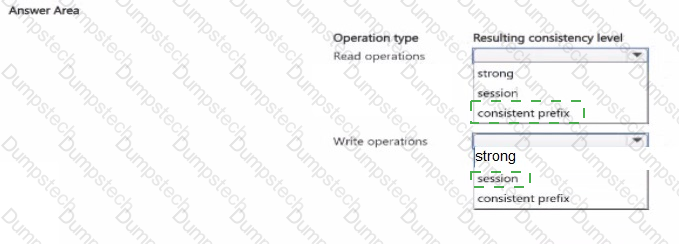
You provisioned an Azure Cosmos DB for NoSQL account named account1 with the default consistency level.
You plan to configure the consistency level on a per request basis. You plan to request Consistent Prefix consistency on a per-request basis.
You need to identify the resulting consistency level for read and write operations.
Which levels result from this configuration? To answer, select the appropriate options in the answer a rea.
NOTE: Each correct selection is worth one point.

Your solution must answer questions about numeric data in large Excel-based reports, for example:
" What was Q3 revenue for the West region? "
Which approach is most appropriate?
You are designing an Azure Function app that exposes a public API.
The solution must:
Validate incoming request data and return results immediately to the caller.
Support Microsoft Entra ID authentication.
Scale automatically under variable load.
You need to implement a trigger.
Which trigger should you implement?
An AI platform uses App Configuration for feature flags and endpoint routing.
The platform stores secrets alongside configuration data and does NOT support dynamic configuration refresh.
You need to redesign the configuration approach so that:
configuration supports dynamic refresh;
secrets are stored outside App Configuration;
the application can securely access both App Configuration and Key Vault.
You need to enable secure dynamic configuration management for the platform.
Which three actions should you perform? Each correct answer presents part of the solution. Choose three.
NOTE: Each correct selection is worth one point.
