Black Friday VIP Hour Limited Time 75% Discount Offer - Ends in 0d 00h 00m 00s - Coupon code = simple75
Pass the Microsoft Certified: Machine Learning Operations (MLOps) Engineer AI-300 Questions and answers with Dumpstech
A team provisions an Azure Machine Learning environment by triggering pull requests.
Deployments must be automated, auditable, and require approval before running.
You need to select a deployment automation tool.
Which tool should you use?
A real-time endpoint is deployed in Azure Machine Learning to serve predictions to a web application.
Users report intermittent failures and unexpected responses when calling the endpoint.
You need to identify the appropriate troubleshooting action for each reported issue.
Which troubleshooting action should you perform for each issue? To answer, move the appropriate troubleshooting actions to the correct issues. You may use each troubleshooting action once, more than once, or not at all. You may need to move the split bar between panes or scroll to view content. NOTE: Each correct selection is worth one point.



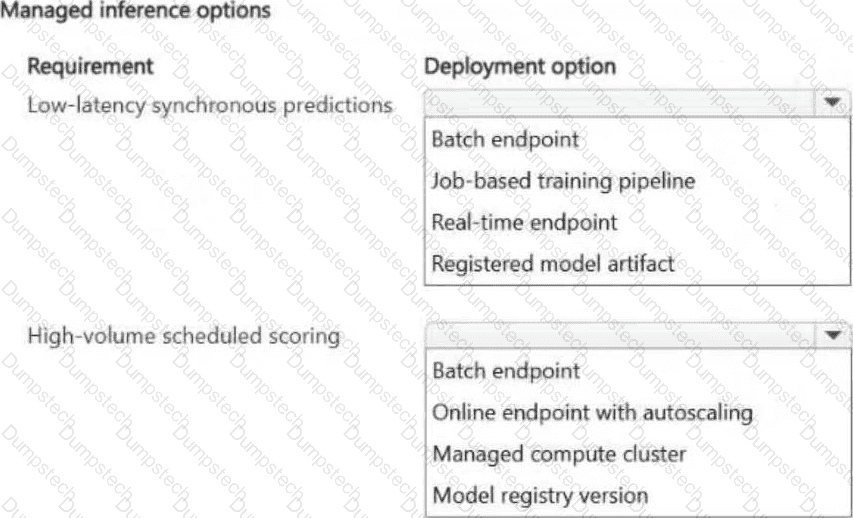
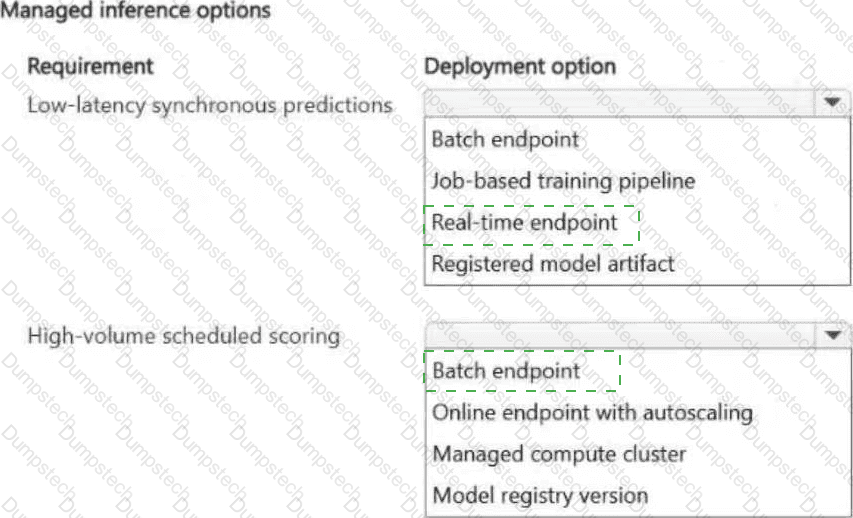
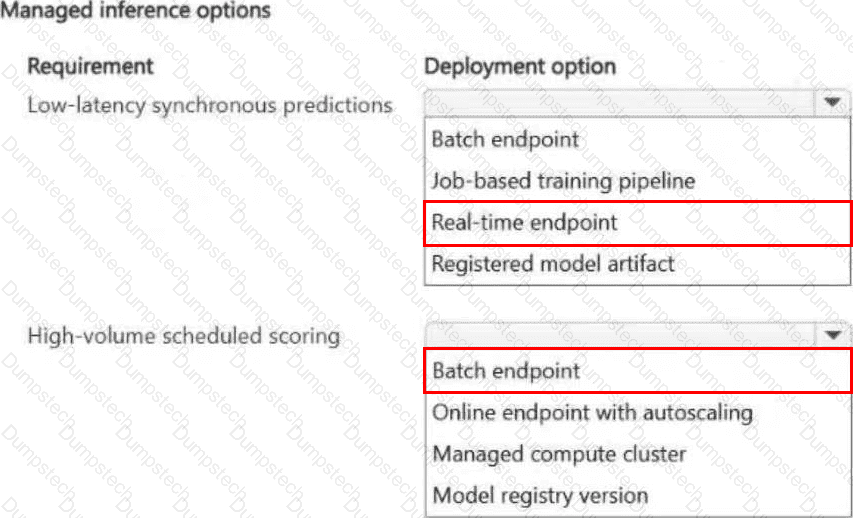
A team trains an MLflow model that scores customer churn risk. The model will be consumed by different downstream systems.
One system requests predictions synchronously during customer interactions.
Another system submits files containing millions of records for scheduled scoring.
You need to deploy the model by using managed inference options that match each usage pattern.
Which option should you use for each usage pattern? To answer, select the appropriate options in the answer area. NOTE: Each correct selection is worth one point.
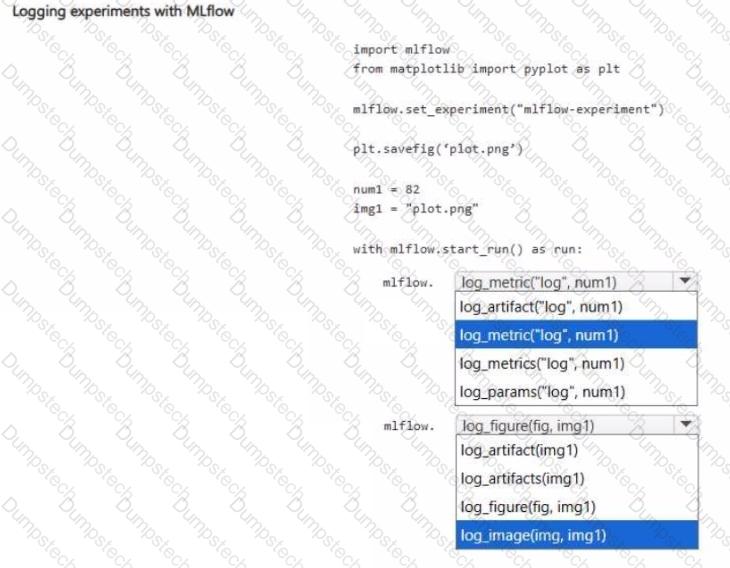
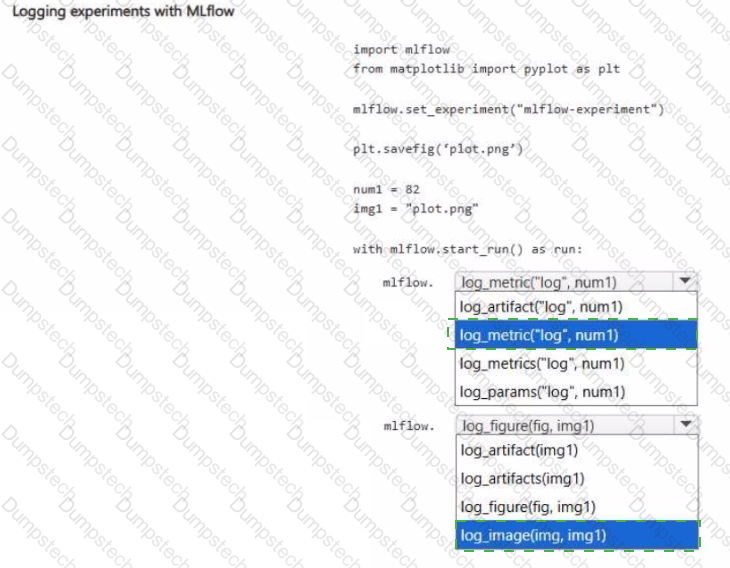
You have an Azure Machine Learning workspace.
You plan to set up logging and tracking experiments by using MLflow Tracking.
You need to log the accuracy as a numerical value and the training loss as a plot.
How should you complete the commands? To answer, select the appropriate options in the answer area.
NOTE: Each correct selection is worth one point.
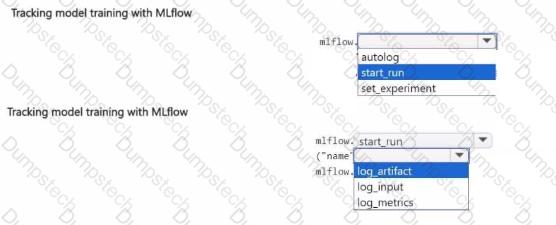
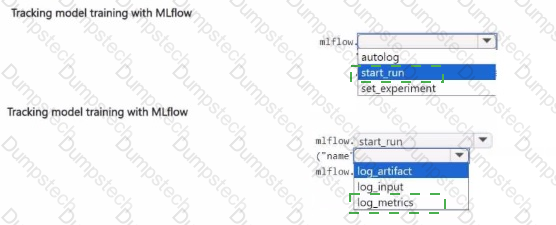
You manage an Azure Machine Learning workspace.
You train a model interactively with a Jupyter Notebook in the workspace During training, a dataset is created with accuiacy and loss metrics for each epoch.
You need to configure model tracking with MLflow to log the dataset created during the training.
How should you complete the code segment? To answer, select the appropriate options in the answer area.
NOTE: Each correct selection is worth one point.
You create an Azure Machine Learning workspace. You use Azure Machine Learning designer to create a pipeline within the workspace. You need to submit a pipeline run from the designer.
What should you do first?
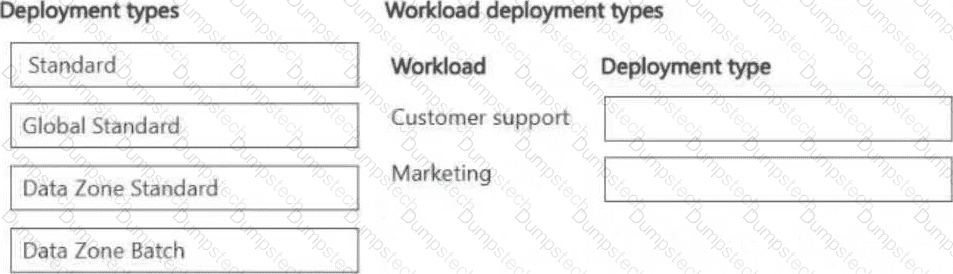
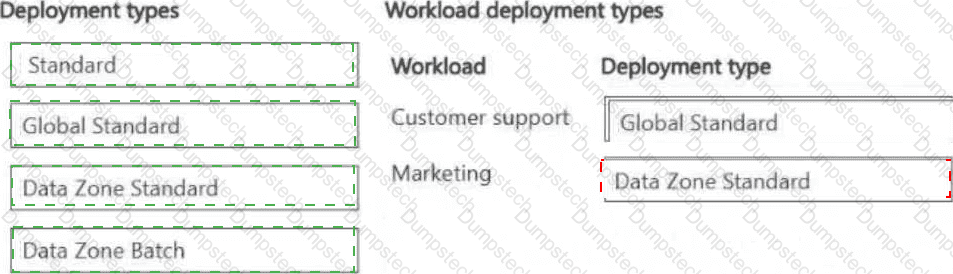
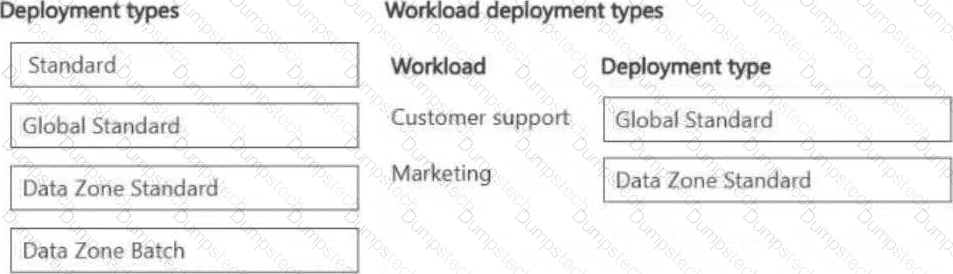
A company plans to deploy a foundation model in Microsoft Foundry.
The mode must support the following workloads:
A customer support workload used across multiple regions
A marketing workload that must remain within a specific region due to data residency requirements You need to select the deployment type.
Which deployment type should you use for each workload? To answer, move the appropriate deployment types to the correct requirements. You may use each deployment type once, more than once, or not at all. You may need to move the split bar between panes or scroll to view content. NOTE: Each correct selection is worth one point.
You manage an Azure Machine Learning workspace.
You must log multiple metrics by using MLflow.
You need to maximize logging performance.
What are two possible ways to achieve this goal? Each correct answer presents a complete solution.
NOTE: Each correct selection is worth one point.
You are designing an Azure Machine Learning solution for traffic optimization.
The model must be deployed as a web service on a serverless compute and provide real-time predictions based on current traffic and weather conditions. You need to choose an inferencing strategy for the solution. Which compute should you use?
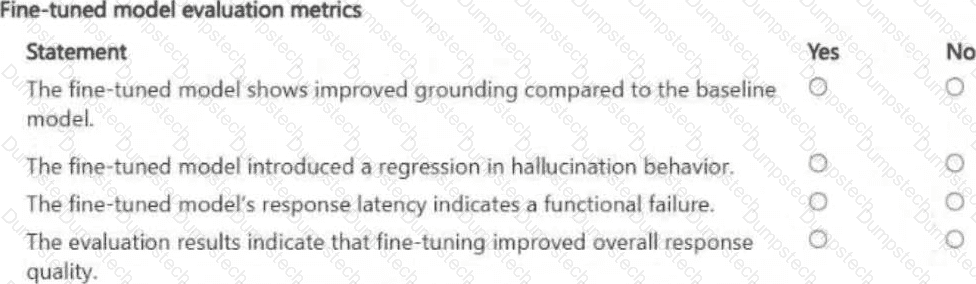
You are monitoring a fine-tuned large language model deployed in Microsoft Foundry.
You evaluate the model before and after fine-tuning by using the same evaluation dataset.
You review the following evaluation results:
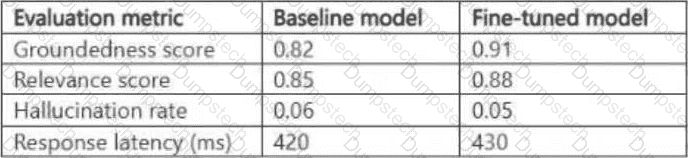
You need to determine whether the fine-tuned model shows improved performance without introducing regression.
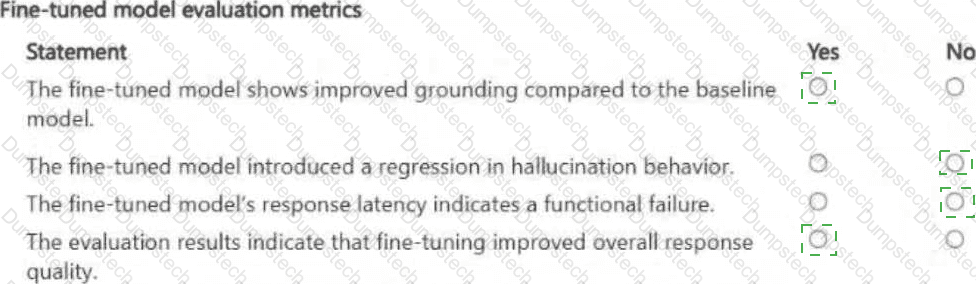
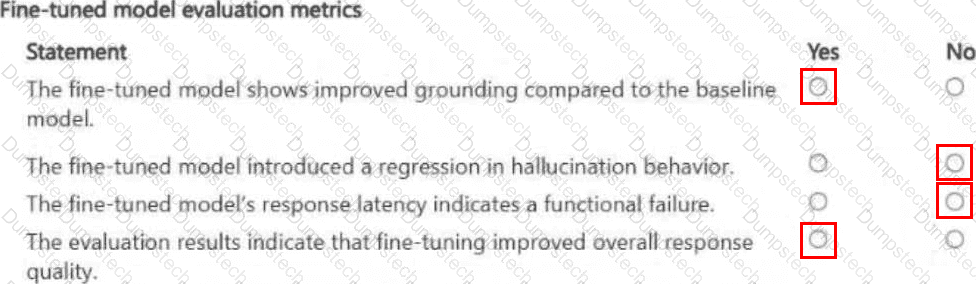
For each of the following statements, select Yes if the statement is true. Otherwise, select No. NOTE: Each correct selection is worth one point.