
Pre-Winter Sale Limited Time 75% Discount Offer - Ends in 0d 00h 00m 00s - Coupon code = simple75
Pass the Microsoft Certified: Azure Cosmos DB Developer Specialty DP-420 Questions and answers with Dumpstech
You have an Azure Cosmos DB for NoSQL database that hosts a container named Container^
You are developing a new app named App1 that will use Container 1.
You need to ensure that when App1 attempts to delete a document in Container1, the action is blocked, and an error is returned to the app.
What should you use?
You have the following Azure Resource Manager (ARM) template.
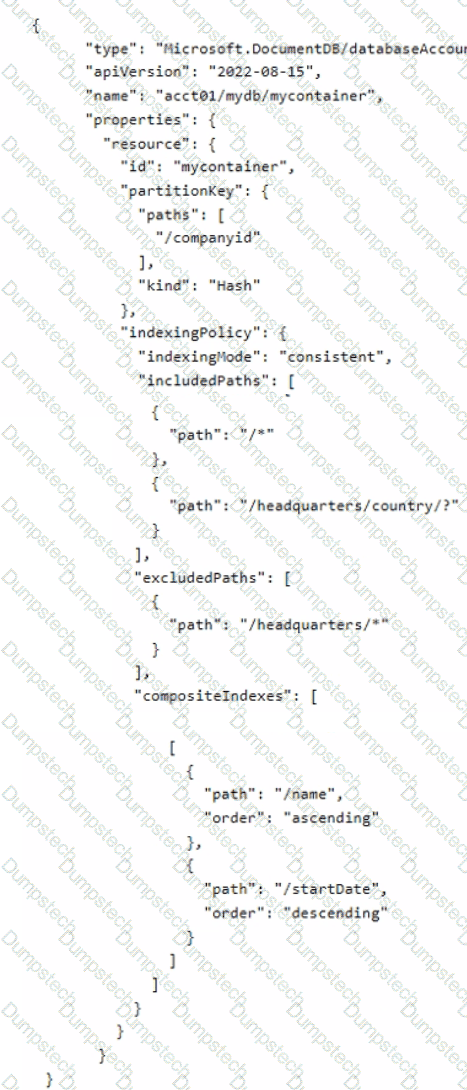
You plan to deploy the template in incremental mode.
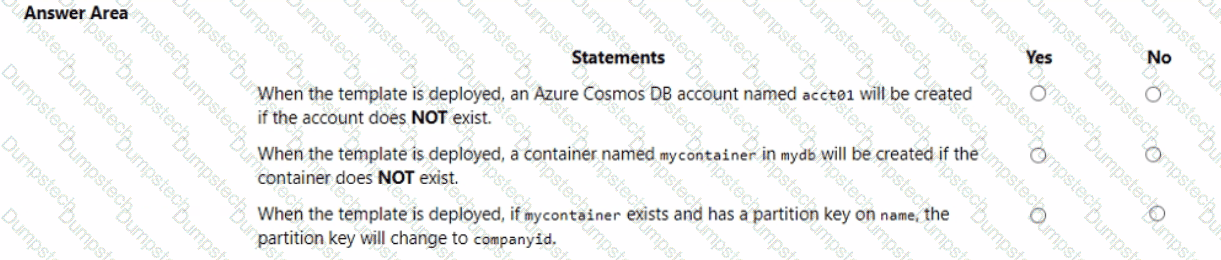
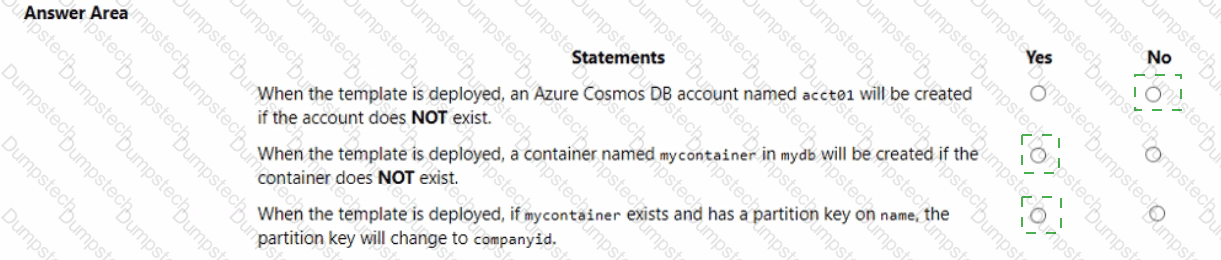
For each of the following statements, select Yes if the statement is true. Otherwise, select No.
You are developing an application that will use an Azure Cosmos DB Core (SQL) API account as a data source.
You need to create a report that displays the top five most ordered fruits as shown in the following table.
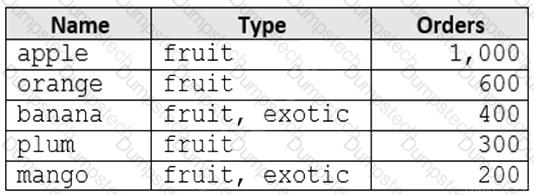
A collection that contains aggregated data already exists. The following is a sample document:
{
" name " : " apple " ,
" type " : [ " fruit " , " exotic " ],
" orders " : 10000
}
Which two queries can you use to retrieve data for the report? Each correct answer presents a complete solution.
NOTE: Each correct selection is worth one point.
A)

B)

C)

D)

You have an Azure Cosmos DB for NoSQL account1 that is configured for automatic failover. The account1 account has a single read-write region in West US and a and a read region in East US.
You run the following PowerShell command.

What is the effect of running the command?
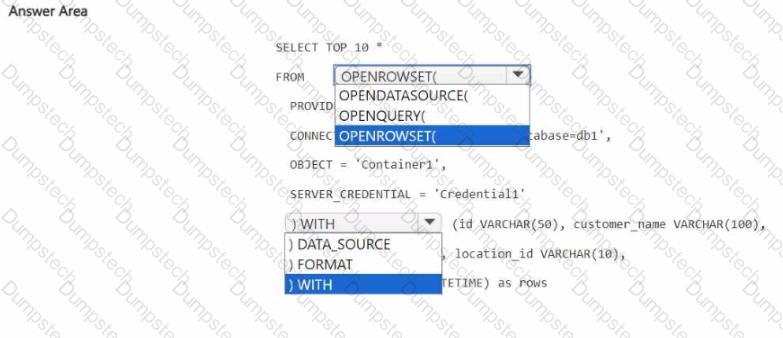
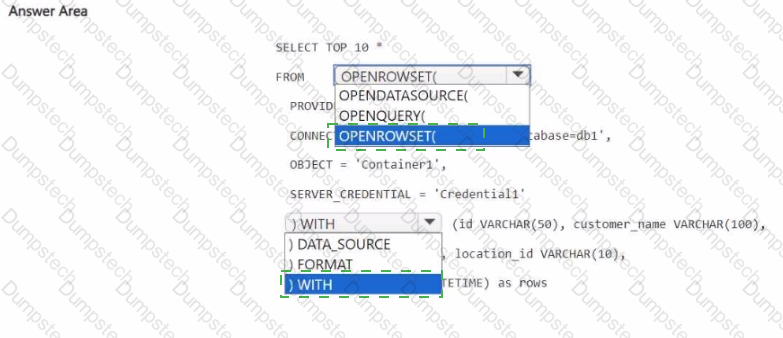
You have an Azure subscription that contains the resources shown in the following table.

You need to query Container1 from the serverless SQL pool of workspace1.
How should you complete the query? To answer, select the appropriate options in the answer area.
NOTE: Each correct selection is worth one point.
You are designing an Azure Cosmos DB Core (SQL) API solution to store data from IoT devices. Writes from the devices will be occur every second.
The following is a sample of the data.
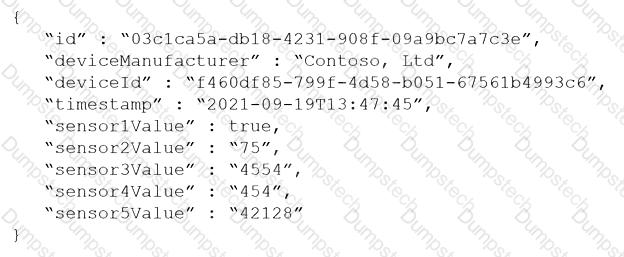
You need to select a partition key that meets the following requirements for writes:
Minimizes the partition skew
Avoids capacity limits
Avoids hot partitions
What should you do?
You have a container named container1 in an Azure Cosmos DB for NoSQL account named account1 that is set to the session default consistency level. The average size of an item in container1 is 20 KB.
You have an application named App1 that uses the Azure Cosmos DB SDK and performs a point read on the same set of items in container1 every minute.
You need to minimize the consumption of the request units (RUs) associated to the reads by App1. What should you do?
You have an Azure subscription that contains the resources shown in the following table.

You need to store the account key of account1 in KV1. What should you use?
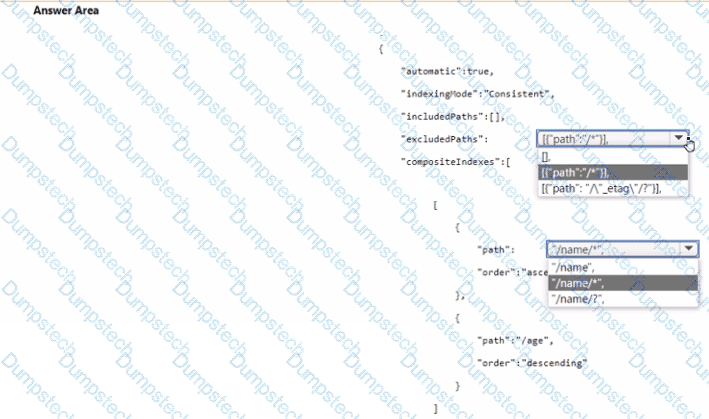
You have an Azure Cosmos DB for NoSQL account.
You plan 10 create a container named container1. The container1 container will store items that include two properties named nm and age
The most commonly executed queries will query container1 for a specific name. The following is a sample of the query.
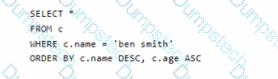
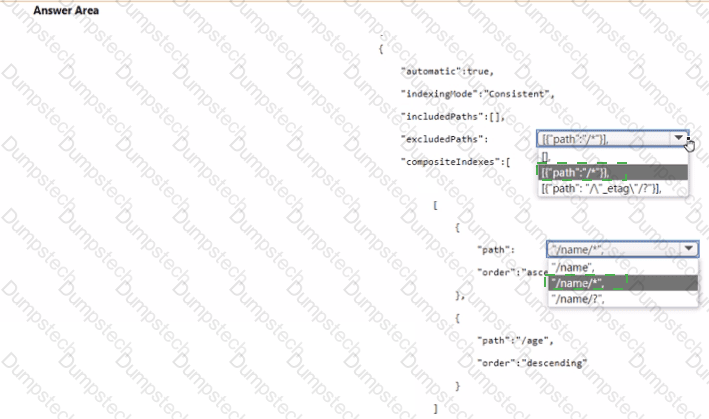
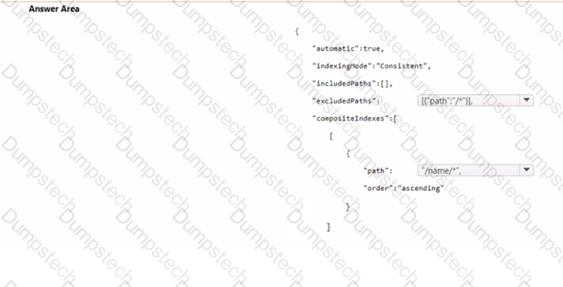
You need to define an opt-in Indexing policy for container1. The solution must meet the following requirements:
• Minimize the number of request units consumed by the queries.
• Ensure that the _etag property is excluded from indexing.
How should you define the indexing poky? To answer, select the appropriate options in the answer area. NOTE: Each correct selection Is worth one point.
 C:\Users\GlobeTech-Cert\Desktop\hanzala\Untitled.jpg
Note: This question is part of a series of questions that present the same scenario. Each question in the series contains a unique solution that might meet the stated goals. Some question sets might have more than one correct solution, while others might not have a correct solution.
After you answer a question in this section, you will NOT be able to return to it. As a result, these questions will not appear in the review screen.
You have an Azure Cosmos DB Core (SQL) API account named account 1 that uses autoscale throughput.
You need to run an Azure function when the normalized request units per second for a container in account1 exceeds a specific value.
Solution: You configure an application to use the change feed processor to read the change feed and you configure the application to trigger the function.
Does this meet the goal?
