
Summer Sale Limited Time 75% Discount Offer - Ends in 0d 00h 00m 00s - Coupon code = simple75
Pass the Microsoft Certified: Fabric Data Engineer Associate DP-700 Questions and answers with Dumpstech
Note: This question is part of a series of questions that present the same scenario. Each question in the series contains a unique solution that might meet the stated goals. Some question sets might have more than one correct solution, while others might not have a correct solution.
After you answer a question in this section, you will NOT be able to return to it. As a result, these questions will not appear in the review screen.
You have a Fabric eventstream that loads data into a table named Bike_Location in a KQL database. The table contains the following columns:
BikepointID
Street
Neighbourhood
No_Bikes
No_Empty_Docks
Timestamp
You need to apply transformation and filter logic to prepare the data for consumption. The solution must return data for a neighbourhood named Sands End when No_Bikes is at least 15. The results must be ordered by No_Bikes in ascending order.
Solution: You use the following code segment:

Does this meet the goal?
HOTSPOT
You have a Fabric workspace that contains an eventstream named EventStream1.
You discover that an EventStream1 transformation fails.
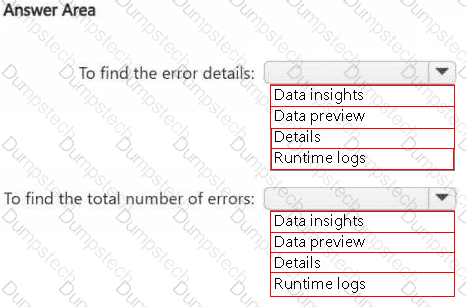
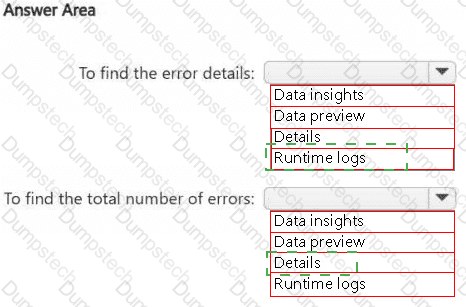
You need to find the following error information:
The error details, including the occurrence time
The total number of errors
What should you use? To answer, select the appropriate options in the answer area.
NOTE: Each correct selection is worth one point.
You are implementing a medallion architecture in a Fabric lakehouse.
You plan to create a dimension table that will contain the following columns:
• ID
• CustomerCode
• CustomerName
• CustomerAddress
• CustomerLocation
• ValidFrom
• ValidTo
You need to ensure that the table supports the analysis of historical sales data by customer location at the time of each sale Which type of slowly changing dimension (SCD) should you use?
You have a Fabric lakehouse that contains the resources shown in the following table.

You need to use a notebook to query for customers in the United States and load the filtered data into USCustomers. The solution must minimize the number of scripts used.
Which statement should you use?
Note: This question is part of a series of questions that present the same scenario. Each question in the series contains a unique solution that might meet the stated goals. Some question sets might have more than one correct solution, while others might not have a correct solution.
After you answer a question in this section, you will NOT be able to return to it. As a result, these questions will not appear in the review screen.
You have a KQL database that contains two tables named Stream and Reference. Stream contains streaming data in the following format.
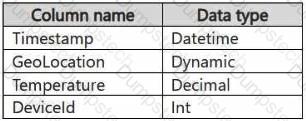
Reference contains reference data in the following format.
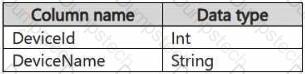
Both tables contain millions of rows.
You have the following KQL queryset.
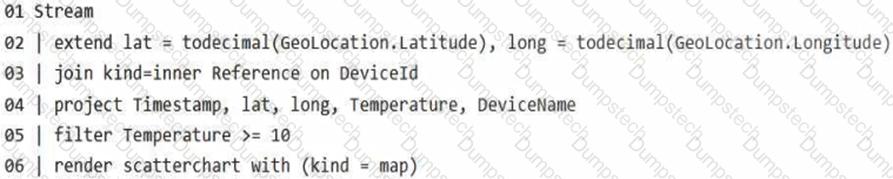
You need to reduce how long it takes to run the KQL queryset.
Solution: You change project to extend.
Does this meet the goal?
You have a Fabric workspace that contains a lakehouse named Lakehouse1. Data is ingested into Lakehouse1 as one flat table. The table contains the following columns.
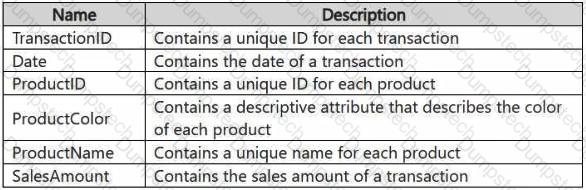
You plan to load the data into a dimensional model and implement a star schema. From the original flat table, you create two tables named FactSales and DimProduct. You will track changes in DimProduct.
You need to prepare the data.
Which three columns should you include in the DimProduct table? Each correct answer presents part of the solution.
NOTE: Each correct selection is worth one point.
Note: This question is part of a series of questions that present the same scenario. Each question in the series contains a unique solution that might meet the stated goals. Some question sets might have more than one correct solution, while others might not have a correct solution.
After you answer a question in this section, you will NOT be able to return to it. As a result, these questions will not appear in the review screen.
You have a Fabric eventstream that loads data into a table named Bike_Location in a KQL database. The table contains the following columns:
BikepointID
Street
Neighbourhood
No_Bikes
No_Empty_Docks
Timestamp
You need to apply transformation and filter logic to prepare the data for consumption. The solution must return data for a neighbourhood named Sands End when No_Bikes is at least 15. The results must be ordered by No_Bikes in ascending order.
Solution: You use the following code segment:

Does this meet the goal?

You are building a Fabric notebook named MasterNotebookl in a workspace. MasterNotebookl contains the following code.
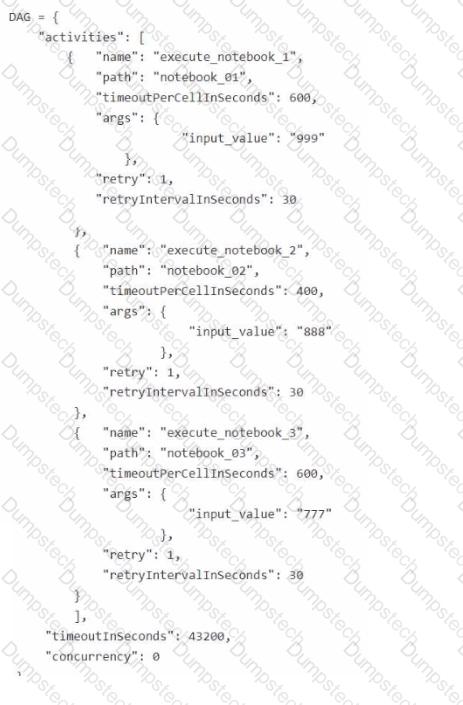
You need to ensure that the notebooks are executed in the following sequence:
1. Notebook_03
2. Notebook.Ol
3. Notebook_02
Which two actions should you perform? Each correct answer presents part of the solution. NOTE: Each correct selection is worth one point.
