New Year Sale Limited Time 70% Discount Offer - Ends in 0d 00h 00m 00s - Coupon code = simple70

Pass the Netskope NCCSA NSK300 Questions and answers with Dumpstech

Exam NSK300 Premium Access

View all detail and faqs for the NSK300 exam

Practice at least 50% of the questions to maximize your chances of passing.
Viewing page 1 out of 2 pages
Viewing questions 1-10 out of questions
Questions # 1:

You are implementing a solution to deploy Netskope for machine traffic in an AWS account across multiple VPCs. You want to deploy the least amount of tunnels while providing connectivity for all VPCs.

How would you accomplish this task?

Options:

A.

Use IPsec tunnels from the AWS Virtual Private Gateway.

B.

Use GRE tunnels from the AWS Transit Gateway.

C.

Use GRE tunnels from the AWS Virtual Private Gateway

D.

Use IPsec tunnels from the AWS Transit Gateway.

Questions # 2:

You do not want a scheduled Advanced Analytics dashboard to be automatically updated when Netskope makes improvements to that dashboard. In this scenario, what would you do to retain the original dashboard?

Options:

A.

Create a new dashboard from scratch that mimics the Netskope dashboard you want to use.

B.

Copy the dashboard into your Group or Personal folders and schedule from these folders.

C.

Ask Netskope Support to provide the dashboard and import into your Personal folder.

D.

Download the dashboard you want and Import from File into your Group or Personal folder.

Questions # 3:

Your Netskope Client tunnel has connected to Netskope; however, the user is not receiving any steering or client configuration updates What would cause this issue?

Options:

A.

The client is unable to establish communication to add-on-[tenantl.goskope.com.

B.

The client is unable to establish communication to gateway-(tenant|.goskope.com.

C.

The Netskope Client service is not running.

D.

An invalid steering exception was created in the tenant

Questions # 4:

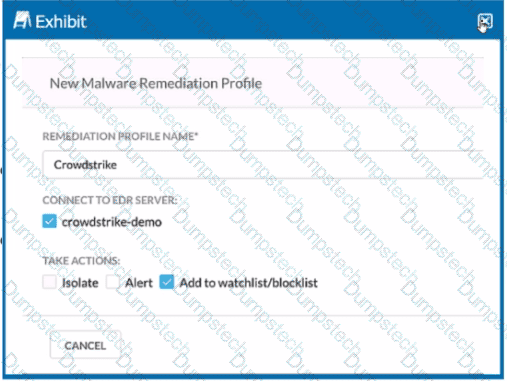
Review the exhibit.

Question # 4

You are asked to integrate Netskope with Crowdstrike EDR. You added the Remediation profile shown in the exhibit.

Which action will this remediation profile take?

Options:

A.

The endpoint will be isolated.

B.

The malware hash will be added as an IOC in Crowdstrike.

C.

The malware will be quarantined.

D.

The malware hash will be added as an IOC in Netskope.

Questions # 5:

You are implementing Netskope Cloud Exchange in your company lo include functionality provided by third-party partners. What would be a reason for using Netskope Cloud Risk Exchange in this scenario?

Options:

A.

to ingest events and alerts from a Netskope tenant

B.

to feed SOC with detection and response services

C.

to map multiple scores to a normalized range

D.

to automate service tickets from alerts of interest

Questions # 6:

You built a number of DLP profiles for different sensitive data types. If a file contains any of this sensitive data, you want to take the most restrictive policy action but also create incident details for all matching profiles.

Which statement is correct in this scenario?

Options:

A.

Create a Real-time Protection policy for each DLP profile; each matched profile will generate a unique DLP incident.

B.

Create a Real-time Protection policy for each DLP profile; all matched profiles will show up in a single DLP incident

C.

Create a single Real-time Protection policy and include all of the DLP profiles; each matched profile will generate a unique DLP incident

D.

Create a single Real-time Protection policy and include all of the DLP profiles; all matched profiles will show up in a single DLP incident.

Questions # 7:

A hospital has a patient form that they share with their patients over Gmail. The blank form can be freely shared among anyone. However, if the form has any information filled out. the document is considered confidential.

Which rule type should be used in the DLP profile to match such a document?

Options:

A.

Use fingerprint classification.

B.

Use a dictionary rule for all your patient names.

C.

Use Exact Match with patient names

D.

Use predefined DLP Rule(s) that match the patient name.

Questions # 8:

You created a Real-time Protection policy that blocks all activities to non-corporate S3 buckets, but determine that the policy is too restrictive. Specifically, users are complaining that normal websites have stopped rendering properly.

How would you solve this problem?

Options:

A.

Create a Real-time Protection policy to allow the Browse activity to the Amazon S3 application.

B.

Create a Real-time Protection policy to allow the Browse activity to the Cloud Storage category

C.

Create a Real-time Protection policy to allow the Download activity to the Cloud Storage category

D.

Create a Real-time Protection policy to allow the Download activity to the Amazon S3 application

Questions # 9:

Your company has a large number of medical forms that are allowed to exit the company when they are blank. If the forms contain sensitive data, the forms must not leave any company data centers, managed devices, or approved cloud environments. You want to create DLP rules for these forms.

Which first step should you take to protect these forms?

Options:

A.

Use Netskope Secure Forwarder to create EDM hashes of all forms.

B.

Use Netskope Secure Forwarder to create an MIP tag for all forms.

C.

Use Netskope Secure Forwarder to create fingerprints of all forms.

D.

Use Netskope Secure Forwarder to create an ML Model of all forms

Questions # 10:

You are architecting a Netskope steering configuration for devices that are not owned by the organization The users could be either on-premises or off-premises and the architecture requires that traffic destined to the company's instance of Microsoft 365 be steered to Netskope for inspection.

How would you achieve this scenario from a steering perspective?

Options:

A.

Use IPsec and GRE tunnels.

B.

Use reverse proxy.

C.

Use explicit proxy and the Netskope Client

D.

Use DPoP and Secure Forwarder

Viewing page 1 out of 2 pages
Viewing questions 1-10 out of questions