
75only - Ends in 0d 00h 00m 00s - Coupon code = 75only

Pass the Nokia Network Routing Specialist II (NRS II) 4A0-C03 Questions and answers with Dumpstech

Exam 4A0-C03 Premium Access

View all detail and faqs for the 4A0-C03 exam

Practice at least 50% of the questions to maximize your chances of passing.
Viewing page 1 out of 5 pages
Viewing questions 1-10 out of questions
Questions # 1:

Refer to the exhibit. Static routing will be used for a network connecting a corporate head office and a branch office. The head office has many directly connected subnetworks, while the branch office has one subnetwork and one connection to the head office. Which configuration is most likely on the head-office and branch-office routers?

Exhibit — reconstructed from the question scenario

Head office

Inter-office connection

Branch office

Subnet A, Subnet B, Subnet C → HQ router

HQ router ↔ Branch router

Branch router → Branch subnet

Illustrative topology reconstructed from the original question statement.

Options:

A.

The head office has a default route and the branch office has a specific static route.

B.

The head office and the branch offices both have specific static routes.

C.

The head office and the branch office both have default routes.

D.

The head office has a specific static route and the branch office has a default route.

Questions # 2:

The BGP import policy north-and-south is applied on router R5. Router R1 advertises prefix 140.100.1.0/24 with its community set to 65200:1. Which statement about R5's processing of the received route update for prefix 140.100.1.0/24 is TRUE?

Exhibit:
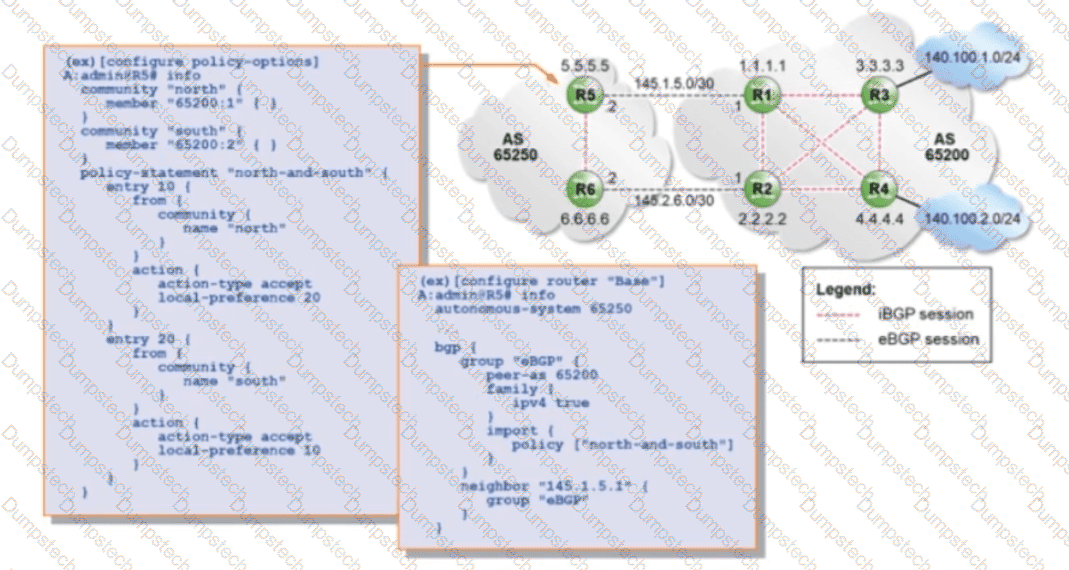
Question # 2

[ex][configure policy-options]

Options:

A.

admin@R5# info

community "north" {

member "65200:1" { }

}

community "south" {

member "65200:2" { }

}

policy-statement "north-and-south" {

entry 10 {

from {

community {

name "north"

}

}

action {

action-type accept

local-preference 20

}

}

entry 20 {

from {

community {

name "south"

}

}

action {

B.

The prefix is rejected.

C.

The prefix's local preference is set to 20.

D.

The prefix's community value is removed.

E.

The prefix's community value is modified to 65200:2.

Questions # 3:

Which statement about MP-BGP VPN-IPv4 route updates is TRUE?

Options:

A.

They are used to signal intra-region transport tunnels for VPRN services.

B.

They can be optionally used to improve the reliability and scalability of VPRN services.

C.

They allow PE routers hosting a VPRN service to share routing information from different customer sites.

D.

They allow PE routers hosting a VPRN service to exchange routing information with CE routers.

Questions # 4:

Which of the following is not a characteristic of LDP when ECMP is enabled?

Options:

A.

The number of entries in the LIB remains unchanged after ECMP is enabled.

B.

The number of the entries in the LFIB increases when there are multiple equal cost paths to the FEC.

C.

Hashing is used to select the egress label.

D.

A router advertises multiple labels for a FEC when there are multiple paths to the FEC.

Questions # 5:

An E-pipe has a configured service MTU of 5000. Which VC-MTU value will be derived?

Options:

A.

4078

B.

4986

C.

5014

D.

5022

Questions # 6:

Which of the following statements about the implementation of explicit null is TRUE?

Options:

A.

The penultimate router will forward packets to the eLER, based on the IP header.

B.

The eLER will receive packets with a top label value of 0.

C.

The eLER will receive packets with a top label value of 3.

D.

The penultimate router will pop the top label from the packets.

Questions # 7:

For a link-state routing protocol, which of the following statements regarding link-state updates is FALSE?

Options:

A.

When a link-state update reaches its maximum age on a router, the router will flood that update to its neighbors.

B.

When a router detects that a link-state update has reached its maximum age, it will request a new update from the source router.

C.

Aging helps ensure that routers that are no longer part of the topology will eventually get removed from the link-state database.

D.

The age value is updated as the link-state update is flooded throughout the network and when it is in the link-state database.

Questions # 8:

A traditional (non-EVPN) VPRN service uses MP-BGP and LDP transport tunnels. Which statement about the VPN service label is TRUE?

Options:

A.

The service label is advertised using LDP.

B.

The service label is prepended to the customer IPv4 prefixes.

C.

The service label must be manually configured for the VPRN on each PE router.

D.

The service label is carried in an MP-BGP VPN-IPv4 route update.

Questions # 9:

Which of the following statements regarding T-LDP is FALSE?

Options:

A.

Link-based and T-LDP sessions may be configured on the same LSR.

B.

T-LDP supports sessions between non-directly connected devices.

C.

T-LDP can be configured between directly connected devices.

D.

T-LDP Hello messages are sent to a multicast address.

Questions # 10:

What is the purpose of a T-LDP session?

Options:

A.

It allows link LDP to be configured on the edge devices only.

B.

It is used to signal the transport labels in the provider core.

C.

It allows selective control over which devices are configured for LDP.

D.

It is used to signal the service labels in the provider core.

Viewing page 1 out of 5 pages
Viewing questions 1-10 out of questions