
75only - Ends in 0d 00h 00m 00s - Coupon code = 75only

Pass the Oracle Database 19c 1z0-082 Questions and answers with Dumpstech

Exam 1z0-082 Premium Access

View all detail and faqs for the 1z0-082 exam

Practice at least 50% of the questions to maximize your chances of passing.
Viewing page 1 out of 5 pages
Viewing questions 1-10 out of questions
Questions # 1:

Which is the default column or columns for sorting output from compound queries using SET operators such as INTERSECT in a SQL statement?

Options:

A.

the first column in the first SELECT of the compound query

B.

the first VARCHAR2 column in the first SELECT of the compound query

C.

the first NUMBER column in the first SELECT of the compound query

D.

the first NUMBER or VARCHAR2 column in the last SELECT of the compound query

E.

the first column in the last SELECT of the compound query

Questions # 2:

A script abc.sql must be executed to perform a job.

A database user HR, who is defined in this database, executes this command:

$ sqlplus hr/hr@orcl @abc.sql

What will happen upon execution?

Options:

A.

The command succeeds and HR will be connected to the orcl and abc.sql databases

B.

The command succeeds and HR will be connected to the orcl database instance, and the abc.sql script will be executed

C.

The command fails because the script must refer to the full path name

D.

The command fails and reports an error because @ is used twice

Questions # 3:

In one of your databases, you create a user, HR, and then execute this command:

GRANT CREATE SESSION TO hr WITH ADMIN OPTION;

Which three actions can HR perform? (Choose three.)

Options:

A.

Revoke the CREATE SESSION privilege from other users

B.

Revoke the CREATE SESSION privilege from user HR

C.

Log in to the database instance

D.

Grant the CREATE SESSION privilege with ADMIN OPTION to other users

E.

Execute DDL statements in the HR schema

F.

Execute DML statements in the HR schema

Questions # 4:

Examine the description of the SALES table:
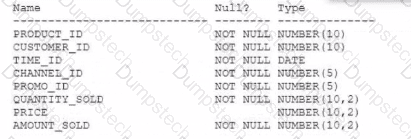
Question # 4

The SALES table has 55,000 rows.

Examine this statement:

Question # 4

Which two statements are true? (Choose two.)

Options:

A.

SALES1 has NOT NULL constraints on any selected columns which had those constraints in the SALES table.

B.

SALES1 has PRIMARY KEY and UNIQUE constraints on any selected columns which had those constraints in the SALES table.

C.

SALES1 is created with 55,000 rows.

D.

SALES1 is created with no rows.

E.

SALES1 is created with 1 row.

Questions # 5:

Which three statements are true about indexes and their administration in an Oracle database? (Choose three.)

Options:

A.

An index can be created as part of a CREATE TABLE statement.

B.

A DROP INDEX statement always prevents updates to the table during the drop operation.

C.

If a query filters on an indexed column, then the index will always be used during execution of the query.

D.

A descending index is a type of function-based index.

E.

An INVISIBLE index is not maintained when Data Manipulation Language (DML) is performed on its underlying table.

F.

A UNIQUE and non-unique index can be created on the same table column.

Questions # 6:

In the PROMOTIONS table, the PROMO_BEGIN_DATE column is of data type DATE and the default date format is DD-MON-RR.

Which two statements are true about expressions using PROMO_BEGIN_DATE contained in a query? (Choose two.)

Options:

A.

TO_NUMBER(promo_begin_date) - 5 will return a number.

B.

PROMO_BEGIN_DATE - SYSDATE will return a number.

C.

PROMO_BEGIN_DATE - SYSDATE will return an error.

D.

PROMO_BEGIN_DATE - 5 will return a date.

E.

TO_DATE(PROMO_BEGIN_DATE * 5) will return a date.

Questions # 7:

Which three statements are true about Deferred Segment Creation in Oracle databases? (Choose three.)

Options:

A.

It is supported for Index Organized Tables (IOTs) contained in locally managed tablespaces.

B.

Sessions may dynamically switch back and forth from deferred to immediate segment creation.

C.

It is the default behavior for tables and indexes.

D.

It is supported for SYS-owned tables contained in locally managed tablespaces.

E.

Indexes inherit the deferred or immediate segment creation attribute from their parent table.

Questions # 8:

In the SALES database, DEFERRED_SEGMENT_CREATION is TRUE.

Examine this command:

SQL > CREATE TABLE T1(c1 INT PRIMARY KEY, c2 CLOB);

Which segment or segments, if any, are created as a result of executing the command?

Options:

A.

T1, an index segment for the primary key, a LOB segment, and a lobindex segment

B.

no segments are created

C.

T1 only

D.

T1 and an index segment created for the primary key only

E.

T1, an index segment for the primary key, and a LOB segment only

Questions # 9:

Which three statements are true regarding single row subqueries? (Choose three.)

Options:

A.

They must be placed on the right side of the comparison operator or condition.

B.

They must be placed on the left side of the comparison operator or condition.

C.

They can be used in the WHERE clause.

D.

A SQL statement may have multiple single row subquery blocks.

E.

They must return a row to prevent errors in the SQL statement.

F.

They can be used in the HAVING clause.

Questions # 10:

Which three statements are true about Oracle synonyms? (Choose three.)

Options:

A.

A synonym cannot be created for a PL/SQL package

B.

A synonym can be available to all users

C.

A SEQUENCE can have a synonym

D.

A synonym created by one user can refer to an object belonging to another user

E.

Any user can drop a PUBLIC synonym

Viewing page 1 out of 5 pages
Viewing questions 1-10 out of questions