
Black Friday VIP Hour Limited Time 75% Discount Offer - Ends in 0d 00h 00m 00s - Coupon code = simple75
Pass the Paloalto Networks Network Security Administrator NetSec-Architect Questions and answers with Dumpstech
Exam NetSec-Architect Premium Access
View all detail and faqs for the NetSec-Architect exam
A global organization is upgrading its data-center and private-cloud infrastructure. The environment includes:
A Nutanix AHV cluster that hosts critical east-west application workloads
A VMware ESXi cluster with multi-socket hosts that supports high-throughput workloads ( > 10 Gbps)
A new pair of PA-5450 firewalls to secure the perimeter and perform encrypted-traffic inspection at scale
Strict performance service-level agreements (SLAs) for both north-south and east-west traffic, with substantial reliance on TLS 1.3 and IPSec
A Network Functions Virtualization (NFV) environment on KVM that provides high-performance security services to maximize packet throughput and minimize latency
The chief architect must ensure that the firewall design avoids hypervisor contention, optimizes non-uniform memory access (NUMA), and uses hardware features for encrypted traffic.
VM-Series on Nutanix AHV — Resource Allocation
Because the Nutanix cluster is already heavily utilized, the architect’s primary concern is preventing performance degradation of the virtual firewall. Thin provisioning or ballooning could add latency and unpredictability, which is unacceptable for a security-sensitive workload.
VM-Series on VMware ESXi — NUMA and vCPU Placement
In the VMware ESXi environment, the architect is deploying VM-Series for workloads exceeding 10 Gbps. Allocating vCPUs across NUMA nodes or oversubscribing cores would add latency through cross-socket memory access and scheduling delays. Likewise, dedicating logical hyperthreads does not deliver the deterministic data-plane performance required.
Operational Integration and High Availability
With performance assured through proper hypervisor and hardware provisioning, the architect also considers high availability (HA). VM-Series pairs are deployed in active/passive HA across Nutanix and VMware clusters, while PA-5450s provide the data center’s north-south secure perimeter deployment. This provides resilience without creating unnecessary east-west inspection bottlenecks.
The recommendation must be a scalable, high-performance firewall deployment that aligns with enterprise SLAs and the CISO’s encrypted-traffic concerns.
Which resource-allocation strategy should the architect use for the VM-Series virtual machine (VM)?
A global organization is securing critical applications during a cloud-based migration toward a cloud-first design. It is currently performing a brownfield migration of its most critical applications—such as CRM and product intellectual property/design systems—to Azure Cloud. The organization already operates an active/passive high-availability (HA) NGFW at its data center with multiple zones and has replicated that design in its existing Azure HA deployment.
The organization recognizes that it must modernize its security posture as critical workloads leave the data center and users connect from anywhere. Its security model follows a traditional “hard shell, soft center” approach:
Zero Trust gaps:
Current network segmentation is perimeter-based. The organization wants to extend Zero Trust principles across cloud and on-premises environments.
The network relies extensively on VLANs and IP address-based Access Control Lists (ACLs), segmented mainly by office location and broad departmental groups.
Once employees are on the corporate network (that is, inside the “perimeter”), they have relatively broad access.
If attackers compromise a single endpoint (for example, through a phishing email), they can easily move laterally and scan for high-value targets.
Cloud blind spots:
The organization uses Azure for its production environments and hosts applications containing sensitive customer data.
Cloud security controls are often managed separately from the on-premises network. Access is frequently granted through overly permissive identity and access management (IAM) roles and keys based on the resource, rather than the user’s real-time context or application health.
Remote user access:
Many remote users still hairpin through the corporate data center merely to access internet or SaaS resources, causing latency and inefficiency.
Traditional VPN is used for remote employees.
The VPN provides access to the entire internal network segment, making the remote endpoint the new, weaker perimeter. There is no continuous validation of the user’s device health after the initial connection.
Visibility and logging:
Logs are mainly stored on-premises and then forwarded to a local Security Information and Event Management (SIEM) solution. As applications migrate to Azure, visibility into cloud traffic and user behavior becomes fragmented.
Data security concern:
Sensitive data, including product design files, will now reside in SaaS and cloud environments. The organization requires data security to prevent leakage and enforce compliance.
Ingress security:
Third-party partners and suppliers need access into data-center and cloud applications, creating risk at ingress points.
The organization must ensure data security and prevent leakage of sensitive product design files as it migrates to SaaS and cloud environments.
How would implementing a Next-Generation CASB (CASB-X) capability address the concerns in the scenario?
For comprehensive profiling coverage, an IoT sensor should be deployed in the path between the IoT device and which infrastructure component?
An organization plans to migrate to an SSE model with Prisma Access for hybrid-workforce connectivity. After a bandwidth analysis, network engineers have identified a need for high-bandwidth sustained throughput ( > 2 Gbps) to the data center for privately hosted applications (for example, three-tier applications, active FTP and SMB file servers, and EDR toolsets).
The organization’s business-continuity requirements include using multiple cloud providers for private-application connectivity, so that an outage of any single cloud provider cannot disrupt operations. The network operations team has raised concerns about migrating to SSE because of legacy routing technical debt, noting that multiple redistribution protocols exist across the environment.
Which two network connectivity methods will meet the business requirements for accessing private applications from Prisma Access? (Choose two.)
An organization has a directive to adopt a Zero Trust framework centered on identity- and role-based access groups, device security, and content inspection across all Security policies. To meet this objective, it purchased an Enterprise License Agreement (ELA) that includes Advanced Threat Prevention, IoT Security, and GlobalProtect.
The current security architecture uses Panorama to manage 60 NGFWs—a mix of PA-3240, PA-1410, and PA-440 models. Sites with PA-3240s host private application resources in the trust data center zone. All sites have an untrust zone for internet access and a users zone for managed and unmanaged endpoint devices. A transit mesh zone provides site-to-site connectivity through PAN-OS SD-WAN.
Privately hosted applications include web servers, SMB and NFS file servers, and hosted Active Directory. The organization is adopting group-mapping restrictions for these private applications, with groups added daily. It also plans to build AI applications to assist data teams with complex queries, hosted in the large offices containing data centers, and is exploring public-cloud hosting.
The organization uses on-premises Exchange, Dropbox, Zoom, and ChatGPT. Several shadow SaaS applications require further investigation. Users have been uploading confidential files to Google Drive within the organization by using personal logins.
IoT devices on the network are associated with their own VLAN in the users zone. Using Device Security, all IoT devices have been categorized by asset profiles with medium or high confidence, policy sets have been imported into Panorama, and a default deny has been applied to the IoT networks.
The organization has deployed SSL decryption and uses URL categorization for most content filtering. Malicious categories, unknown websites, and high-risk websites are blocked, while the remaining sites are set to alert.
Which action should the architect recommend to restrict the confidential-file exfiltration present in the organization's environment by using existing technology?
An architect is evaluating a use case with these requirements:
Visibility into the health of an end user’s path for the five most critical applications
Metrics showing the effect of endpoint health on an application
Centralized call-quality analytics from the Zoom video-conferencing solution
Insights into supporting protocols, such as DNS
Support for 600 users on Windows desktops in one sales office
Which solution should be recommended to satisfy these requirements?
An organization is directed to adopt a Zero Trust framework focused on identity and role-based access groups, device security, and content inspection across all Security policies. To meet this objective, it purchased an Enterprise License Agreement (ELA) that includes Advanced Threat Prevention, IoT Security, and GlobalProtect.
The existing security architecture uses Panorama to manage 60 NGFWs—a mix of PA-3240, PA-1410, and PA-440 appliances. Sites with PA-3240s host private application resources in the trust data center zone. All sites have an untrust zone for internet access and a users zone for managed and unmanaged endpoint devices. A transit mesh zone is present to establish site-to-site connectivity through PAN-OS SD-WAN.
Privately hosted applications include web servers, SMB and NFS file servers, and hosted Active Directory. The organization is adopting group-mapping restrictions for these private applications, with groups added daily. It also plans to build AI applications to assist data teams with complex queries; these will be hosted in the large offices that contain data centers, and the organization is exploring hosting them in the public cloud.
The organization uses on-premises Exchange, Dropbox, Zoom, and ChatGPT. Several shadow SaaS applications require further investigation. Users have been using their personal Google Drive logins to upload confidential files within the organization.
IoT devices on the network are associated with their own VLAN in the users zone. Using Device Security, all IoT devices have been categorized by asset profiles with medium or high confidence, policy sets have been imported into Panorama, and a default deny has been applied to the IoT networks.
The organization has deployed SSL decryption and uses URL categorization for most content filtering. Malicious categories, unknown websites, and high-risk websites are blocked, while the remaining sites are set to alert.
Which deployment method should the architect recommend to enable User-ID-based rules, restrict or allow access as close to the source as possible, and minimize operational overhead?
The network security architect responsible for a Zero Trust migration has completed the identification and classification of all mission-critical Data, Applications, Assets, and Services (DAAS). The architect must now collect the required data to guide the technical design of the micro-perimeters and the placement of VM-Series virtual firewalls in Azure.
According to the Palo Alto Networks Zero Trust implementation methodology, what mandatory next step gathers the data needed to design the segmentation and position the security controls?
A multinational organization has a large, global population of remote users. This user population includes several persona types with different requirements and concerns about adopting a Zero Trust Network Access (ZTNA) solution.
Developers need to temporarily bypass security controls for business purposes, but the security team considers this a potential risk. Developers commonly access development servers on-premises in private data centers and in the public cloud. These development applications use web (HTTP/HTTPS), API, RPC, and SMB-based applications.
Sales staff travel frequently and connect to the network through many different connection types, but they are generally restricted to SaaS-based web applications. They often report performance issues when any agent is installed and want the capability to temporarily disable those agents. Data exfiltration and insider risk have been identified as the main threats for this user class.
Executives are concerned about being high-value targets. Security must remain consistent across multiple endpoint types, including mobile and desktop devices. Executive team members have stated that their main objective is for the solution to be responsive and easy to troubleshoot.
Which solution should be recommended to reduce the security risk and address the sales team's concerns?
An organization is building a cloud-first network infrastructure. The updated architecture includes Prisma Access, as shown in the diagram. The organization selected Strata Cloud Manager (SCM) to manage Prisma Access and NGFWs deployed in the data center and public-cloud environments. It has 150 NGFWs that terminate service connections, segment networks, and secure data-center and public-cloud resources.
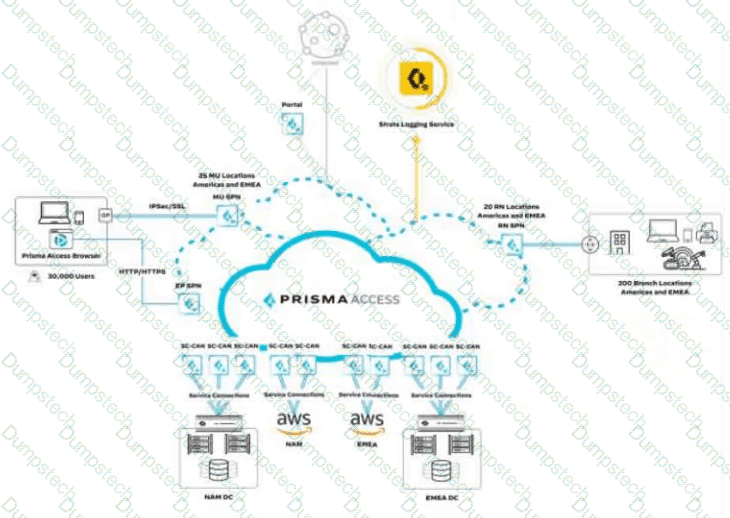
A resilience requirement is to provide highly available directory services and authentication for the NGFW and Prisma Access deployment.
Which traffic flow is valid for administrators connecting over SSH to network equipment hosted in the data center?
