
75only - Ends in 0d 00h 00m 00s - Coupon code = 75only
Pass the Salesforce Consultant Analytics-Con-201 Questions and answers with Dumpstech
A CRM Analytics administrator is working on deploying a dashboard and a dataset from a developer sandbox to a full sandbox. They have deployed the dataset via change set and manually copy-pasted the dashboard JSON into the target org. However, they notice that the conditional formatting and the widget-specific number formats have been lost in the target environment.
What is causing this issue?
CRM Analytics team plans to enable data sync.
Which limit specific to data syne should the team consider before enabling the feature because it may impact existing jobs?
Universal Containers (UC) has a "Sales Manager” dashboard. UC has a compare table that has multiple groupings and columns added showing the Total and Subtotals of the numeric values. A consultant is
asked to add additional groups to enhance details about UC's customers.
Which feature should the consultant use to make the navigation of the compare tables easier for the end user?
A new picklist value was added for the Category field on the Account object. This field is already added as part of the Account object data sync and the respective recipe that uses this field.
The CRM Analytics team reports that when they start the recipe it runs successfully with no errors or warnings, but theyare unable to See this new valueson their existing dashboards.
What is the oridi4 of this issue?
Universal Containers (UC) creates a dataset, "Book11", containing a budget per region per month for the first 6 months of the year, as shown in the graphic below. Now, UC wants to create a lens showing
the total budget for each region for each month. Every combination of region and month must be shown in the lens, even if there is no data.
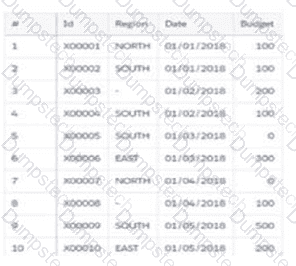
How should a CRM Analytics consultant help UC build this lens?
CRM Analytics users at Cloud Kicks are granted access to an app with specific dashboards. When trying to download a specific widget, they are unable to do so.
Universal Containers uses CRM Analytics to build dashboards for different departments: Sales, Service, and Marketing. Users in the samedepartment have the same role and need to have access to the same dashboards. Dashboards for different departments use some common datasets with the same row-level security.
How should a CRM Analytics consultant address this need?
Universal Containers (UC) recently activated data sync in the CRM Analytics data manager. After running the sync, UC notices that the aggregate sum of a field within the company's dataset is different
than what they manually calculated by summing the same data in the Salesforce object.
What is causing the issue with the newly synced data?
Universal Containers (UC) is rolling out CRM Analytics to its field sales that include dashboards withorder data from an external source.
UC has a well-defined role hierarchy where everyone is assigned to an appropriate node on the hierarchy. In addition, the order data has a reference to a Salesforce opportunity.
An individual sales rep should be able to view all orders that they own or as part of the account team or opportunity team. The sales manager should be able to view all orders for the entire sales team. Similarly, the VP of sales should be able to view orders for everyone who rolls up in that hierarchy.
The dataset has a field called Ownerld which represents the order owner.
Given this information, how should a CRM Analytics consultant implement the above requirements?
A CRM Analytics consultant at Cloud Kicks is trying to upload data using an External Data API and the CSV file with the data wasuploaded successfully. Upon analyzing the data using a lens, they find
they are unable to perform any mathematical operations as all the data and fields are treated as dimensions.
What is causing the problem?
