
Pre-Winter Sale Limited Time 75% Discount Offer - Ends in 0d 00h 00m 00s - Coupon code = simple75
Pass the Salesforce MuleSoft MuleSoft-Integration-Architect-I Questions and answers with Dumpstech
An organization is creating a set of new services that are critical for their business. The project team prefers using REST for all services but is willing to use SOAP with common WS-" standards if a particular service requires it.
What requirement would drive the team to use SOAP/WS-* for a particular service?
A DevOps team has adequate observability of individual system behavior and performance, but it struggles to track the entire lifecycle of each request across different microservices.
Which additional observability approach should this team consider adopting?
A company wants its users to log in to Anypoint Platform using the company's own internal user credentials. To achieve this, the company needs to integrate an external identity provider (IdP) with the company's Anypoint Platform master organization, but SAML 2.0 CANNOT be used. Besides SAML 2.0, what single-sign-on standard can the company use to integrate the IdP with their Anypoint Platform master organization?
A new upstream API Is being designed to offer an SLA of 500 ms median and 800 ms maximum (99th percentile) response time. The corresponding API implementation needs to sequentially invoke 3 downstream APIs of very similar complexity. The first of these downstream APIs offers the following SLA for its response time: median: 100 ms, 80th percentile: 500 ms, 95th percentile: 1000 ms. If possible, how can a timeout be set in the upstream API for the invocation of the first downstream API to meet the new upstream API's desired SLA?
An integration Mute application is being designed to process orders by submitting them to a backend system for offline processing. Each order will be received by the Mute application through an HTTPS POST and must be acknowledged immediately. Once acknowledged, the order will be submitted to a backend system. Orders that cannot be successfully submitted due to rejections from the backend system will need to be processed manually (outside the backend system).
The Mule application will be deployed to a customer-hosted runtime and is able to use an existing ActiveMQ broker if needed.
The backend system has a track record of unreliability both due to minor network connectivity issues and longer outages.
What idiomatic (used for their intended purposes) combination of Mule application components and ActiveMQ queues are required to ensure automatic submission of orders to the backend system, while minimizing manual order processing?
A travel company wants to publish a well-defined booking service API to be shared with its business partners. These business partners have agreed to ONLY consume SOAP services and they want to get the service contracts in an easily consumable way before they start any development. The travel company will publish the initial design documents to Anypoint Exchange, then share those documents with the business partners. When using an API-led approach, what is the first design document the travel company should deliver to its business partners?
An organization's security policies mandate complete control of the login credentials used to log in to Anypoint Platform. What feature of Anypoint Platform should be used to meet this requirement?
A leading eCommerce giant will use MuleSoft APIs on Runtime Fabric (RTF) to process customer orders. Some customer-sensitive information, such as credit card information, is required in request payloads or is included in response payloads in some of the APIs. Other API requests and responses are not authorized to access some of this customer-sensitive information but have been implemented to validate and transform based on the structure and format of this customer-sensitive information (such as account IDs, phone numbers, and postal codes).
What approach configures an API gateway to hide sensitive data exchanged between API consumers and API implementations, but can convert tokenized fields back to their original value for other API requests or responses, without having to recode the API implementations?
Later, the project team requires all API specifications to be augmented with an additional non-functional requirement (NFR) to protect the backend services from a high rate of requests, according to defined service-level
agreements (SLAs). The NFR's SLAs are based on a new tiered subscription level "Gold", "Silver", or "Platinum" that must be tied to a new parameter that is being added to the Accounts object in their enterprise data model.
Following MuleSoft's recommended best practices, how should the project team now convey the necessary non-functional requirement to stakeholders?
An XA transaction Is being configured that involves a JMS connector listening for Incoming JMS messages. What is the meaning of the timeout attribute of the XA transaction, and what happens after the timeout expires?
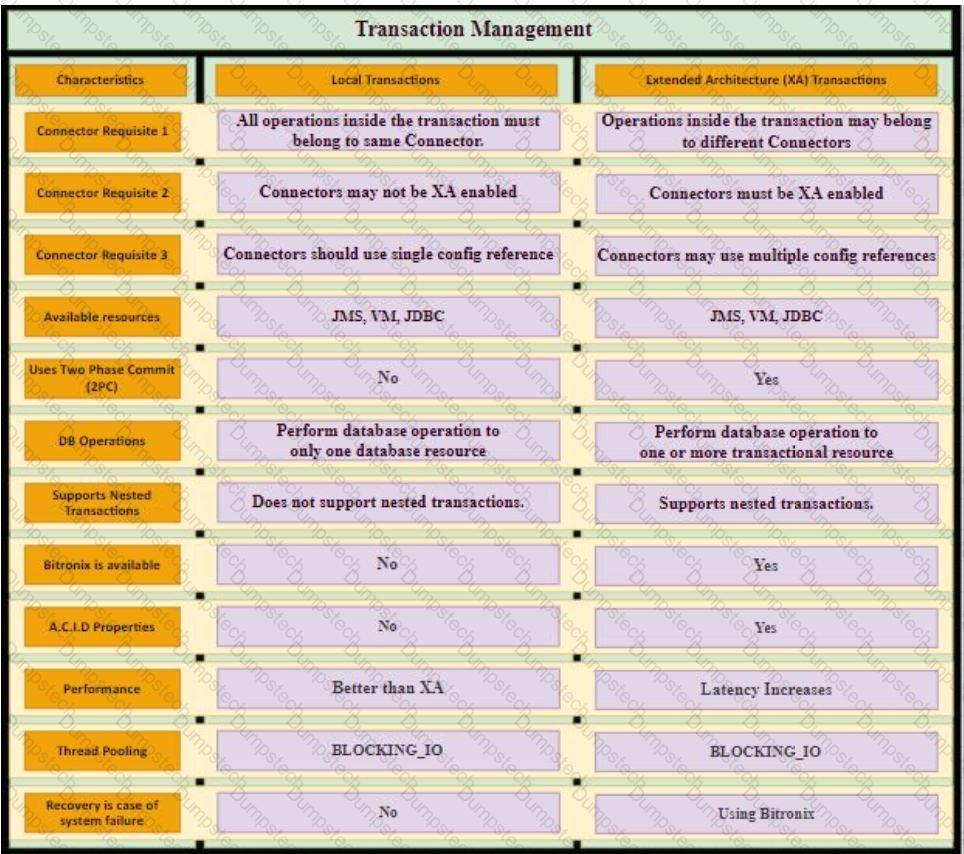 Graphical user interface, table Description automatically generated with medium confidence
An insurance provider is implementing Anypoint platform to manage its application infrastructure and is using the customer hosted runtime for its business due to certain financial requirements it must meet. It has built a number of synchronous API's and is currently hosting these on a mule runtime on one server
These applications make use of a number of components including heavy use of object stores and VM queues.
Business has grown rapidly in the last year and the insurance provider is starting to receive reports of reliability issues from its applications.
The DevOps team indicates that the API's are currently handling too many requests and this is over loading the server. The team has also mentioned that there is a significant downtime when the server is down for maintenance.
As an integration architect, which option would you suggest to mitigate these issues?
