
Pre-Winter Sale Limited Time 75% Discount Offer - Ends in 0d 00h 00m 00s - Coupon code = simple75
Pass the Snowflake SnowPro Advanced: Architect ARA-C01 Questions and answers with Dumpstech
An Architect on a new project has been asked to design an architecture that meets Snowflake security, compliance, and governance requirements as follows:
1) Use Tri-Secret Secure in Snowflake
2) Share some information stored in a view with another Snowflake customer
3) Hide portions of sensitive information from some columns
4) Use zero-copy cloning to refresh the non-production environment from the production environment
To meet these requirements, which design elements must be implemented? (Choose three.)
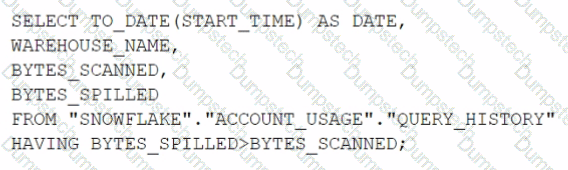
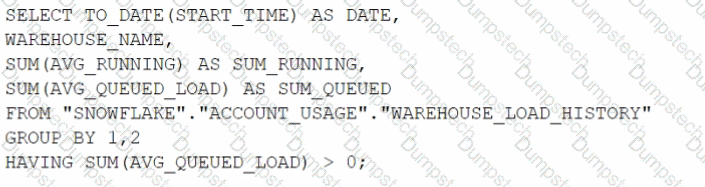
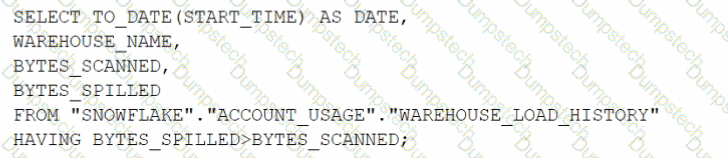
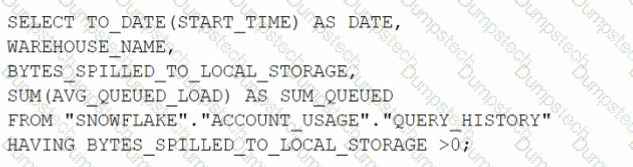
Which query will identify the specific days and virtual warehouses that would benefit from a multi-cluster warehouse to improve the performance of a particular workload?
A)
B)
C)
D)
A company is designing high availability and disaster recovery plans and needs to maximize redundancy and minimize recovery time objectives for their critical application processes. Cost is not a concern as long as the solution is the best available. The plan so far consists of the following steps:
1. Deployment of Snowflake accounts on two different cloud providers.
2. Selection of cloud provider regions that are geographically far apart.
3. The Snowflake deployment will replicate the databases and account data between both cloud provider accounts.
4. Implementation of Snowflake client redirect.
What is the MOST cost-effective way to provide the HIGHEST uptime and LEAST application disruption if there is a service event?
A table for IOT devices that measures water usage is created. The table quickly becomes large and contains more than 2 billion rows.
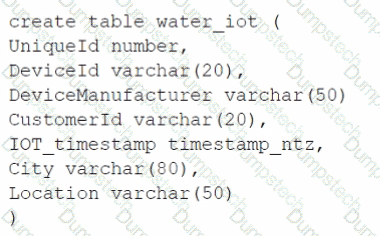
The general query patterns for the table are:
1. DeviceId, lOT_timestamp and Customerld are frequently used in the filter predicate for the select statement
2. The columns City and DeviceManuf acturer are often retrieved
3. There is often a count on Uniqueld
Which field(s) should be used for the clustering key?
An Architect entered the following commands in sequence:

USER1 cannot find the table.
Which of the following commands does the Architect need to run for USER1 to find the tables using the Principle of Least Privilege? (Choose two.)
A user has the appropriate privilege to see unmasked data in a column.
If the user loads this column data into another column that does not have a masking policy, what will occur?
An Architect executes the following statements in order:
CREATE TABLE emp (id INTEGER);
INSERT INTO emp VALUES (1),(2);
CREATE TEMPORARY TABLE emp (id INTEGER);
INSERT INTO emp VALUES (1);
Then executes:
SELECT COUNT(*) FROM emp;
DROP TABLE emp;
SELECT COUNT(*) FROM emp;
What will be the result?
An Architect clones a database and all of its objects, including tasks. After the cloning, the tasks stop running.
Why is this occurring?
A retail company has 2000+ stores spread across the country. Store Managers report that they are having trouble running key reports related to inventory management, sales targets, payroll, and staffing during business hours. The Managers report that performance is poor and time-outs occur frequently.
Currently all reports share the same Snowflake virtual warehouse.
How should this situation be addressed? (Select TWO).
A table, EMP_ TBL has three records as shown:
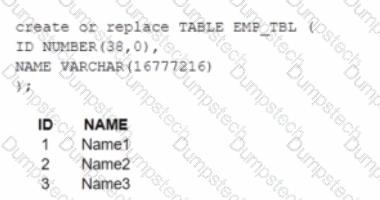
The following variables are set for the session:

Which SELECT statements will retrieve all three records? (Select TWO).
