
Summer Sale Limited Time 75% Discount Offer - Ends in 0d 00h 00m 00s - Coupon code = simple75

Pass the Splunk Enterprise Certified Admin SPLK-1003 Questions and answers with Dumpstech

Exam SPLK-1003 Premium Access

View all detail and faqs for the SPLK-1003 exam

Practice at least 50% of the questions to maximize your chances of passing.
Viewing page 6 out of 7 pages
Viewing questions 51-60 out of questions
Questions # 51:

All search-time field extractions should be specified on which Splunk component?

Options:

A.

Deployment server

B.

Universal forwarder

C.

Indexer

D.

Search head

Questions # 52:

Which valid bucket types are searchable? (select all that apply)

Options:

A.

Hot buckets

B.

Cold buckets

C.

Warm buckets

D.

Frozen buckets

Questions # 53:

What is the correct curl to send multiple events through HTTP Event Collector?

Options:

A.

Option A

B.

Option B

C.

Option C

D.

Option D

Questions # 54:

When enabling data integrity control, where does Splunk Enterprise store the hash files for each bucket?

Options:

A.

Splunk Enterprise stores hash files in the logdata directory of the corresponding bucket.

B.

Splunk Enterprise stores hash files in the rawdata directory of the corresponding bucket.

C.

Splunk Enterprise stores hash files in the hashdata directory of the corresponding bucket.

D.

Splunk Enterprise stores hash files in the metadata directory of the corresponding bucket.

Questions # 55:

In which scenario would a Splunk Administrator want to enable data integrity check when creating an index?

Options:

A.

To ensure that hot buckets are still open for writes and have not been forced to roll to a cold state

B.

To ensure that configuration files have not been tampered with for auditing and/or legal purposes

C.

To ensure that user passwords have not been tampered with for auditing and/or legal purposes.

D.

To ensure that data has not been tampered with for auditing and/or legal purposes

Questions # 56:

Which of the following are supported options when configuring optional network inputs?

Options:

A.

Metadata override, sender filtering options, network input queues (quantum queues)

B.

Metadata override, sender filtering options, network input queues (memory/persistent queues)

C.

Filename override, sender filtering options, network output queues (memory/persistent queues)

D.

Metadata override, receiver filtering options, network input queues (memory/persistent queues)

Questions # 57:

An add-on has configured field aliases for source IP address and destination IP address fields. A specific user prefers not to have those fields present in their user context. Based on the defaultprops.confbelow, whichSPLUNK_HOME/etc/users/buttercup/myTA/local/props.confstanza can be added to the user’s local context to disable the field aliases?

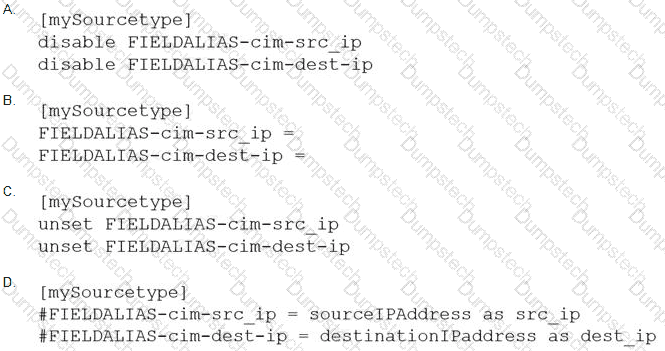
Question # 57

Question # 57

Options:

A.

Option A

B.

Option B

C.

Option C

D.

Option D

Questions # 58:

Which of the following Splunk components require a separate installation package?

Options:

A.

Deployment server

B.

License master

C.

Universal forwarder

D.

Heavy forwarder

Questions # 59:

A security team needs to ingest a static file for a specific incident. The log file has not been collected previously and future updates to the file must not be indexed.

Which command would meet these needs?

Options:

A.

splunk add one shot / opt/ incident [data .log —index incident

B.

splunk edit monitor /opt/incident/data.* —index incident

C.

splunk add monitor /opt/incident/data.log —index incident

D.

splunk edit oneshot [opt/ incident/data.* —index incident

Questions # 60:

What is the valid option for a [monitor] stanza in inputs.conf?

Options:

A.

enabled

B.

datasource

C.

server_name

D.

ignoreOlderThan

Viewing page 6 out of 7 pages
Viewing questions 51-60 out of questions