
Black Friday VIP Hour Limited Time 75% Discount Offer - Ends in 0d 00h 00m 00s - Coupon code = simple75

Pass the UiPath Certified Professional - Agentic Automation Track UiPath-AAPv1 Questions and answers with Dumpstech

Exam UiPath-AAPv1 Premium Access

View all detail and faqs for the UiPath-AAPv1 exam

Practice at least 50% of the questions to maximize your chances of passing.
Viewing page 3 out of 4 pages
Viewing questions 21-30 out of questions
Questions # 21:

What approach is recommended when designing evaluations for agents with strictly defined, deterministic output requirements?

Options:

A.

Trajectory evaluators are best suited for deterministic outputs as they assess run history and behavioral patterns for exact matching.

B.

Use the LLM-as-a-Judge evaluator by default because of its ability to adapt to deterministic output requirements in addition to flexible outputs.

C.

Use any evaluator type interchangeably, as all evaluators produce equally reliable results for deterministic outputs.

D.

Use Exact match or JSON similarity evaluators for highly structured outputs, such as exact strings, numerical values, Boolean responses, or arrays of primitives.

Questions # 22:

An organization is designing a customer-facing service agent using the agent story blueprint format.

To align with UiPath agent components, which story structure best reflects proper instruction and interaction design?

Options:

A.

Specify the agent department and reporting line, define desired customer outcomes, reference historical feedback as context, integrate chat interfaces, and measure performance using satisfaction surveys alone.

B.

Specify the agent role and operating environment, define explicit behavioral instructions in the prompt, identify relevant contextual sources, integrate appropriate tools, and define measurable success criteria with escalation paths.

C.

Specify the automation goal and system owner, define high-level service objectives, reference general organizational policies as context, integrate notification channels, and measure performance using system uptime metrics.

D.

Specify the process category and compliance scope, define expected efficiency targets, reference archived cases as context, integrate analytics dashboards, and measure performance using quarterly audit reviews.

Questions # 23:

A team wants an agent to be selectable in the Run Job activity within Studio Web workflows.

Which lifecycle step best makes it available?

Options:

A.

Observe the agent after it is tested, evaluated, and refined for intended behavior

B.

Simulate the agent after it is tested, evaluated, and refined for intended behavior

C.

Publish the agent after it is tested, evaluated, and refined for intended behavior

D.

Debug the agent after it is tested, evaluated, and refined for intended behavior

Questions # 24:

When integrating UiPath Data Fabric with event-driven automation, which action causes the connector to generate an event?

Options:

A.

Exporting entity data from Data Fabric to an external system.

B.

Opening the Data Fabric entity configuration in the Admin section.

C.

Assigning user permissions to the Data Fabric entity.

D.

Creating or updating a record in the Data Fabric entity.

Questions # 25:

Given the following BPMN for the "SME to review the discrepancies" task, which option should be selected in the "Action" dropdown?
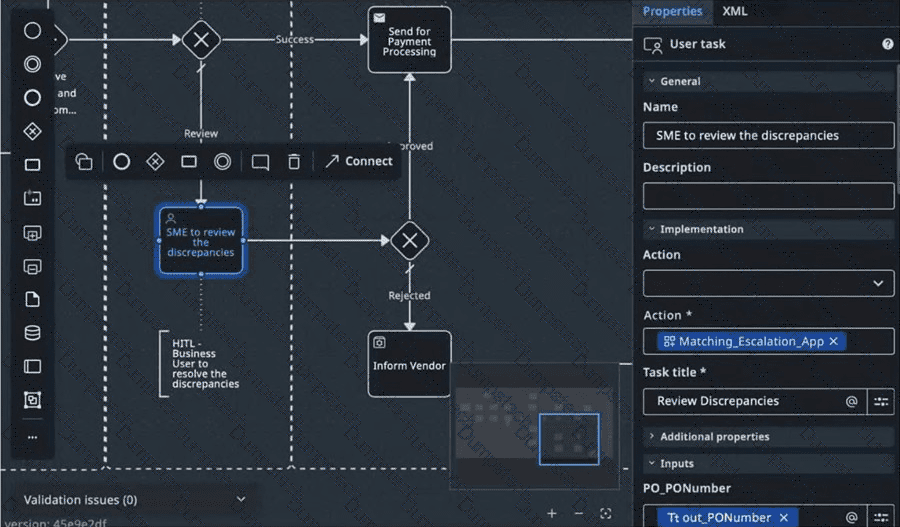
Question # 25

Original exhibit — Question 56

Options:

A.

Create action app task

B.

Create validation app task

C.

Create and wait for action app task

D.

Create and wait for validation app task

Questions # 26:

In a UiPath Maestro process with multiple active instances running concurrently, what happens to global variables when one instance updates a global variable's value?

Options:

A.

Global variables become read-only after the first instance sets a value, preventing further modifications

B.

The updated value becomes immediately visible and usable by all other running instances of the same process

C.

The value change is queued and only applied to new instances started after the update occurs

D.

The update is isolated to the instance that performed it and does not affect other concurrent instances

Questions # 27:

How do execution traces help identify the root cause of failed evaluations?

Options:

A.

By showing detailed agent actions and tool interactions during the run.

B.

By summarizing evaluation results into a single score for easy comparison.

C.

By suggesting modifications to evaluator criteria automatically.

D.

By aggregating failed evaluations into a new evaluation set for review.

Questions # 28:

What must be configured to create an Automation Ops policy for a specific tenant?

Options:

A.

Policy name, Priority, Roles

B.

Policy name, Description, Roles

C.

Policy name, Priority, Description

D.

Policy name, Description, Period

Questions # 29:

In an agent run’s trace view, what information does hovering over a node typically reveal?

Options:

A.

The agent's role and prompt structure

B.

The agent's feedback score and retry count

C.

The agent's memory usage and model type

D.

Execution status, timestamps, and input/output previews

Questions # 30:

When writing effective prompts for agents, what should always be included to help ensure reliable performance?

Options:

A.

Multiple example responses for each possible user input scenario.

B.

Detailed explanations of the business context for every argument.

C.

A clear role definition, task breakdown, reasoning instructions, and output formatting.

D.

Separate prompts for each reasoning step to simplify task execution.

Viewing page 3 out of 4 pages
Viewing questions 21-30 out of questions