New Year Sale Limited Time 70% Discount Offer - Ends in 0d 00h 00m 00s - Coupon code = simple70

Salesforce MuleSoft-Platform-Architect-I - Salesforce Certified MuleSoft Platform Architect (Mule-Arch-201)

Last Update Dec 22, 2025

Salesforce Certification Exams Pack

Everything from Basic, plus:
  • Exam Name: Salesforce Certified MuleSoft Platform Architect (Mule-Arch-201)
  • 152 Questions Answers with Explanation Detail
  • Total Questions: 152 Q&A's
  • Single Choice Questions: 147 Q&A's
  • Multiple Choice Questions: 5 Q&A's


Online Learning
$28.5 $94.99 70% OFF
Add to Cart Free Practice
530

Students Passed

86%

Average Score

96%

Questions came word for word

10+

Years Teaching

Related Exams

Explore other related Salesforce exams to broaden your certification path. These certifications complement your skills and open new opportunities for career growth.

Want to bag your dream Salesforce Certified MuleSoft Platform Architect (Mule-Arch-201) (MuleSoft-Platform-Architect-I) Certification Exam?

Know how you can make it happen

If you're looking to secure Salesforce MuleSoft (MuleSoft-Platform-Architect-I) certification, remember there's no royal path to it. It's your prep for this exam that can make the difference. Stay away from those low-quality exam PDFs and unreliable dumps that have no credibility.

An innovative prep system that never fails

To save you from frustration, Dumpstech comes with a comprehensive prep system that is clear, effective, and built to help you succeed without the least chance of failure.

It's overwhelmingly recommended by thousands of Dumpstech's loyal customers as practical, relevant and intuitively crafted to match the candidates' actual exam needs.

Real exam questions with verified answers

Dumpstech's Salesforce exam MuleSoft-Platform-Architect-I questions are designed to deliver you the essence of the entire syllabus. Each question mirrors the real exam format and comes with an accurate and verified answer. Dumpstech's prep system is not mere cramming; it is crafted to add real information and impart deep conceptual understanding to the exam candidates.

Realistic Mock Tests

Dumpstech's smart testing engine generates multiple mock tests to develop familiarity with the real exam format and learn thoroughly the most significant from the perspective of Salesforce MuleSoft-Platform-Architect-I real exam. They also support you to revise the syllabus and enhance your efficiency to answer all exam questions within the time limit.

Kickstart your prep with the most trusted resource!

Dumpstech offers you the most authentic, accurate, and current information that liberates you from the hassle of searching for any other study resource. This comprehensive resource equips you perfectly to develop confidence and clarity to answer exam queries.

Dumpstech's support for your exam success

  •  Complete Salesforce MuleSoft-Platform-Architect-I Question Bank
  •  Single-page exam view for faster study
  •  Download or print the PDF and prep offline
  •  Zero Captchas. Zero distractions. Just uninterrupted prep
  •  24/7 customer online support

100% Risk Coverage

Dumpstech's authentic and up-to-date content guarantees you success in the Salesforce Certified MuleSoft Platform Architect (Mule-Arch-201) certification exam. If you perchance you lose your exam despite your reliance on Dumpstech's exam questions PDF, Dumpstech doesn't leave you alone. You have the option of taking back refund of your money or try a different exam paying no additional amount.

Begin your Dumpstech journey: A Step-by-step Guide

  •  Create your account with Dumpstech
  •  Select Salesforce Certified MuleSoft Platform Architect (Mule-Arch-201) (MuleSoft-Platform-Architect-I) Exam
  •  Download Free Demo PDF
  •  Examine and compare the content with other study resources
  •  Go through the feedback of our successful clients
  •  Start your prep with confidence and win your dream cert

If you want to crack the Salesforce Certified MuleSoft Platform Architect (Mule-Arch-201) (MuleSoft-Platform-Architect-I) exam in one go, your journey starts here. Dumpstech is your real ally that gets you certified fast with the least possibility of losing your chance.

Total Questions: 152
Free Practice Questions: 44

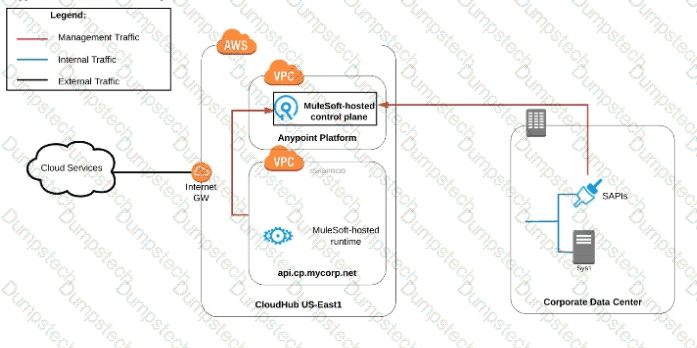
An organization uses various cloud-based SaaS systems and multiple on-premises systems. The on-premises systems are an important part of the organization's application network and can only be accessed from within the organization's intranet.

What is the best way to configure and use Anypoint Platform to support integrations with both the cloud-based SaaS systems and on-premises systems?

A) Use CloudHub-deployed Mule runtimes in an Anypoint VPC managed by Anypoint Platform Private Cloud Edition control plane

B) Use CloudHub-deployed Mule runtimes in the shared worker cloud managed by the MuleSoft-hosted Anypoint Platform control plane

C) Use an on-premises installation of Mule runtimes that are completely isolated with NO external network access, managed by the Anypoint Platform Private Cloud Edition control plane

D) Use a combination of Cloud Hub-deployed and manually provisioned on-premises Mule runtimes managed by the MuleSoft-hosted Anypoint Platform control plane

Question # 1

Options:

A.

Option A

B.

Option B

C.

Option C

D.

Option D

Answer
B
Explanation

Explanation

Correct Answer: Use a combination of CloudHub-deployed and manually provisioned on-premises Mule runtimes managed by the MuleSoft-hosted Platform control plane.

*****************************************

Key details to be taken from the given scenario:

>> Organization uses BOTH cloud-based and on-premises systems

>> On-premises systems can only be accessed from within the organization's intranet

Let us evaluate the given choices based on above key details:

>> CloudHub-deployed Mule runtimes can ONLY be controlled using MuleSoft-hosted control plane. We CANNOT use Private Cloud Edition's control plane to control CloudHub Mule Runtimes. So, option suggesting this is INVALID

>> Using CloudHub-deployed Mule runtimes in the shared worker cloud managed by the MuleSoft-hosted Anypoint Platform is completely IRRELEVANT to given scenario and silly choice. So, option suggesting this is INVALID

>> Using an on-premises installation of Mule runtimes that are completely isolated with NO external network access, managed by the Anypoint Platform Private Cloud Edition control plane would work for On-premises integrations. However, with NO external access, integrations cannot be done to SaaS-based apps. Moreover CloudHub-hosted apps are best-fit for integrating with SaaS-based applications. So, option suggesting this is BEST WAY.

The best way to configure and use Anypoint Platform to support these mixed/hybrid integrations is to use a combination of CloudHub-deployed and manually provisioned on-premises Mule runtimes managed by the MuleSoft-hosted Platform control plane.

Which component monitors APIs and endpoints at scheduled intervals, receives reports about whether tests pass or fail, and displays statistics about API and endpoint

performance?

Options:

A.

API Analytics

B.

Anypoint Monitoring dashboards

C.

APT Functional Monitoring

D.

Anypoint Runtime Manager alerts

Answer
C
Explanation

    Understanding API Functional Monitoring:

      API Functional Monitoring is a feature within MuleSoft's Anypoint Platform that enables users to monitor the health and performance of APIs and endpoints by running functional tests at scheduled intervals.

      It checks whether APIs are functioning as expected by running test calls and then evaluating if the response meets the desired conditions. This is particularly useful for testing endpoint availability, checking for specific data in responses, and measuring API performance over time.

    Component Features:

      Scheduled Intervals: Functional monitoring allows configuring tests to run at regular intervals, such as every minute, hour, or day, depending on the monitoring requirements.

      Reports on Test Pass/Fail Status: After each test run, API Functional Monitoring reports whether the API passed or failed the test conditions.

      Performance Statistics: It displays metrics like average response time, success rate, and error rates, giving insights into API health and performance.

    Evaluating the Options:

      Option A (API Analytics): API Analytics provides insights on API usage and metrics but does not involve scheduled tests for pass/fail status or endpoint health checks.

      Option B (Anypoint Monitoring Dashboards): These dashboards display API metrics but do not actively test API endpoints or provide pass/fail reporting on a scheduled basis.

      Option C (Correct Answer): API Functional Monitoring fits the description, as it is designed to monitor API and endpoint health with scheduled test runs and display statistics about performance.

      Option D (Anypoint Runtime Manager Alerts): Runtime Manager alerts notify users of issues with application status but do not actively test endpoints at scheduled intervals.

    Conclusion:

      Option C (API Functional Monitoring) is the correct answer because it provides the necessary tools to test API functionality, monitor endpoint health, and display performance statistics in real-time.

Refer to MuleSoft documentation on API Functional Monitoring for further guidance on setting up and configuring these tests in Anypoint Platform.

A large lending company has developed an API to unlock data from a database server and web server. The API has been deployed to Anypoint Virtual Private Cloud

(VPC) on CloudHub 1.0.

The database server and web server are in the customer's secure network and are not accessible through the public internet. The database server is in the customer's AWS

VPC, whereas the web server is in the customer's on-premises corporate data center.

How can access be enabled for the API to connect with the database server and the web server?

Options:

A.

Set up VPC peering with AWS VPC and a VPN tunnel to the customer's on-premises corporate data center

B.

Set up VPC peering with AWS VPC and the customer's on-premises corporate data center

C.

Setup a transit gateway to the customer's on-premises corporate data center through AWS VPC

D.

Set up VPC peering with the customer's on-premises corporate data center and a VPN tunnel to AWS VPC

Answer
A
Explanation

    Scenario Overview:

      The API resides in Anypoint Virtual Private Cloud (VPC) on CloudHub 1.0, where it requires connectivity to both an AWS-hosted database server and an on-premises web server.

      Both servers are isolated from the public internet: the database server is within the customer’s AWS VPC, and the web server is within the customer's on-premises corporate data center.

    Connectivity Requirements:

      To connect to the AWS database server from the API in Anypoint VPC, VPC peering is ideal. This would allow a private network connection between the MuleSoft Anypoint VPC and the customer’s AWS VPC, enabling secure, direct access to the database.

      To connect to the on-premises web server, a VPN tunnel is suitable. This would establish a secure, encrypted connection from the Anypoint VPC to the customer’s corporate data center, allowing secure data flow between the API and the on-premises web server.

    Analysis of Options:

      Option A (Correct Answer): Setting up VPC peering with AWS VPC enables private network connectivity with the database server, while a VPN tunnel to the on-premises data center allows secure access to the web server. This combination meets the requirements for secure, controlled access to both resources.

      Option B: VPC peering alone would not suffice because it does not support a connection from the Anypoint VPC directly to an on-premises network. A VPN is necessary for on-premises access.

      Option C: Setting up a transit gateway would provide connectivity within AWS but would not enable direct connectivity from CloudHub to the on-premises network.

      Option D: VPC peering with the on-premises network is not possible because VPC peering is typically used to connect two VPCs, not a VPC with an on-premises network.

    Conclusion:

      Option A is the correct choice, as it provides a complete solution by using VPC peering for AWS VPC connectivity and a VPN tunnel for secure on-premises connectivity. This setup aligns with Anypoint Platform best practices for connecting Anypoint VPCs to both AWS-hosted and on-premises systems, ensuring secure, controlled access to both the database and web server.

For more detailed reference, MuleSoft documentation on Anypoint VPC peering and VPN connectivity provides additional context on best practices for setting up these connections within a hybrid network infrastructure.

Candidate Reviews

See how DumpsTech helps candidates pass with confidence.

4.8
1,247 reviews

New Releases Exams

Stay ahead in your career with the latest certification exams from leading vendors. DumpsTech brings you newly released exams with reliable study resources to help you prepare confidently.

Salesforce MuleSoft-Platform-Architect-I FAQ'S

Find answers to the most common questions about the Salesforce MuleSoft-Platform-Architect-I exam, including what it is, how to prepare, and how it can boost your career.

The Salesforce MuleSoft-Platform-Architect-I certification is a globally-acknowledged credential that is awarded to candidates who pass this certification exam by obtaining the required passing score. This credential attests and validates the candidates' knowledge and hands-on skills in domains covered in the Salesforce MuleSoft-Platform-Architect-I certification syllabus. The Salesforce MuleSoft-Platform-Architect-I certified professionals with their verified proficiency and expertise are trusted and welcomed by hiring managers all over the world to perform leading roles in organizations. The success in Salesforce MuleSoft-Platform-Architect-I certification exam can be ensured only with a combination of clear knowledge on all exam domains and securing the required practical training. Like any other credential, Salesforce MuleSoft-Platform-Architect-I certification may require periodic renewal to stay current with new innovations in the concerned domains.

The Salesforce MuleSoft-Platform-Architect-I is a valuable career booster that levels up your profile with the distinction of validated competency awarded by a renowned organization. Often rated as a dream cert by several ambitious professionals, the Salesforce MuleSoft-Platform-Architect-I certification ensures you an immensely rewarding career trajectory. With this cert, you fulfill the eligibility criterion for advance level certifications and build an outstanding career pyramid. With the tangible proof of your expertise, the Salesforce MuleSoft-Platform-Architect-I certification provide you with new job opportunities or promotions and enhance your regular income.

Passing the Salesforce Certified MuleSoft Platform Architect (Mule-Arch-201) (MuleSoft-Platform-Architect-I) requires a comprehensive study plan that includes understanding the exam objectives and finding a study resource that can provide you verified and up-to-date information on all the domains covered in your syllabus. The next step should be practicing the exam format, know the types of questions and learning time management for the successful completion of your test within the given time. Download practice exams and solve them to strengthen your grasp on actual exam format. Rely only on resources that are recommended by others for their credible and updated information. Dumpstech's extensive clientele network is the mark of credibility and authenticity of its products that promise a guaranteed exam success.

In today's competitive world, the Salesforce MuleSoft-Platform-Architect-I certification is a ladder of success and a means of distinguishing your expertise over the non-certified peers. In addition to this, the Salesforce MuleSoft-Platform-Architect-I certified professionals enjoy more credibility and visibility in the job market for their candidature. This distinction accelerates career growth allowing the certified professionals to secure their dream job roles in enterprises of their choice. This industry-recognized credential is always attractive to employers and the professionals having it are paid well with an instant 15-20% increase in salaries. These are the reasons that make Salesforce MuleSoft-Platform-Architect-I certification a trending credential worldwide.