Spring Sale Limited Time 70% Discount Offer - Ends in 0d 00h 00m 00s - Coupon code = simple70

Pass the Amazon Web Services AWS Certified Associate MLA-C01 Questions and answers with Dumpstech

Exam MLA-C01 Premium Access

View all detail and faqs for the MLA-C01 exam

Practice at least 50% of the questions to maximize your chances of passing.
Viewing page 7 out of 8 pages
Viewing questions 61-70 out of questions
Questions # 61:

A government agency is conducting a national census to assess program needs by area and city. The census form collects approximately 500 responses from each citizen. The agency needs to analyze the data to extract meaningful insights. The agency wants to reduce the dimensions of the high-dimensional data to uncover hidden patterns.

Which solution will meet these requirements?

Options:

A.

Use the principal component analysis (PCA) algorithm in Amazon SageMaker AI.

B.

Use the t-Distributed Stochastic Neighbor Embedding (t-SNE) algorithm in Amazon SageMaker AI.

C.

Use the k-means algorithm in Amazon SageMaker AI.

D.

Use the Random Cut Forest (RCF) algorithm in Amazon SageMaker AI.

Questions # 62:

An ML engineer needs to deploy ML models to get inferences from large datasets in an asynchronous manner. The ML engineer also needs to implement scheduled monitoring of the data quality of the models. The ML engineer must receive alerts when changes in data quality occur.

Which solution will meet these requirements?

Options:

A.

Deploy the models by using scheduled AWS Glue jobs. Use Amazon CloudWatch alarms to monitor the data quality and to send alerts.

B.

Deploy the models by using scheduled AWS Batch jobs. Use AWS CloudTrail to monitor the data quality and to send alerts.

C.

Deploy the models by using Amazon Elastic Container Service (Amazon ECS) on AWS Fargate. Use Amazon EventBridge to monitor the data quality and to send alerts.

D.

Deploy the models by using Amazon SageMaker AI batch transform. Use SageMaker Model Monitor to monitor the data quality and to send alerts.

Questions # 63:

An ML engineer needs to deploy ML models to get inferences from large datasets in an asynchronous manner. The ML engineer also needs to implement scheduled monitoring of the data quality of the models. The ML engineer must receive alerts when changes in data quality occur.

Which solution will meet these requirements?

Options:

A.

Deploy the models by using scheduled AWS Glue jobs. Use Amazon CloudWatch alarms to monitor the data quality and to send alerts.

B.

Deploy the models by using scheduled AWS Batch jobs. Use AWS CloudTrail to monitor the data quality and to send alerts.

C.

Deploy the models by using Amazon Elastic Container Service (Amazon ECS) on AWS Fargate. Use Amazon EventBridge to monitor the data quality and to send alerts.

D.

Deploy the models by using Amazon SageMaker AI batch transform. Use SageMaker Model Monitor to monitor the data quality and to send alerts.

Questions # 64:

An ML engineer is analyzing potential biases in a customer dataset before training an ML model. The dataset contains customer age (numeric), product reviews (text), and purchase outcomes (categorical).

Which statistical metrics should the ML engineer use to identify potential biases in the dataset before model training?

Options:

A.

Calculate the statistical mean and standard deviation of customer age distribution. Count word frequencies in product reviews.

B.

Calculate the class imbalance metric of purchase outcomes. Use product reviews to check sentiment distribution to capture bias.

C.

Calculate the class imbalance metric of purchase outcomes and the difference in proportions of labels (DPL) across customer age groups.

D.

Calculate the correlation coefficient between customer age and purchase outcomes. Calculate unique word counts in product reviews.

Questions # 65:

A credit card company has a fraud detection model in production on an Amazon SageMaker endpoint. The company develops a new version of the model. The company needs to assess the new model ' s performance by using live data and without affecting production end users.

Which solution will meet these requirements?

Options:

A.

Set up SageMaker Debugger and create a custom rule.

B.

Set up blue/green deployments with all-at-once traffic shifting.

C.

Set up blue/green deployments with canary traffic shifting.

D.

Set up shadow testing with a shadow variant of the new model.

Questions # 66:

A financial company receives a high volume of real-time market data streams from an external provider. The streams consist of thousands of JSON records every second.

The company needs to implement a scalable solution on AWS to identify anomalous data points.

Which solution will meet these requirements with the LEAST operational overhead?

Options:

A.

Ingest real-time data into Amazon Kinesis Data Streams. Use the built-in RANDOM_CUT_FOREST function in Amazon Managed Service for Apache Flink to process the data streams and to detect data anomalies.

B.

Ingest real-time data into Amazon Kinesis Data Streams. Deploy an Amazon SageMaker AI endpoint for real-time outlier detection. Create an AWS Lambda function to detect anomalies. Use the data streams to invoke the Lambda function.

C.

Ingest real-time data into Apache Kafka on Amazon EC2 instances. Deploy an Amazon SageMaker AI endpoint for real-time outlier detection. Create an AWS Lambda function to detect anomalies. Use the data streams to invoke the Lambda function.

D.

Send real-time data to an Amazon Simple Queue Service (Amazon SQS) FIFO queue. Create an AWS Lambda function to consume the queue messages. Program the Lambda function to start an AWS Glue extract, transform, and load (ETL) job for batch processing and anomaly detection.

Questions # 67:

An ML engineer needs to organize a large set of text documents into topics. The ML engineer will not know what the topics are in advance. The ML engineer wants to use built-in algorithms or pre-trained models available through Amazon SageMaker AI to process the documents.

Which solution will meet these requirements?

Options:

A.

Use the BlazingText algorithm to identify the relevant text and to create a set of topics based on the documents.

B.

Use the Sequence-to-Sequence algorithm to summarize the text and to create a set of topics based on the documents.

C.

Use the Object2Vec algorithm to create embeddings and to create a set of topics based on the embeddings.

D.

Use the Latent Dirichlet Allocation (LDA) algorithm to process the documents and to create a set of topics based on the documents.

Questions # 68:

A company has trained an ML model that is packaged in a container. The company will integrate the model with an existing Python web application. The company needs to host the model on AWS by using Kubernetes.

The company does not want to manage the control plane and must provision the resources in a repeatable manner. The infrastructure must be provisioned by using Python.

Which solution will meet these requirements?

Options:

A.

Use AWS CloudFormation to provision Amazon EC2 instances in multiple Availability Zones. Set up a Kubernetes cluster. Host the model container on the Kubernetes cluster.

B.

Use the AWS CLI to provision an Amazon Elastic Kubernetes Service (Amazon EKS) cluster. Store the image in an Amazon Elastic Container Registry (Amazon ECR) repository. Host the model container on the EKS cluster.

C.

Use the AWS Cloud Development Kit (AWS CDK) to provision an Amazon Elastic Kubernetes Service (Amazon EKS) cluster. Store the image in an Amazon Elastic Container Registry (Amazon ECR) repository. Host the model container on the EKS cluster.

D.

Use AWS CloudFormation to provision an Amazon Elastic Kubernetes Service (Amazon EKS) cluster. Store the image in an Amazon Elastic Container Registry (Amazon ECR) repository. Host the model container on the EKS cluster.

Questions # 69:

A company has AWS Glue data processing jobs that are orchestrated by an AWS Glue workflow. The AWS Glue jobs can run on a schedule or can be launched manually.

The company is developing pipelines in Amazon SageMaker Pipelines for ML model development. The pipelines will use the output of the AWS Glue jobs during the data processing phase of model development. An ML engineer needs to implement a solution that integrates the AWS Glue jobs with the pipelines.

Which solution will meet these requirements with the LEAST operational overhead?

Options:

A.

Use AWS Step Functions for orchestration of the pipelines and the AWS Glue jobs.

B.

Use processing steps in SageMaker Pipelines. Configure inputs that point to the Amazon Resource Names (ARNs) of the AWS Glue jobs.

C.

Use Callback steps in SageMaker Pipelines to start the AWS Glue workflow and to stop the pipelines until the AWS Glue jobs finish running.

D.

Use Amazon EventBridge to invoke the pipelines and the AWS Glue jobs in the desired order.

Questions # 70:

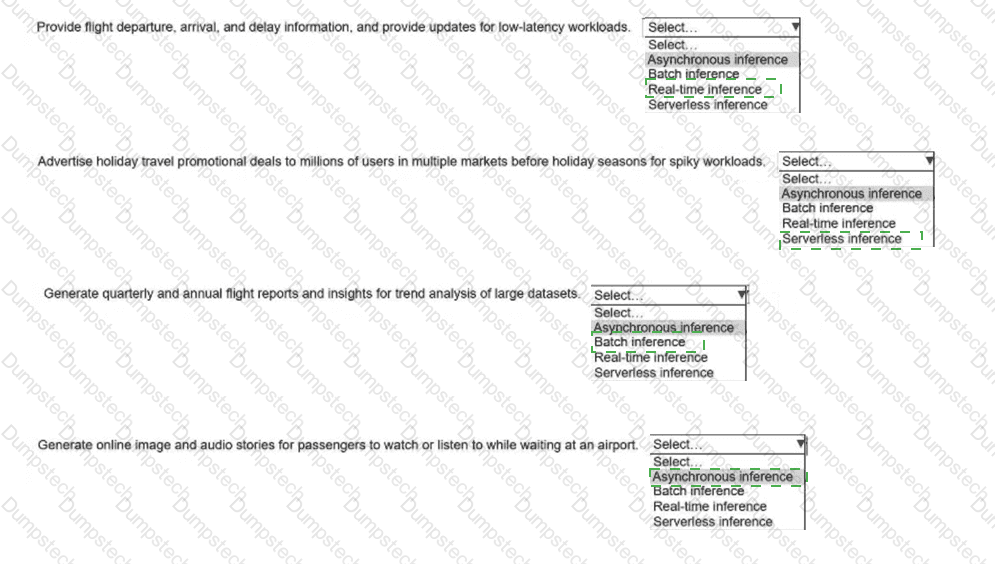
An airline company deploys ML models to one dozen Amazon SageMaker Al inference endpoints. The inference endpoints must be able to handle different types of

workloads in a cost-effective way.

Select the correct inference option from the following list to handle each type of workload. Select each inference option one time. (Select FOUR.)

    Asynchronous inference

    Batch inference

    Real-time inference

    Serverless inference

Question # 70

Options:

Viewing page 7 out of 8 pages
Viewing questions 61-70 out of questions