
Spring Sale Limited Time 70% Discount Offer - Ends in 0d 00h 00m 00s - Coupon code = simple70

Pass the ASQ Six Sigma Black Belt CSSBB Questions and answers with Dumpstech

Exam CSSBB Premium Access

View all detail and faqs for the CSSBB exam

Practice at least 50% of the questions to maximize your chances of passing.
Viewing page 1 out of 9 pages
Viewing questions 1-10 out of questions
Questions # 1:

This question refers to the following situation. A company has two facilities that ship the same product. The following table shows the number of defectives and the total volume for the facilities, per month. There is one opportunity per unit.
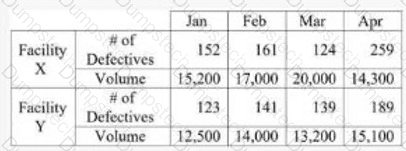
Question # 1

In terms of the PPM values for January and February, which facility performed better in each of those months?

Options:

A.

January: Facility X February: Facility X

B.

January: Facility X February: Facility Y

C.

January: Facility Y February: Facility Y

D.

January: Facility Y February: Facility X

Questions # 2:

Which of the following decision-making styles promotes distributed participation, equalization of power, productive controversy, cohesion, involvement, and commitment?

Options:

A.

Subgroup

B.

Consultative

C.

Transactional

D.

Consensus

Questions # 3:

In the factorial design main-effects plot shown, which factor setting gives the lower response?

Options:

A.

Factor A high

B.

Factor A low

C.

Factor B high

D.

Factor B low

Questions # 4:

A process decision program chart (PDPC) can be used to develop a

Options:

A.

project schedule

B.

cause and effect matrix

C.

tree diagram

D.

contingency plan

Questions # 5:

There has been an increase in the measurement of hazardous materials being detected at a transportation terminus over the last 3 months. The terminus is located in an area that has been unusually rainy during the same period. Which of the following tools should be used to determine whether there is a relationship between the chemical hazards and the rainfall?

Options:

A.

Simple linear regression

B.

Fishbone diagram

C.

Failure mode and effects analysis

D.

Repeatability and reproducibility study

Questions # 6:

Rank in order, from first to last, the following steps to conducting a hypothesis test.

    Draw a conclusion about the test

    Specify the parameter to be tested

    Determine the test statistic to use

    Calculate the critical values

    Define the rejection criteria

Options:

A.

2,3,4,5,1

B.

2,3,5,4,1

C.

3,2,5,1,4

D.

3,5,2,1,4

Questions # 7:

A commuter wants to determine which of two routes to take to work. If route X appears to have more traffic than route Y, the commuter should test which of the following null hypotheses?

Options:

A.

It takes the same amount of time to get to work by route X as by route Y.

B.

It takes more time to get to work by route X than by route Y.

C.

There is a significant difference in the time it takes to get to work by each route.

D.

There is more variation in travel time getting to work by route X than by route Y.

Questions # 8:

Which of the following levels of the work breakdown structure (WBS) includes an explanation of the purpose of the project?

Options:

A.

Project

B.

Phase

C.

Activity

D.

Task

Questions # 9:

In experimental design, a residual is defined as the difference between

Options:

A.

the df total and df treatment

B.

the SS total and SS treatment

C.

one experimental observation and another experimental observation

D.

the observed experimental value and the expected experimental value

Questions # 10:

Which of the following factors provides the most significant trade-off during tolerance design?

Options:

A.

Performance variation versus manufacturing cost

B.

Engineering cost versus manufacturing productivity

C.

Engineering schedule versus manufacturing schedule

D.

Program management cost versus manufacturing cost

Viewing page 1 out of 9 pages
Viewing questions 1-10 out of questions