
Black Friday VIP Hour Limited Time 75% Discount Offer - Ends in 0d 00h 00m 00s - Coupon code = simple75

Pass the Cisco AI Technical Practitioner (AITECH) 810-110 Questions and answers with Dumpstech

Exam 810-110 Premium Access

View all detail and faqs for the 810-110 exam

Practice at least 50% of the questions to maximize your chances of passing.
Viewing page 1 out of 3 pages
Viewing questions 1-10 out of questions
Questions # 1:

Which family of generative AI models is best suited for identifying and summarizing technical themes found across thousands of unstructured network incident reports?

Options:

A.

Variational autoencoders

B.

Diffusion models

C.

Large language models

D.

Generative adversarial networks

Questions # 2:

A practitioner is tackling a complex architectural problem by dividing it into four prompts that run in sequence, where the output of each prompt becomes the input for the next prompt in the chain. Which prompt engineering technique does this describe?

Options:

A.

Few-shot prompting

B.

Meta-prompting

C.

Prompt chaining

D.

Chain-of-thought prompting

Questions # 3:

Drag each analytical bias from the left to the scenario it describes on the right. Not all options will be used.
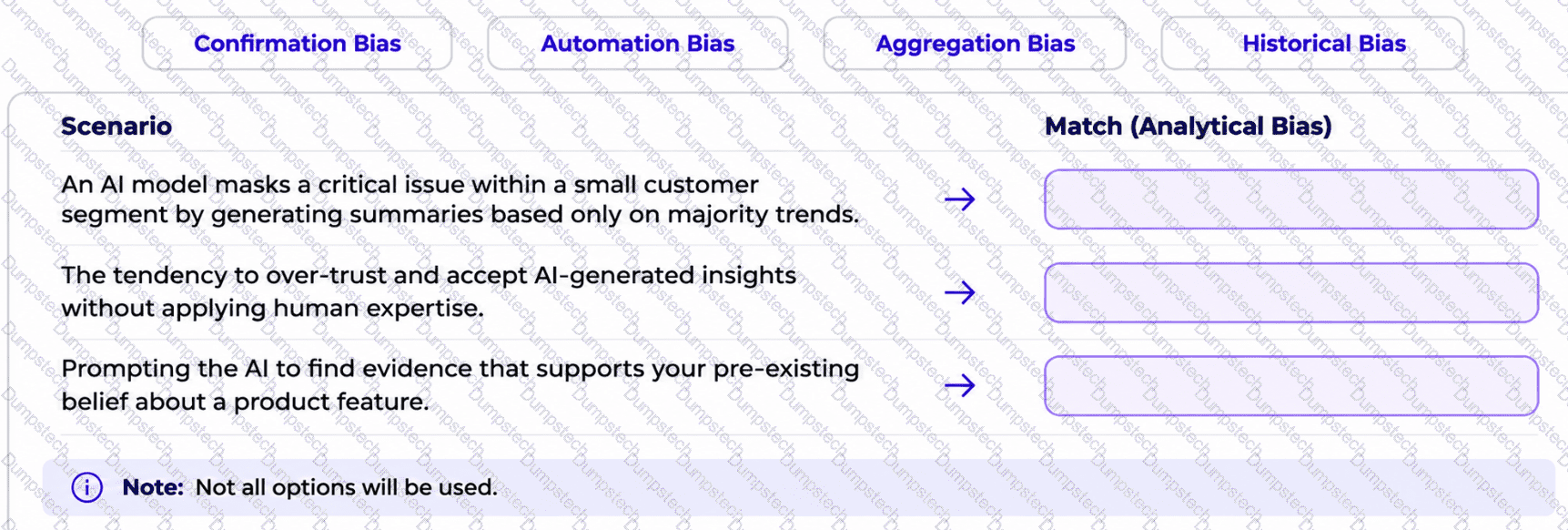
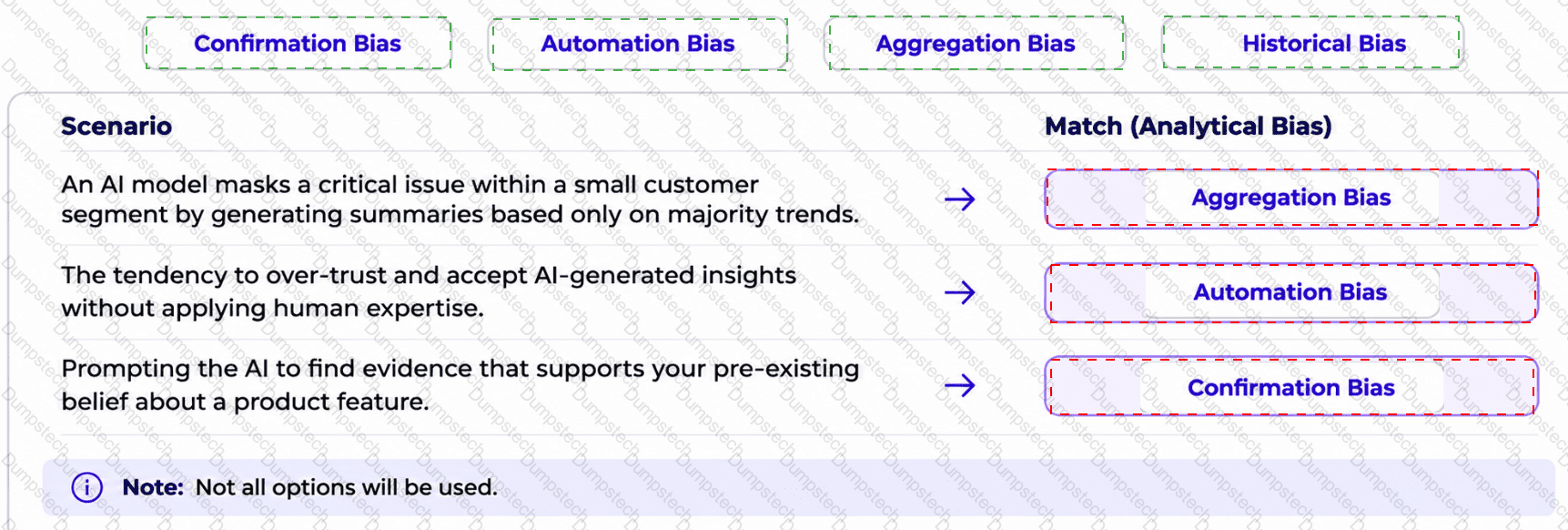
Question # 3

Options:

Questions # 4:

When using AI to draft a technical proposal, what is the benefit of adopting a format-agnostic strategy?

Options:

A.

It maintains contextual alignment.

B.

It minimizes token consumption.

C.

It allows for easy repurposing.

D.

It ensures the most creative text.

Questions # 5:

Why might an AI practitioner use a model hub such as Hugging Face in the early phases of an AI project?

Options:

A.

To generate a fine-tuned dataset tailored for a niche business problem.

B.

To access and evaluate a wide variety of pre-trained models.

C.

To ensure that the AI model will not produce biased outputs.

D.

To monitor and cap the monthly API token usage costs.

Questions # 6:

When recommending AI for use with proprietary software documentation, which argument addresses the main intellectual-property legal risk?

Options:

A.

AI tools may expose confidential intellectual property risking trade secret violations and loss of IP ownership protections.

B.

AI models are trained on public domain data, so all outputs are exempt from copyright infringement claims.

C.

AI-generated content is automatically granted full copyright protection under existing international intellectual property treaties.

D.

Organizations must obtain a commercial use license from the AI provider before proprietary documentation can be legally protected.

Questions # 7:

A developer gives an AI model three examples, each pairing a log entry with a specific error category, before asking it to categorize a new log entry. Which prompting technique does this represent?

Options:

A.

Zero-shot prompting

B.

Chain-of-thought

C.

Few-shot prompting

D.

Metaprompting

Questions # 8:

An AI-powered system must dynamically determine which tools to use when troubleshooting complex network outages. Why is an autonomous agentic system typically more costly to operate than a directive workflow for this task?

Options:

A.

Agents require specialized, high-cost GPU hardware clusters to maintain the state of the reasoning loop during tool execution.

B.

Agents require multiple API keys for every tool they access, which increases subscription costs.

C.

Agents consume tokens for every step of their internal reasoning loop, whereas workflows execute fixed, pre-programmed logic.

D.

Agents are billed by the hour of uptime, whereas workflows are billed only when a request is made.

Questions # 9:

Which workflow mechanism is illustrated when a company adopts a policy allowing an AI agent to draft a customer email, but requiring a human to approve the message before it is sent?

Options:

A.

Drift monitoring

B.

Approval gate

C.

Data lineage

D.

Injection mitigation

Questions # 10:

What is the reason that assigning a persona is regarded as a technical best practice in prompt engineering?

Options:

A.

It provides instructions for desired action.

B.

It reduces the total token usage.

C.

It provides a pattern to emulate.

D.

It guides the tone and vocabulary.

Viewing page 1 out of 3 pages
Viewing questions 1-10 out of questions