
Summer Sale Limited Time 75% Discount Offer - Ends in 0d 00h 00m 00s - Coupon code = simple75

Pass the Databricks Data Analyst Databricks-Certified-Data-Analyst-Associate Questions and answers with Dumpstech

Exam Databricks-Certified-Data-Analyst-Associate Premium Access

View all detail and faqs for the Databricks-Certified-Data-Analyst-Associate exam

Practice at least 50% of the questions to maximize your chances of passing.
Viewing page 2 out of 4 pages
Viewing questions 11-20 out of questions
Questions # 11:

A database was created in Databricks SQL using the following statement:

CREATE SCHEMA accounting LOCATION ' dbfs:/accounting/data ' ;

Where will data for this database be stored?

Options:

A.

dbfs:/accounting/data/accounting.db

B.

dbfs:/accounting/data

C.

dbfs:/accounting/data.db

D.

dbfs:/user/hive/warehouse/accounting.db

Questions # 12:

A data analyst has opened the SQL Editor page and written a new SQL statement. The data analyst now wants to save that statement to easily refer back to it later and add it to a dashboard. The results of the SQL statement must be able to be displayed as a counter, table, or data visualization.

Which approach should the data analyst use to accomplish this task?

Options:

A.

Save the SQL statement as a Dashboard

B.

Save the SQL statement within a Notebook

C.

Save the SQL statement as a Query

D.

Save the SQL statement in the Query History page

Questions # 13:

A data analyst creates a Databricks SQL Query where the result set has the following schema:

region STRING

number_of_customer INT

When the analyst clicks on the " Add visualization " button on the SQL Editor page, which of the following types of visualizations will be selected by default?

Options:

A.

Violin Chart

B.

Line Chart

C.

IBar Chart

D.

Histogram

E.

There is no default. The user must choose a visualization type.

Questions # 14:

A data analyst has produced a visualization. A stakeholder has viewed the visualization and is complaining that the visualization is difficult to interpret. After looking at the visualization, the analyst determines that the scale of the y-axis must be changed.

Where are the controls for changing the scale of the y-axis in Databricks SQL?

Options:

A.

Query Editor → Y Axis

B.

Dashboard Editor → Axes → Y Axis

C.

Visualization Editor → Y Axis

D.

Settings → User Settings → Scaling

Questions # 15:

A data engineering team has created a Structured Streaming pipeline that processes data in micro-batches and populates gold-level tables. The microbatches are triggered every minute.

A data analyst has created a dashboard based on this gold-level data. The project stakeholders want to see the results in the dashboard updated within one minute or less of new data becoming available within the gold-level tables.

Which of the following cautions should the data analyst share prior to setting up the dashboard to complete this task?

Options:

A.

The required compute resources could be costly

B.

The gold-level tables are not appropriately clean for business reporting

C.

The streaming data is not an appropriate data source for a dashboard

D.

The streaming cluster is not fault tolerant

E.

The dashboard cannot be refreshed that quickly

Questions # 16:

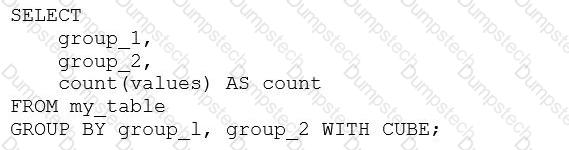
A data analyst is processing a complex aggregation on a table with zero null values and their query returns the following result:

Which of the following queries did the analyst run to obtain the above result?

A)

B)

C)

D)

E)
Question # 16

Options:

A.

Option A

B.

Option B

C.

Option C

D.

Option D

E.

Option E

Questions # 17:

Which of the following is stored in the Databricks customer’s cloud account?

Options:

A.

Databricks web application

B.

Cluster management metadata

C.

Repos

D.

Data

E.

Notebooks

Questions # 18:

Which of the following statements describes descriptive statistics?

Options:

A.

A branch of statistics that uses summary statistics to quantitatively describe and summarize data.

B.

A branch of statistics that uses a variety of data analysis techniques to infer properties of an underlying distribution of probability.

C.

A branch of statistics that uses quantitative variables that must take on a finite or countably infinite set of values.

D.

A branch of statistics that uses summary statistics to categorically describe and summarize data.

E.

A branch of statistics that uses quantitative variables that must take on an uncountable set of values.

Questions # 19:

After running DESCRIBE EXTENDED accounts.customers;, the following was returned:

Question # 19

Now, a data analyst runs the following command:

DROP accounts.customers;

Which of the following describes the result of running this command?

Options:

A.

Running SELECT * FROM delta. `dbfs:/stakeholders/customers` results in an error.

B.

Running SELECT * FROM accounts.customers will return all rows in the table.

C.

All files with the .customers extension are deleted.

D.

The accounts.customers table is removed from the metastore, and the underlying data files are deleted.

E.

The accounts.customers table is removed from the metastore, but the underlying data files are untouched.

Questions # 20:

Which of the following statements about a refresh schedule is incorrect?

Options:

A.

A query can be refreshed anywhere from 1 minute lo 2 weeks

B.

Refresh schedules can be configured in the Query Editor.

C.

A query being refreshed on a schedule does not use a SQL Warehouse (formerly known as SQL Endpoint).

D.

A refresh schedule is not the same as an alert.

E.

You must have workspace administrator privileges to configure a refresh schedule

Viewing page 2 out of 4 pages
Viewing questions 11-20 out of questions