75only - Ends in 0d 00h 00m 00s - Coupon code = 75only

Pass the Fortinet NSE 5 Network Security Analyst NSE5_FWB_AD-8.0 Questions and answers with Dumpstech

Exam NSE5_FWB_AD-8.0 Premium Access

View all detail and faqs for the NSE5_FWB_AD-8.0 exam

Practice at least 50% of the questions to maximize your chances of passing.
Viewing page 2 out of 2 pages
Viewing questions 11-20 out of questions
Questions # 11:

You recently deployed two FortiWeb devices in an active-active (A-A) high availability (HA) cluster.

During routine maintenance, you want to confirm that the cluster is synchronizing the correct configuration areas and that both FortiWeb devices behave consistently in production.

As the FortiWeb administrator, which two configuration areas should you examine to verify that HA synchronization is functioning correctly? (Choose two.)

Options:

A.

Check the network configuration on both FortiWeb devices—such as interfaces and static routes—to ensure they are aligned.

B.

Review policy configurations, including server policies and protection profiles, to confirm they match across the cluster.

C.

Review inspection and mitigation log files to determine if they are being replicated across both FortiWeb devices.

D.

Verify whether firmware images and upgrade history are synchronized between the FortiWeb devices.

Questions # 12:

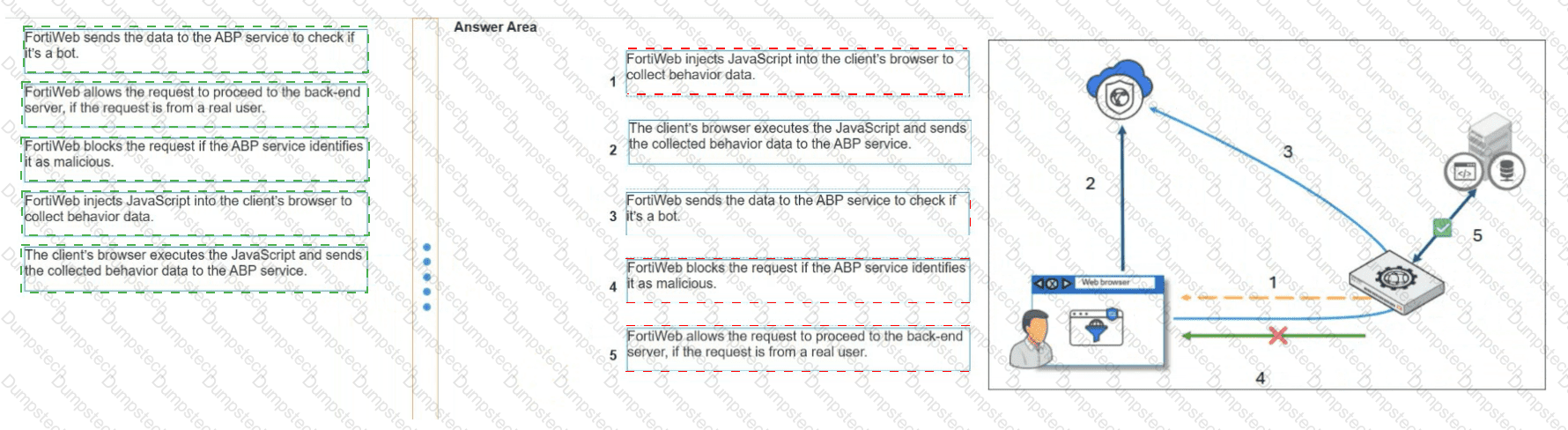
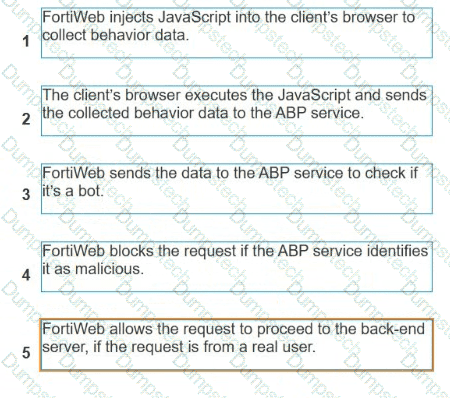
You are reviewing the FortiWeb integration with the Advanced Bot Protection (ABP) service.

Match each step in the ABP flow with its description.
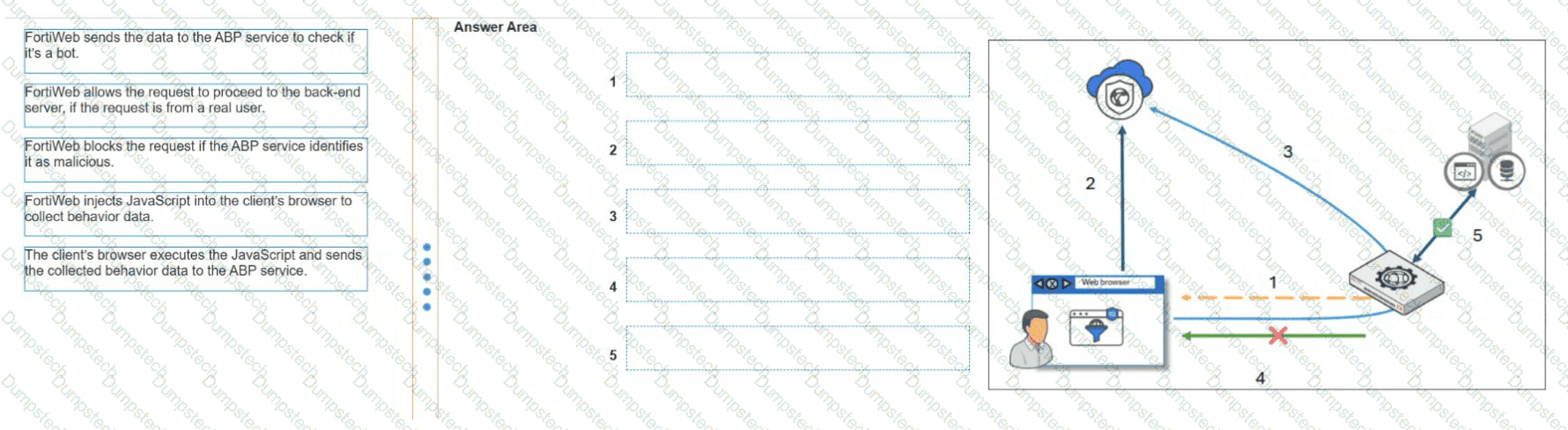
Question # 12

Options:

Questions # 13:

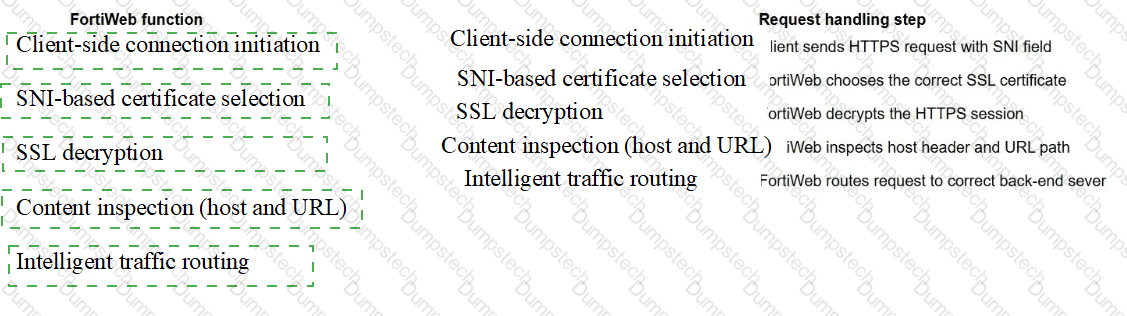
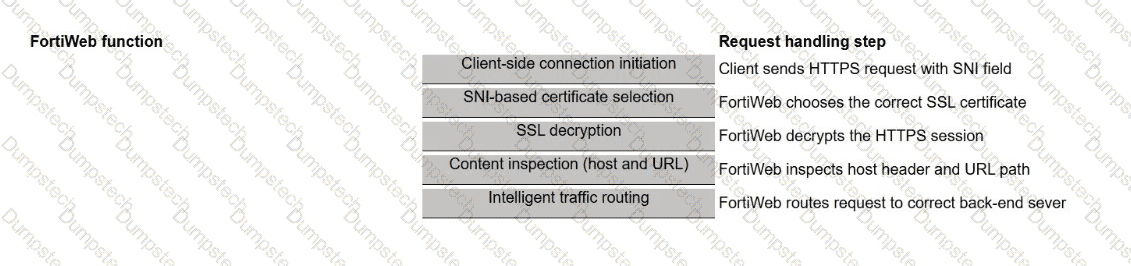
You are hosting multiple secure web applications behind a single public IP address on FortiWeb.

When a client connects to a service, FortiWeb needs to:

    Identify the correct SSL certificate.

    Decrypt the request.

    Route the request to the correct back-end server.

Match each FortiWeb function to the request handling step that performs the function.
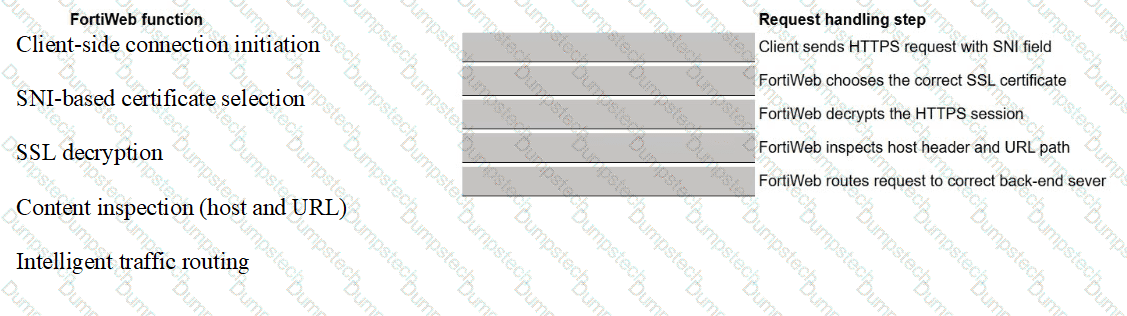
Question # 13

Options:

Questions # 14:

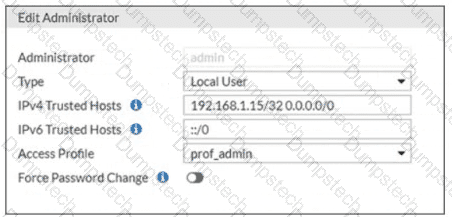
Refer to the exhibit.

Question # 14

There is only one administrator account configured on FortiWeb and IPv6 is not configured on any interface.

Which action should an administrator take to restrict any brute force attacks that attempt to gain access to the FortiWeb management GUI?

Options:

A.

Make configuration changes on the upstream device.

B.

Replace 0.0.0.0/0 with a specific IP address.

C.

Delete the built-in administrator user and create a new one.

D.

Change the setting in the Access Profile field to Read_Only .

Questions # 15:

Your team is spending too much time digging through FortiWeb logs to investigate threats.

How can FortiAI improve this workflow?

Options:

A.

It disables logging to improve performance.

B.

It blocks malicious IP addresses automatically.

C.

It replaces the need for FortiGuard updates.

D.

It explains recent events using natural language.

Questions # 16:

A FortiWeb administrator sees the following request:

GET /api/v1/data HTTP/1.1

Host: example.com

Authorization: ApiKey abc123def456

The API key belongs to a user in group B who is authorized to access only /api/v1/reports.

What should the administrator do to prevent this unauthorized access?

Options:

A.

Restrict access to /api/v1/data using user group–based access control.

B.

Block /api/v1/data for all user groups to avoid policy confusion.

C.

Move the user to group A so they can access both endpoints.

D.

Allow all valid API keys to access any API endpoint.

Questions # 17:

You are setting up a FortiWeb policy to protect a customer login portal. Users connect to https://login.training.lab, and you want FortiWeb to forward those requests to a load-balanced pool of back-end servers.

Which three components must you configure to complete the server policy?

Options:

A.

Virtual server, server pool, and port settings (service).

B.

Web application firewall (WAF) profile, DoS policy, and server name indication (SNI)-based certificate.

C.

DNS resolver, URL rewrite rule, and HTTP health check.

D.

Real server, IPsec tunnel, and static route.

Questions # 18:

Which situation best explains when a FortiWeb administrator should enable automatic HTTP-to-HTTPS redirection?

Options:

A.

The organization prefers to keep both HTTP and HTTPS available for flexibility.

B.

Users are accessing a static website that does not handle sensitive data.

C.

The back-end server uses only HTTP and cannot support encryption.

D.

The web application handles logins or personal data and must ensure encrypted communication.

Questions # 19:

A FortiWeb administrator is deciding between using SAML SSO or HTML authentication. They want to minimize the number of credential prompts users receive across multiple Fortinet services.

Which statement accurately describes which option is best, and why?

Options:

A.

SAML SSO, because it supports identity authentication on Fortinet devices.

B.

SAML, because it blocks users from accessing anything not approved in FortiWeb policy.

C.

HTML form authentication, because it’s faster and doesn’t need external systems.

D.

HTML form, because it provides token-based access to remote services.

Questions # 20:

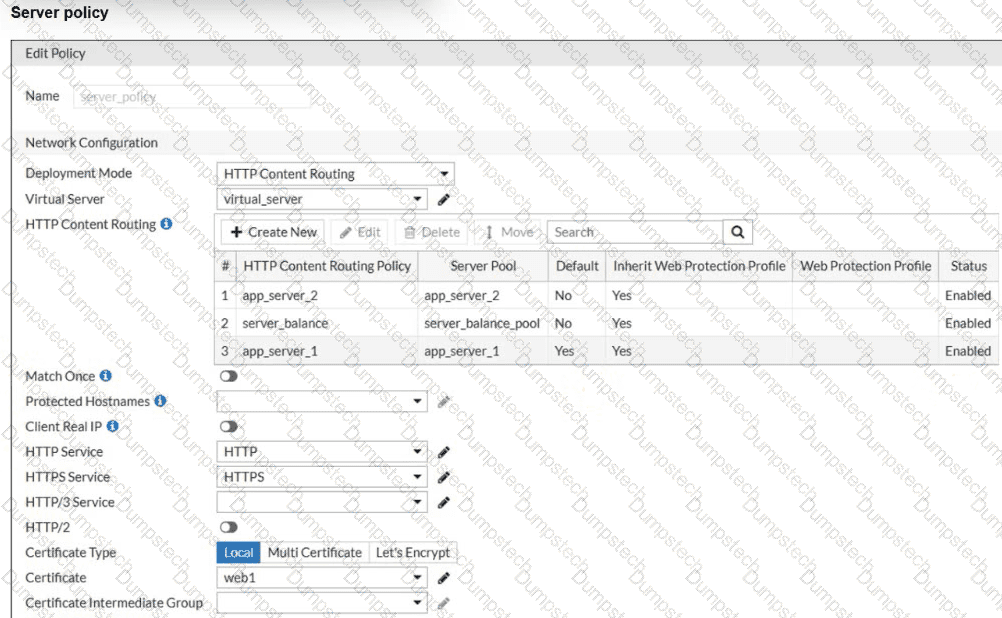
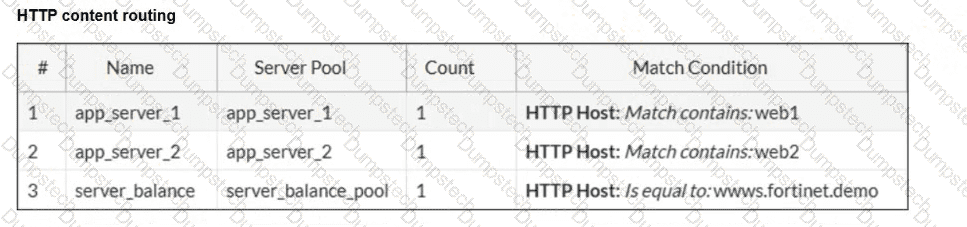
Refer to the exhibits.

Question # 20

Question # 20

A new domain, https://finance.fortinet.demo, was added but not explicitly mapped. Users report the site loads correctly, but you’re unsure which back-end server is being used.

Why is this request succeeding despite no explicit routing rule for finance.fortinet.demo?

Options:

A.

The inherited certificate has a wildcard entry for all subdomains.

B.

FortiWeb auto-generates fallback policies for new domains.

C.

The connection is passed to FortiGate for secondary routing.

D.

The request defaults to app_server_1 because it is marked as the default route.

Viewing page 2 out of 2 pages
Viewing questions 11-20 out of questions