
Black Friday VIP Hour Limited Time 75% Discount Offer - Ends in 0d 00h 00m 00s - Coupon code = simple75
Pass the Huawei HCIP-WLAN H12-323_V2.0 Questions and answers with Dumpstech
Exam H12-323_V2.0 Premium Access
View all detail and faqs for the H12-323_V2.0 exam
The CloudCampus APP’s AP calculator incorporates a variety of scenarios and network-construction standards. Which of the following scenarios is not included?
During acceptance testing of a customer’s wireless network, an engineer discovers that a terminal has a poor service experience. The engineer uses CampusInsight’s user journey function to check the terminal’s service experience, as shown below. Which of the following could cause the poor service experience?
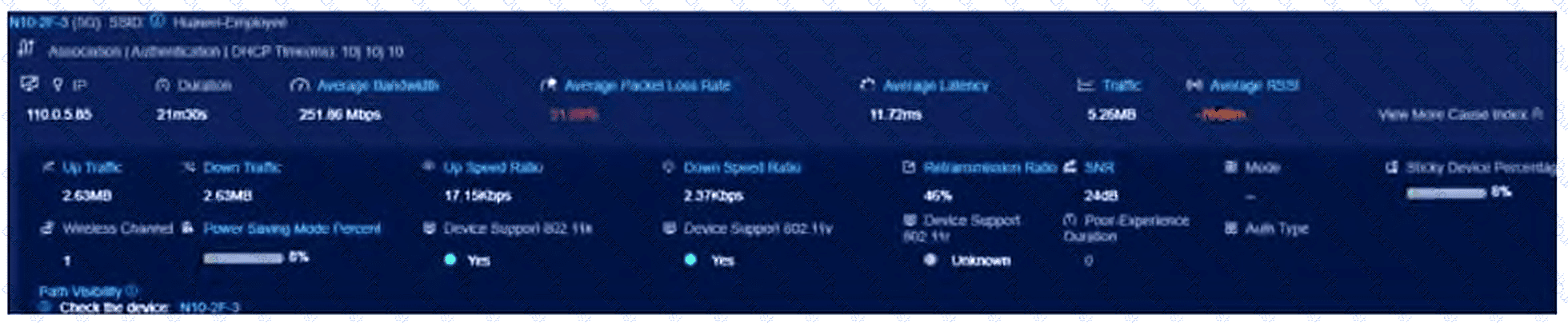
Original exhibit: Q48 Enlarged Exhibit
Provided WLAN network coverage is ensured, AP transmit power can be reduced to lessen co-channel interference.
Actual packet transmission rates of STAs differ greatly depending on the radio modes that STAs support and the radio environment. The airtime scheduling function allocates channel resources according to the channel-occupation time of users connected to the same radio. Each user receives equal time to occupy the channel, ensuring fairness in channel occupation. If multiple users send different packet types, airtime scheduling still takes effect.
Which of the following statements are true regarding STA steering?
A Huawei Wi-Fi 6 AP supports up to 8x8 MIMO on the 5 GHz band when operating in dual-radio mode. When its 5 GHz radio uses 160 MHz channel bandwidth, a Wi-Fi 6 STA operating in 2x2 MIMO + 160 MHz mode connects to that radio. What is this STA’s maximum theoretical rate?
An AP steers a STA when that STA satisfies the steering conditions. STAs running voice or video services are not steered.
Like broadcast packets, multicast packets are transmitted at a low rate on a WLAN. It is recommended to enable multicast packet suppression when no multicast service is operating, so wireless network resources can be fully utilized.
Which of the following factors must be considered and validated during signal coverage design for a WLAN planning project?
CHOOSE THREE
Some STAs cannot access a WLAN because of coverage holes. In this situation, the transmit-power values of neighboring APs can be adjusted to enlarge the coverage area and eliminate the holes. Which command sequence is used to manually adjust AP transmit power?
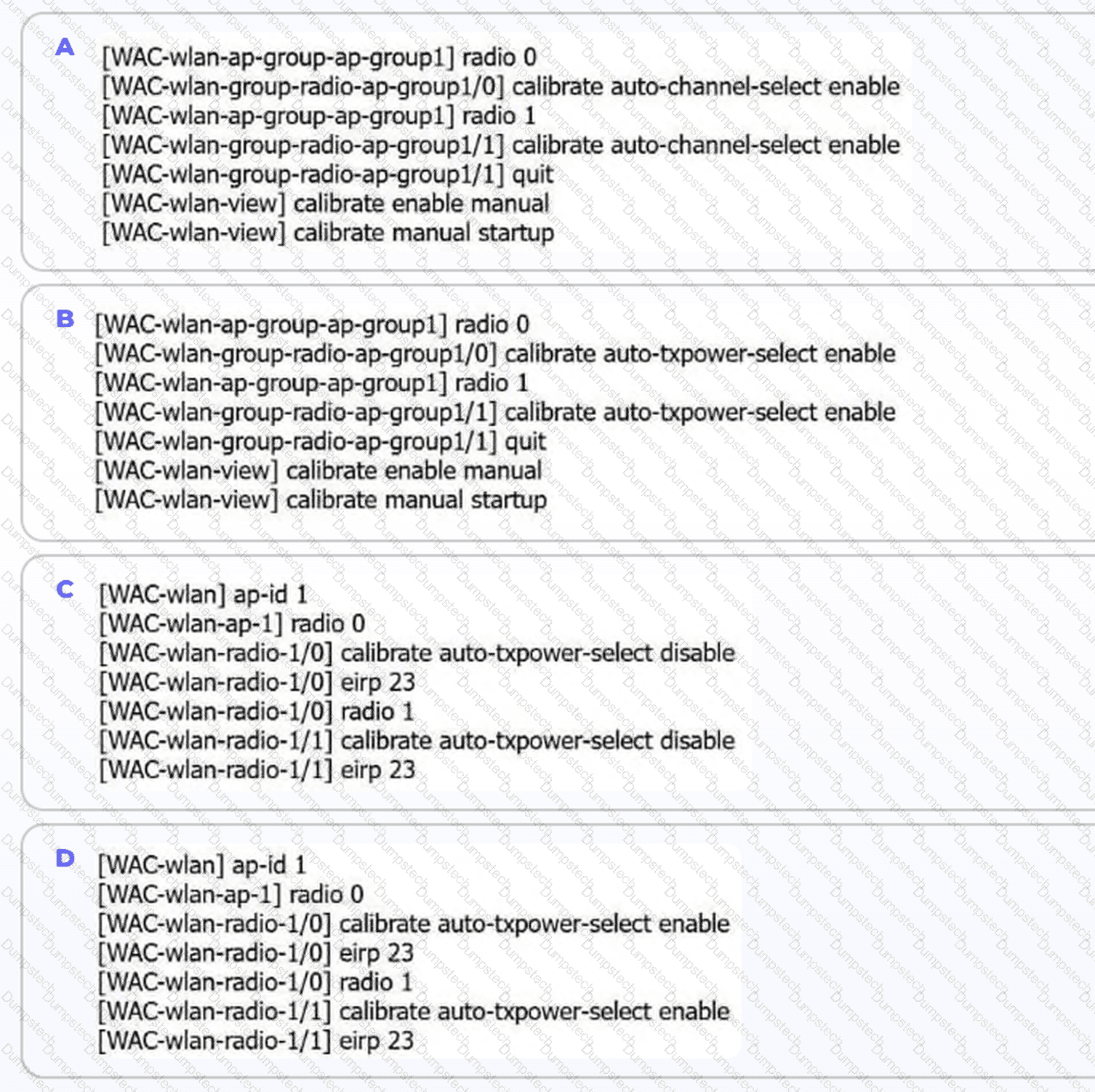
Original exhibit: Q53 Enlarged Exhibit
