
Black Friday VIP Hour Limited Time 75% Discount Offer - Ends in 0d 00h 00m 00s - Coupon code = simple75

Pass the Huawei HCIE-Datacom H35-831 Questions and answers with Dumpstech

Exam H35-831 Premium Access

View all detail and faqs for the H35-831 exam

Practice at least 50% of the questions to maximize your chances of passing.
Viewing page 1 out of 2 pages
Viewing questions 1-10 out of questions
Questions # 1:

Which of the following statements is incorrect about the SR-TE tunnel configuration below?

[R1] interface tunnel1

[R1-Tunnel1] ip address unnumbered interface LoopBack0

[R1-Tunnel1] tunnel-protocol mpls te

[R1-Tunnel1] destination 3.3.3.3

[R1-Tunnel1] mpls te tunnel-id 1

[R1-Tunnel1] mpls te signal-protocol segment-routing

[R1-Tunnel1] mpls te pce delegate

Select all that apply.

Options:

A.

The tunnel ID of the tunnel is 1. Other SR-TE tunnels on the device cannot have the same tunnel ID as this tunnel.

B.

The tunnel interface borrows the address of the Loopback 0 interface.

C.

The tunnel interface uses SR as the tunneling protocol.

D.

The tunnel interface uses a manually specified path.

Questions # 2:

Which of the following SIDs encapsulates the outer destination address for BIERv6 multicast packets?

Options:

A.

End.BIERv6 SID

B.

End.DT6 SID

C.

End.DX6 SID

D.

End.BIER SID

Questions # 3:

In an SDN network, device control planes are deployed centrally. If a node or link in the SDN network fails, which of the following is the optimal protection method?

Options:

A.

Forwarders automatically compute FRR routes to protect services.

B.

The controller will recalculate routes.

C.

Forwarders will recalculate routes.

D.

The SDN controller delivers FRR routes in advance to protect services.

Questions # 4:

SR and LDP interworking technology allows SR and LDP to operate together on the same network. SR and LDP networks can be interconnected through this technology to implement MPLS forwarding. To interwork with an LDP network, an SR network needs a particular device type to advertise SIDs on behalf of SR-incapable LDP devices. What is this device called?

Options:

A.

Mapping client

B.

LDP server

C.

LDP client

D.

Mapping server

Questions # 5:

The new metro network is built with modular, standardized components. It is designed for fixed-mobile convergence (FMC) and cloud-network integration requirements, and it enables flexible network expansion, rapid service provisioning, and network intelligence.

Options:

A.

TRUE

B.

FALSE

Questions # 6:

Which of the following statements is incorrect regarding SRv6 protection technologies?

Options:

A.

In an SRv6 TE Policy scenario, if a specified explicit node fails, TI-LFA cannot be used to restore services.

B.

TI-LFA can be used in both SRv6 BE and SRv6 TE Policy scenarios.

C.

In an SRv6 TE Policy scenario, after headend-based fault detection is configured, the device sets the segment list to down and deletes the segment list entry as long as more than two SRv6 SIDs in the segment list do not exist in the topology.

D.

In an L3VPN scenario, if traffic is carried over an SRv6 TE Policy, both egress protection and VPN FRR can protect PEs.

Questions # 7:

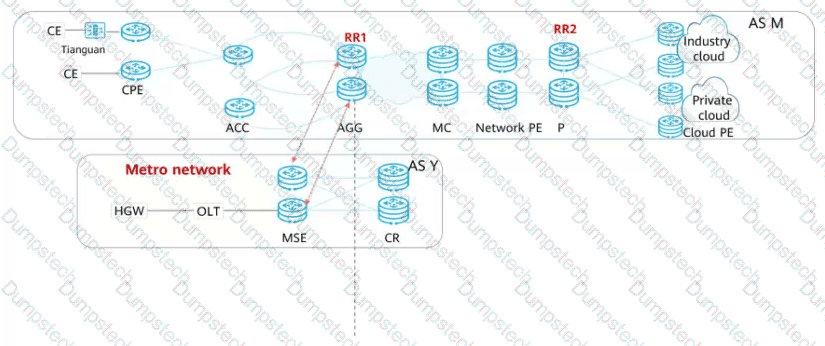
The figure illustrates the fixed-broadband cloudification acceleration scenario of the intelligent cloud-network. Which statements about this network are incorrect?
Question # 7

Exhibit 16.1 — Original topology/configuration figure

Select all that apply.

Options:

A.

On the public network plane, IS-ISv6 peer relationships are established between MSEs and AGGs to transmit SRv6 loopback routes.

B.

On the private network plane, EBGP peer relationships are established between MSEs and AGGs to transmit VPN routes.

C.

On the public network plane, EBGP peer relationships are established between MSEs and AGGs to transmit locator routes.

D.

On the private network plane, IS-ISv6 peer relationships are established between MSEs and AGGs to transmit SRv6 SIDs.

Questions # 8:

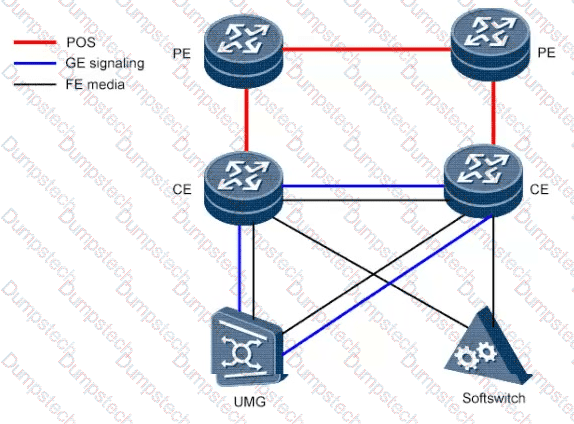
The topology shown is a typical transport-network access-layer structure. Each core-network device is dual-homed to two CEs, and the CEs and PEs are interconnected in a square-loop topology. The access layer must carry voice and signaling services. Two VPN instances must be configured on each CE to isolate voice services from signaling services and provide security and QoS. Signaling services are transmitted in active/standby mode, while voice services are transmitted in load-balancing mode. VRRP must be enabled between the two CEs to terminate signaling flows. From the perspectives of network robustness and architectural suitability, which statements about this topology are correct?
Question # 8

Exhibit 60.1 — Original topology/configuration figure

Select all that apply.

Options:

A.

GE links, not POS links, should be used between CEs and PEs.

B.

GE and FE links between two CEs need be added to an Eth-Trunk to improve reliability.

C.

The total bandwidth of the link between two CEs should be greater than or equal to the bandwidth of the CE-PE interconnection link.

D.

The voice services should be carried on GE links, and the signaling services should be carried on FE links.

Questions # 9:

In SRv6 BE scenarios, the original IPv6 packet encapsulation structure remains unchanged. SRv6 packets continue to be IPv6 packets and can be recognized by common IPv6 devices.

Options:

A.

TRUE

B.

FALSE

Questions # 10:

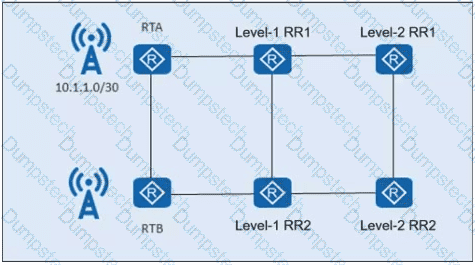
In the transport network shown, two-level RRs are deployed, and RTA has the directly connected network segment 10.1.1.0/30. Which of the following statements about the BGP deployment solution are incorrect?
Question # 10

Exhibit 28.1 — Original topology/configuration figure

Options:

A.

To enable level-2 RRs to learn the route to network segment 10.1.1.0/30, the level-2 RRs must be configured as clients of level-1 RRs.

B.

It is recommended that RRs of the same level be configured with the same cluster ID.

C.

RRs of the same level must be configured as clients of each other.

D.

RTA and RTB can establish IBGP peer relationships with two level-1 RRs. RTA and RTB do not need to establish an IBGP peer relationship.

Viewing page 1 out of 2 pages
Viewing questions 1-10 out of questions