
75only - Ends in 0d 00h 00m 00s - Coupon code = 75only
Pass the iSQI Technical Test Analyst CTAL-TA_V4.0 Questions and answers with Dumpstech
You are working on a project to replace an old sales and merchandising system with a new system that will be based on modern platforms. The old system is still in production but is poorly documented and expensive to maintain. The new version will be developed using modern technology. The main requirements for the system are that it shall:
1. Load sales data, sent electronically from the stores each evening, into a central database.
2. Produce actual sales reports for the merchandisers, whose job is to manage stock levels in stores.
3. Produce sales forecast reports based on a combination of sales history and forecasting parameters. The parameters will be entered by the merchandisers into a browser-based front end and the reports will be produced overnight. The users will be able to see the reports next day, on screen or in print, by requesting this through the browser.
Requirements 1 and 2 are satisfied by the existing system and will be rewritten with no significant changes. Requirement 3 is new and has been clearly specified.
The entry of forecasting parameters and of requests to see the reports will be low volume, but the Merchandising Manager is concerned about usability because the forecasting parameters are complex.
Which test charter would be BEST for the initial exploratory testing of requirement 3?
You are your employer’s most experienced TA. The organisation performs root cause analysis (RCA) thoroughly, but infrequently and only on individual defects that went live at the highest of the five Severity levels.
After six months of live operation for one system, particular concern has been expressed about the volume of usability and security defects and there is a strong desire to reduce their quantities. You have recommended adding product quality characteristics, per ISO 25010, to the defect report template.
How might this recommendation support RCA?
You are conducting a system test of an airline’s flight reservation system and have written a series of test conditions to address the following requirement specification:
• RS-BK14 - Upon successful processing of payment for a new flight booking, the system shall complete the process by displaying a message notifying the customer that the booking reservation has been applied, appended by the booking reference number and, where applicable, the pre-paid seat numbers.
Which test condition is an example of functional appropriateness testing for this requirement?
Which activity involves a test analyst creating the schedule for test execution and preparing the test environments and test data?
Your project is developing an application to process claims against insurance policies. Which of the following is a good example of CRUD completeness testing?
You are developing test cases for an application which performs complex calculations and have decided to model these calculations on a spreadsheet, to determine expected results from inputs.
Which solution to the test oracle problem BEST describes the approach you are using?
What is a common problem associated with using a pseudo-oracle in testing?
Your company, which specializes in medical software, has designed an application for use on smartphones and tablets, that calculates a person’s BMI (Body Mass Index).
How can a test analyst BEST contribute to interoperability testing for this application?
You are testing a loan-assignment system. You have been given the following decision table to analyze; each condition can take only the value Y (yes, the condition holds) or N (no, the condition does not hold).
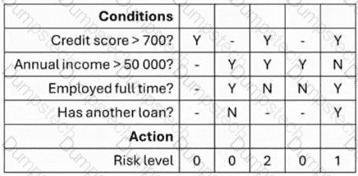
What inference can be made from this decision table?
You are working on an Agile project to develop a web-based online dating service that will allow members of the service to enter their profile, meet people who would be a good match for them, arrange social events with those people and to block people with whom they do not want contact.
Functional correctness, usability, performance and security are all important but the major concern for the stakeholders is data protection. Two environments are available for testing: the regular one is similar to the development environment, the other is a pre-production environment which is configured to become the live system when operation begins, but has currently been loaded with a representative volume of artificial profiles.
The features for member profile entry have been delivered and tested. The current iteration will deliver profile matching, which will be done on-demand in response to a request from a member to see matching profiles in their browser. The tests for these user stories’ acceptance criteria will be aimed primarily at functional correctness and will be scripted. Performance testing and security testing will be done by external specialists when the functionality is stable.
The other TAs in the team are on sick leave and only have time for one exploratory test session before the end of the iteration. What is the MOST appropriate test charter in these circumstances?
