
75only - Ends in 0d 00h 00m 00s - Coupon code = 75only
Pass the iSQI Technical Test Analyst CTAL-TA_V4.0 Questions and answers with Dumpstech
You have been working in an Agile model on a large software project. You developed a traceability matrix that records the risk for each requirement and maps it to the test case that tests that requirement. You have just received a new release in which developers have classified some areas as “high risk” for regression. Consider the following risk table (1 = highest risk):

Based on this information, in what sequence should the test cases be run to help mitigate regression risk?
Your organization has been conducting detailed requirements reviews, but a problem has emerged: the author of the requirements becomes defensive during these reviews. On a couple of occasions, the author felt personally targeted and left the meeting very upset.
What type of review could you implement to help de-personalize the reviews?
Below is a state transition diagram modelling the behaviour of the component that verifies whether the PIN entered by the user is correct. The system starts operating in the “Welcome screen” state and finishes in the “End” state.
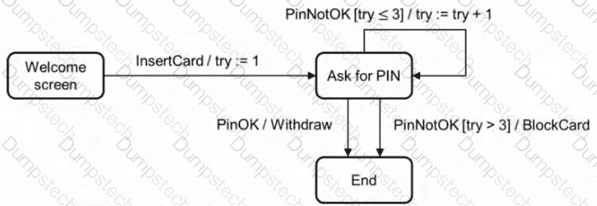
The system should permit three attempts to enter the PIN. If the user enters the correct PIN on any of these attempts, the system performs a withdrawal and ends the operation. If the third attempt is incorrect, the system blocks the card and ends the operation. As a test analyst, you review this diagram for potential defects that could be introduced into the system created from this model.
What should be the conclusion of your analysis?
In a sequential (V-model) software development lifecycle, at what point does test design and implementation take place?
Which of the following is a way to ensure your synthetic data is reflective of production data?
Which of the following is NOT an example of a test-data requirement for an online food-ordering application?
You are testing a beverage vending machine. The beverage costs $1. The machine accepts 25c, 50c, and $1 coins. When the total value of inserted coins is equal to or greater than the beverage price, the system dispenses the beverage and returns any change. However, if it cannot dispense change because it lacks coins, or if the user presses Cancel, the system does not dispense the beverage and returns the inserted coins.
You use a keyword-based approach and have the following keywords available.
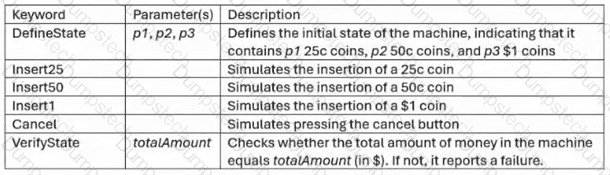
Consider this keyword-based test script used to execute a particular test scenario.
DefineState(1,1,1)
Insert25
Cancel
Insert50
Insert50
Which keyword should end this test script?
You are designing test cases based on this use case:
Use case: logging in to the online banking system
1. The user opens the banking application.
2. The system displays the login page.
3. The user enters their username and password.
4. The user clicks the “Login” button.
5. The system verifies the username and password in the database.
6. The system starts the multi-factor authentication (MFA) procedure.
7. The user undergoes MFA verification.
8. The system logs the user in and redirects them to the welcome screen.
Alternative flows:
3A: The user clicks the “Forgot Password” button. The system sends an e-mail containing a link to reset the password and returns to step 2.
5A: Incorrect password. The system displays the message “Incorrect password”, and, after the user closes the message window, returns to step 3.
Exceptions:
2A: The system is unavailable because of maintenance work. The system displays the message “Maintenance work in progress; try later” and the login process ends.
7A: MFA verification error. The system displays the message “MFA verification failed” and the login process ends.
The test strategy requires coverage of the main scenario, alternative flows, and exceptions for each use case. The strategy permits testing multiple alternative flows in one test case. Each exception must be tested in a separate test case, although a test case can contain alternative flows.
What is the MINIMUM number of test cases that achieves this coverage?
A Customer Relationship Management (CRM) system will be developed for a company that runs a chain of hotels. These are some of the requirements relating to staff in the call center.
• R1. High. An operator shall be able to find and see the details of a customer’s booking. The data that may be used for the search include customer name, customer registration number (in the company’s loyalty enrolment scheme) and booking reference.
• R2. High. An operator shall be able to amend a customer’s booking. The data that may be amended include check-in and check-out dates, hotel, room type and tariff (with / without breakfast).
• R3. High. Before a booking amendment is accepted, the system shall display to the operator any difference in price with respect to the original booking. The operator shall confirm that the customer accepts the revised price and then the system shall record the accepted amendment.
• R4. Medium. Details of the amended booking shall be sent to the customer (see requirements for original customer booking for details).
• R5. High. Details of the extra amount payable shall be sent to the billing system for customer invoicing (see requirements for invoicing of the original customer booking for details).
You have been asked to review these requirements using this checklist:
1. Specific - does each requirement deal with only a single aspect of the solution?
2. Clear - is each requirement expressed in an unambiguous way with no possibility of interpretation or uncertainty about its meaning?
3. Complete - does the set of requirements cover all of the stakeholders’ reasonable needs?
4. Unique - does each requirement address something that no other requirement also covers?
Assume that the other requirements referred to by R4 and R5 have been reviewed with a satisfactory outcome. Considering these five requirements, to which checklist items would you answer ‘No’?
A simple DVD player is described in the following state transition diagram:
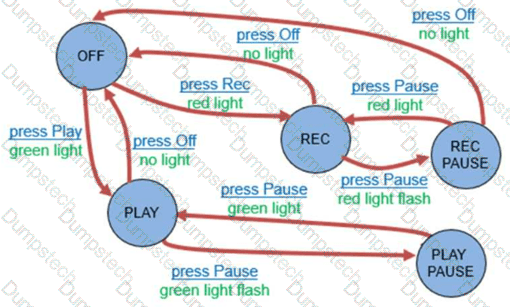
All round trips are feasible, even those that do not start at OFF. How many test cases will be needed for complete round-trip coverage?
