Weekend Sale Limited Time 75% Discount Offer - Ends in 0d 00h 00m 00s - Coupon code = simple75

Pass the Juniper JNCIS-ENT JN0-352 Questions and answers with Dumpstech

Exam JN0-352 Premium Access

View all detail and faqs for the JN0-352 exam

Practice at least 50% of the questions to maximize your chances of passing.
Viewing page 1 out of 2 pages
Viewing questions 1-10 out of questions
Questions # 1:

You are verifying a new BGP peering session with an ISP. You issue the show bgp summary command, but the output shows the peer in the Active state.

Which statement is correct in this scenario?

Options:

A.

The session is waiting to be configured.

B.

The session is established, and routing information is being exchanged.

C.

The session is actively trying to establish a TCP connection.

D.

The session is idle and disabled.

Questions # 2:

You want to configure a floating static route.

What must be configured in this scenario?

Options:

A.

priority

B.

preference

C.

qualified-next-hop

D.

next-hop

Questions # 3:

A switch uses the factory-default storm control configuration. A sudden unknown-unicast burst causes packet loss for only 4-5 seconds before stabilizing.

Which statement describes why normal operation resumes automatically?

Options:

A.

Storm control applies only to multicast traffic by default.

B.

Storm control triggers GRES recovery.

C.

Storm control shuts down the interface and re-enables it after 5 seconds.

D.

Storm control drops only excess packets until traffic falls below the threshold.

Questions # 4:

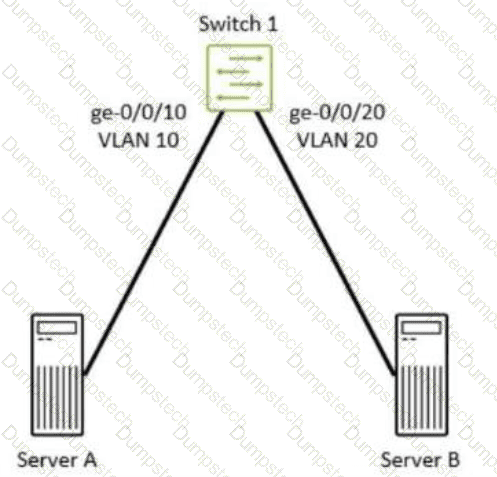
[Exhibit]

Question # 4

Click the Exhibit button.

Referring to the exhibit, all possible firewall filters are configured along the path from Server A to Server B.

In which order will Switch 1 process transmit (Tx) and receive (Rx) firewall filters?

Options:

A.

Rx-Port -- > Rx-VLAN -- > Rx-Router -- > Tx-Router -- > Tx-VLAN - > Tx-Port

B.

Rx-Port -- > Rx-VLAN -- > Rx-Router -- > Tx-VLAN -- > Tx-Port

C.

Rx-Port -- > Rx-VLAN -- > Tx-VLAN -- > Tx-Port

D.

Rx-Port -- > Rx-Router -- > Tx-Router -- > Tx-Port

Questions # 5:

You need to block SSH (TCP port 22) traffic from the 192.168.10.0/24 network.

Which firewall filter term is correct in this scenario?

Options:

A.

term block-ssh { from { source-address 192.168.10.0/24; protocol tcp; destination-port 22; } then discard; }

B.

term block-ssh { from { destination-address 192.168.10.0/24; protocol tcp; destination-port 22; } then discard; }

C.

term block-ssh { from { source-address 192.168.10.0/24; protocol tcp; source-port 22; } then discard; }

D.

term block-ssh { from { source-address 192.168.10.0/24; service ssh; } then reject; }

Questions # 6:

You have enabled MACsec on two directly connected Ethernet devices but MACsec is not working.

Which two actions will solve this problem? (Choose two.)

Options:

A.

Configure the switch interface as a trunk port.

B.

Configure the switch interface as an access port.

C.

Verify the CAK and CKN match on both sides of the link.

D.

Verify the MTU on both sides of the link.

Questions # 7:

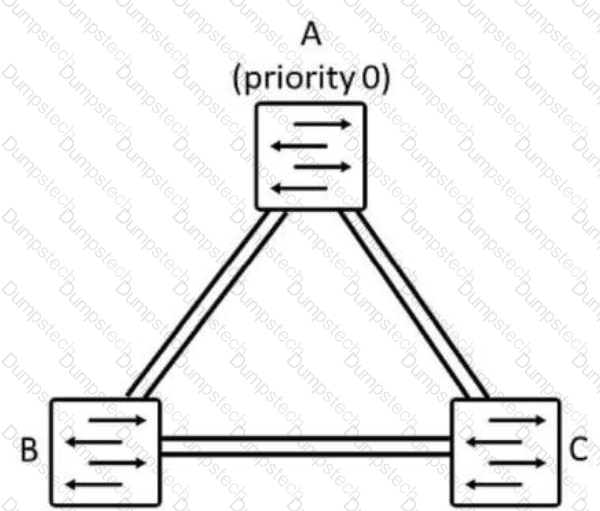
[Exhibit]

Question # 7

Click the Exhibit button.

You want the RSTP primary root path from switch C to traverse switch B.

Referring to the exhibit, which solution will accomplish this task?

Options:

A.

Set switch B priority to 1.

B.

Set the metrics from switch C directly to switch A higher than the combined metrics of switch C through switch B to switch A.

C.

Set the metrics from switch C directly to switch A lower than the combined metrics of switch C through switch B to switch A.

D.

Set switch B priority to 0.

Questions # 8:

A GRE tunnel is experiencing fragmentation issues. You confirm that the tunnel is up and is functioning correctly. You confirm that hosts are sending 1500-byte packets.

In this scenario, which statement is correct?

Options:

A.

You should use the clear-dont-fragment parameter to allow fragmentation.

B.

You should lower the physical interface's MTU to 1476 bytes to avoid fragmentation.

C.

You should enable BFD to more rapidly identify tunnel link failures.

D.

You should use ToS copying to reduce header size.

Questions # 9:

Which statement describes the additional overhead added when a packet is encapsulated in a GRE tunnel?

Options:

A.

GRE adds 12 bytes of overhead to each packet.

B.

GRE adds 32 bytes of overhead to each packet.

C.

GRE adds 24 bytes of overhead to each packet.

D.

GRE adds 20 bytes of overhead to each packet.

Questions # 10:

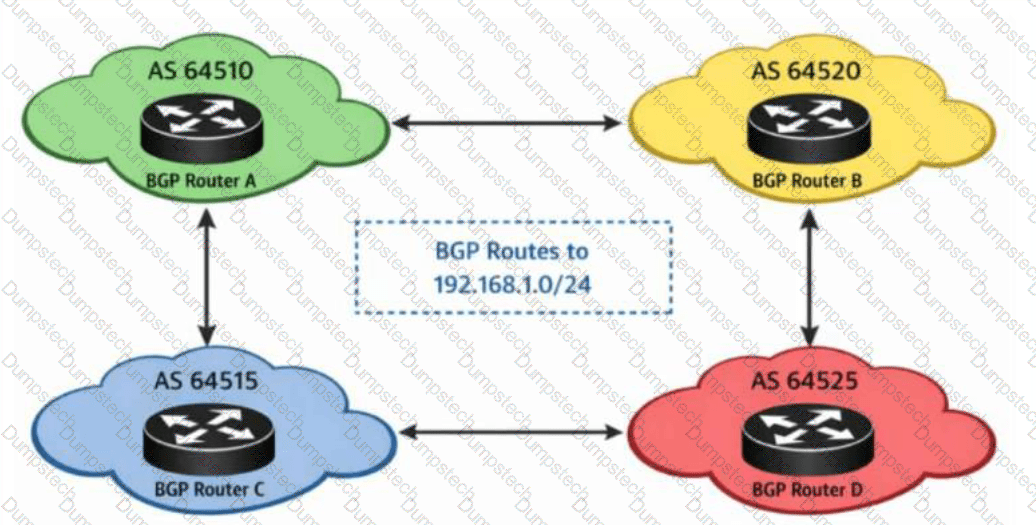
[Exhibit]

Question # 10

Click the Exhibit button.

A network includes several autonomous systems that exchange routing information using BGP. Multiple BGP routes exist for the same prefix.

Referring to the exhibit, which attribute would BGP use first when selecting a preferred route?

Options:

A.

local preference

B.

AS path length

C.

origin type

D.

MED

Viewing page 1 out of 2 pages
Viewing questions 1-10 out of questions