
Spring Sale Limited Time 70% Discount Offer - Ends in 0d 00h 00m 00s - Coupon code = simple70

Pass the Juniper JNCIS-DC JN0-481 Questions and answers with Dumpstech

Exam JN0-481 Premium Access

View all detail and faqs for the JN0-481 exam

Practice at least 50% of the questions to maximize your chances of passing.
Viewing page 1 out of 2 pages
Viewing questions 1-10 out of questions
Questions # 1:

Which element of an intent-based analytics (IBA) probe is used to specify the database objects to which the probe will apply?

Options:

A.

Reference design schema

B.

Graph query

C.

Database nodes

D.

Node-edge relationship

Questions # 2:

You are creating a template using Juniper Apstra. In this scenario, what is a rack-based design compared to a pod-based design?

Options:

A.

A rack-based design allows the operator to select a specified number of downlinked servers, whereas a pod-based design only allows the operator to select fixed “pods” of servers.

B.

A rack-based design refers to a three-stage Clos, and a pod design refers to a five-stage Clos.

C.

A rack-based design is suitable for physical servers, whereas a pod-based design is used for Kubernetes deployments.

D.

A rack-based design connects local servers only, whereas a pod-based design can include virtual workloads in a public cloud.

Questions # 3:

You are trying to deploy a five-stage template to a blueprint as shown in the exhibit. You cannot see your template name in the list of available templates.
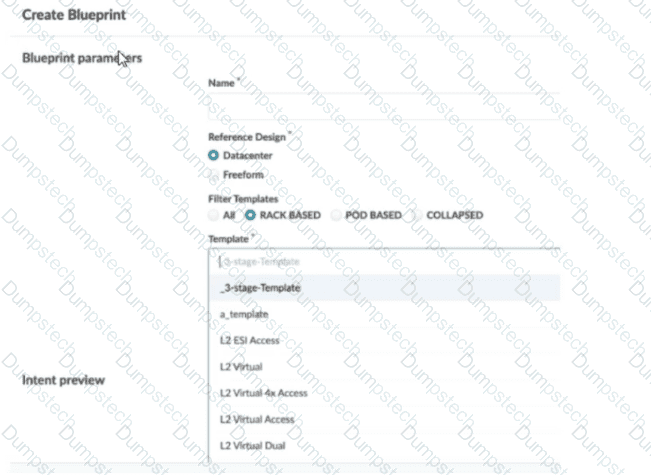
Question # 3

In this scenario, which statement is correct?

Options:

A.

The Collapsed option should be selected.

B.

You must include “five-stage” in the template name for it to appear in the list.

C.

The Pod Based option should be selected.

D.

Only Freeform-type blueprints support five-stage templates.

Questions # 4:

What are two system-defined user roles that are available in Juniper Apstra? (Choose two.)

Options:

A.

authorized

B.

root

C.

viewer

D.

user

Questions # 5:

You are allowed to assign tags for which three objects? (Choose three.)

Options:

A.

Virtual networks

B.

Interfaces

C.

Generic systems

D.

Property sets

E.

Device profiles

Questions # 6:

The analytics probe shown in the exhibit is enabled.
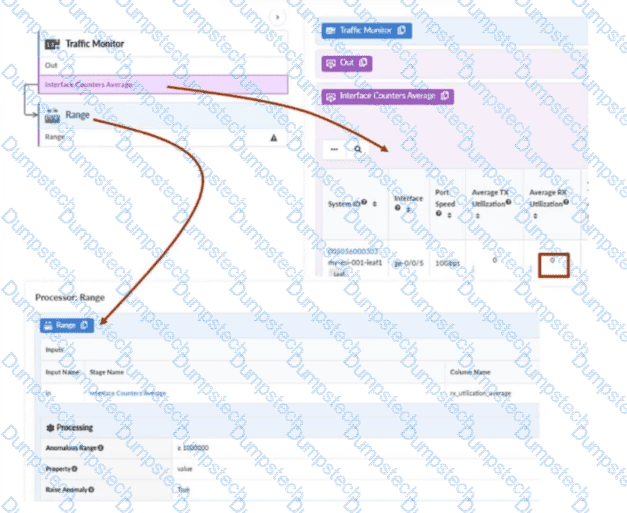
Question # 6

The ge-0/0/5 interface on the my-esl-001-leaf1 node receives an average of greater than 1 Mbps of traffic. Which two statements are correct in this scenario? (Choose two.)

Options:

A.

A probe anomaly will be raised.

B.

The indicator for the Analytics tab in the blueprint will turn red.

C.

The indicator for the Active tab in the blueprint will turn red.

D.

A service anomaly will be raised.

Questions # 7:

What are two agent processes that operate within the Juniper Apstra device agent? (Choose two.)

Options:

A.

Routing agent

B.

Authentication agent

C.

Telemetry agent

D.

Deployment agent

Questions # 8:

In a three-stage Clos network, what are important key design aspects of a data center fabric? (Choose two.)

Options:

A.

External traffic enters and exits the spine devices.

B.

Fabric traffic enters and exits the border devices.

C.

Servers are connected to leaf devices.

D.

Servers are connected to spine devices.

Questions # 9:

What are two types of virtual networks defined inside Juniper Apstra software? (Choose two.)

Options:

A.

VLAN

B.

L3 VPN

C.

VXLAN

D.

L2 VPN

Questions # 10:

You want to assign resources to your blueprint during the deployment phase. In this scenario, which statement is correct?

Options:

A.

To assign resources in the blueprint, you must have completed the device profile and device assignments.

B.

To assign resources in the blueprint, you must have already created them under global resources.

C.

All resources are created and assigned under the blueprint's Resources tab.

D.

All resources are automatically assigned values from the available resource pools.

Viewing page 1 out of 2 pages
Viewing questions 1-10 out of questions