Juniper Certification Exams Pack
Everything from Basic, plus:
- Exam Name: Data Center - Specialist (JNCIS-DC)
- 65 Questions Answers with Explanation Detail
- Total Questions: 65 Q&A's
- Single Choice Questions: 40 Q&A's
- Multiple Choice Questions: 25 Q&A's


Students Passed
Average Score
Questions came word for word
Years Teaching
Explore other related Juniper exams to broaden your certification path. These certifications complement your skills and open new opportunities for career growth.
Know how you can make it happen
If you're looking to secure JNCIS-DC (JN0-481) certification, remember there's no royal path to it. It's your prep for this exam that can make the difference. Stay away from those low-quality exam PDFs and unreliable dumps that have no credibility. What you need is a simulated practice exam with practice questions that mirror the actual JN0-481 test environment.
To save you from frustration, Dumpstech comes with a comprehensive prep system that is clear, effective, and built to help you succeed without the least chance of failure. Whether you're looking for sample test questions or full exam practice questions for the Data Center - Specialist (JNCIS-DC), our system delivers.
It's overwhelmingly recommended by thousands of Dumpstech's loyal customers as practical, relevant and intuitively crafted to match the candidates' actual exam needs. Our prep questions are designed to build real confidence for the SY0-701 test.
Dumpstech's Juniper exam JN0-481 questions are designed to deliver you the essence of the entire syllabus. Each question mirrors the real exam format and comes with an accurate and verified answer. These exam questions and answers give you the clarity you need. Dumpstech's prep system is not mere cramming; it is crafted to add real information and impart deep conceptual understanding to the exam candidates. After each test, review the practice exam answers to identify your weak spots.
Dumpstech's smart testing engine generates multiple mock tests to develop familiarity with the real exam format and learn thoroughly the most significant from the perspective of Juniper JN0-481 real exam. They also support you to revise the syllabus and enhance your efficiency to answer all exam practice questions within the time limit.
Dumpstech offers you the most authentic, accurate, and current information that liberates you from the hassle of searching for any other study resource. If you're looking for a free practice test with answers to evaluate our quality before you commit, download our free demo and see for yourself. This comprehensive resource equips you perfectly to develop confidence and clarity to answer exam queries.
Dumpstech's authentic and up-to-date content guarantees you success in the Data Center - Specialist (JNCIS-DC) certification exam. If you perchance you lose your exam despite your reliance on Dumpstech's exam questions PDF, Dumpstech doesn't leave you alone. You have the option of taking back refund of your money or try a different exam paying no additional amount.
If you want to crack the Data Center - Specialist (JNCIS-DC) (JN0-481) exam in one go, your journey starts here. Dumpstech is your real ally that gets you certified fast with the least possibility of losing your chance.
Which element of an intent-based analytics (IBA) probe is used to specify the database objects to which the probe will apply?
|
B
|
|---|
|
Explanation
In Apstra 5.1, Intent-Based Analytics (IBA) is built on Apstra’s graph-based source of truth, where devices, interfaces, links, routing constructs, and services are represented as nodes with relationships. An IBA probe is effectively a processing pipeline (a directed acyclic graph of stages and processors) that ingests telemetry and then performs calculations, aggregations, and anomaly detection. To make any of that work, the probe must first determine which specific objects in the graph—for example, which leaf switches, which uplinks, which BGP sessions, or which interface counters—should be included in the analysis. The probe element that selects those objects is the graph query. A graph query is evaluated against Apstra’s graph database to return a set of matching nodes/relationships; those query results then become the scope for ingestion and subsequent processing. In other words, the graph query defines “apply this probe to these devices/interfaces/sessions,” and it also provides the context used to bind telemetry identities (key-value pairs describing the metric source) to the correct logical objects in the blueprint. This is why Apstra documentation describes early probe processors producing outputs whose cardinality aligns with the number of results returned by the specified graph query(s). Without a graph query, the probe would not have a deterministic, intent-aligned target set for analytics, and the same probe definition could not be reliably reused across fabrics or blueprints. |
You are creating a template using Juniper Apstra. In this scenario, what is a rack-based design compared to a pod-based design?
|
B
|
|---|
|
Explanation
In Apstra 5.1, templates are used to describe the intended structure of a data center fabric. A rack-based template is used to build the common 3-stage Clos model (spines connected to racks containing leaf/top-of-rack switches and endpoints). In this design, you define the spine logical devices, select one or more rack types, specify rack counts, and define the intended connectivity between spines and racks. This directly models a leaf-spine IP fabric typically used for EVPN-VXLAN in modern data centers. A pod-based template, by contrast, is explicitly used to build 5-stage Clos networks. In Apstra’s terminology, a pod-based template is essentially a “template of templates”: it combines one or more rack-based templates (each representing a 3-stage pod) and adds an additional superspine layer to interconnect those pods into a larger, scalable fabric. This is the architectural distinction: rack-based describes the leaf-spine pod, while pod-based describes the multi-pod superspine architecture. For Junos v24.4 EVPN-VXLAN deployments, the difference matters operationally because 5-stage fabrics introduce additional tiers and scaling considerations (for example, superspine connectivity and expanded ECMP domains). Apstra’s template hierarchy ensures consistent intent modeling across both 3-stage and 5-stage topologies without requiring operators to manually redesign the fabric logic each time they scale out. Verified Juniper sources (URLs): https://www.juniper.net/documentation/us/en/software/apstra5.1/apstra-user-guide/topics/concept/templates.html https://www.juniper.net/documentation/us/en/software/apstra5.1/apstra-user-guide/topics/task/template-create-pod-based.html https://www.juniper.net/documentation/us/en/software/apstra5.1/apstra-user-guide/topics/topic-map/5-stage-clos.html |
You are trying to deploy a five-stage template to a blueprint as shown in the exhibit. You cannot see your template name in the list of available templates.
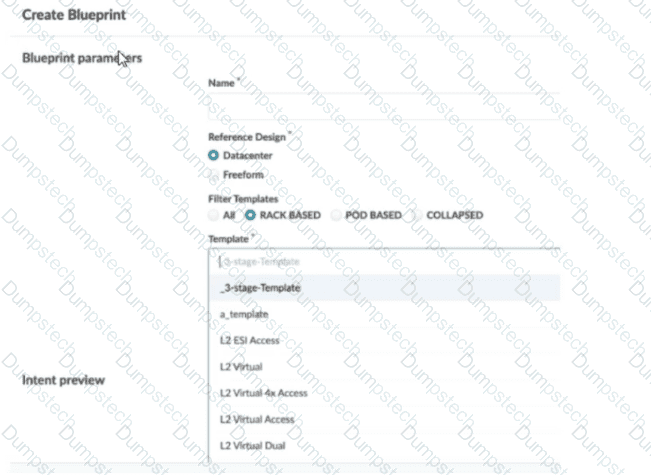
In this scenario, which statement is correct?
|
C
|
|---|
|
Explanation
In Apstra 5.1, templates are organized by template type, and the Create Blueprint screen can filter the template list by those types. A five-stage Clos design in Apstra is represented as a pod-based template (multi-pod fabric with an additional tier such as super-spines to interconnect pods). Because of that, a five-stage template will only appear in the template selector when the Pod Based filter is chosen. If the filter is set to Rack Based or Collapsed, Apstra hides pod-based templates because those types correspond to different topology classes: rack-based aligns with a three-stage leaf–spine pod, while collapsed aligns with a spine-less topology pattern. This behavior is by design to prevent selecting an incompatible template for the intended topology. The template name itself does not need to contain “five-stage”; Apstra determines its type from how the template was created and stored in the catalog. Also, five-stage templates are not limited to Freeform blueprints—five-stage is a data center fabric topology choice, and it is supported within the data center reference design workflows when the appropriate template type is selected. So, to make the five-stage template visible and selectable, choose Pod Based in the template filter. |
See how DumpsTech helps candidates pass with confidence.
Stay ahead in your career with the latest certification exams from leading vendors. DumpsTech brings you newly released exams with reliable study resources to help you prepare confidently.
Find answers to the most common questions about the Juniper JN0-481 exam, including what it is, how to prepare, and how it can boost your career.