Spring Sale Limited Time 70% Discount Offer - Ends in 0d 00h 00m 00s - Coupon code = simple70

Pass the Juniper JNCIP-ENT JN0-650 Questions and answers with Dumpstech

Exam JN0-650 Premium Access

View all detail and faqs for the JN0-650 exam

Practice at least 50% of the questions to maximize your chances of passing.
Viewing page 1 out of 2 pages
Viewing questions 1-10 out of questions
Questions # 1:

Exhibit

You are asked to configure VLAN load balancing on your network using MSTP. Referring to the exhibit, which two statements are correct? (Choose two.)

Options:

A.

Switch1 will be the root bridge for msti 1.

B.

Switch1 will be the root bridge for msti 2.

C.

Switch 1 will not assume the role of root bridge for both mstil and msti2 if Switch2 goes down.

D.

Switch1 will assume the role of root bridge for both mstil and msti2 if Switch2 goes down.

Questions # 2:

Which two statements are correct about multicast routing tables? (Choose two.)

Options:

A.

inet. 2 is used when the multicast forwarding topology differs from unicast forwarding

B.

MBGP and IS-IS place routes in met. l directly.

C.

inet. 0 is used for RPF checks.

D.

IS-IS and OSPFv3 place routes in met. 2 directly.

Questions # 3:

Exhibit

You need to configure the non-RP routers in your network to dynamically learn the location of the RP using standard protocols only. You have already applied the configuration shown in the exhibit, but the routers have not learned the location of the RP.

Which additional step must you take to fulfill these requirements?

Options:

A.

Configure MSDP.

B.

Configure BSR.

C.

Configure Anycast RP.

D.

Configure Auto-RP

Questions # 4:

Exhibit

You configured MVRP in your Layer 2 network using the configuration shown in the exhibit. You verified that the appropnate VLANs are configured and applied on the two access switches. You are using RSTP as your loop prevention mechanism. Unfortunately, the users are not able to communicate with their corresponding server attached to the Access-2 switch.

In this scenario, what should you do to solve this problem?

Options:

A.

Configure VSTP instead of RSTP as your loop-prevention mechanism.

B.

Configure the access interfaces on the Access-2 switch under MVRP.

C.

Configure the ge-070716.0 interface on the Core-1 switch under MVRP.

D.

Configure the access interfaces on the Access-1 switch under MVRP.

Questions # 5:

Exhibit.

Referring to the exhibit, which statement is correct?

Options:

A.

The device with the highest IP address is elected as the DR.

B.

The OSPF state will be stuck in the Exstart state

C.

The OSPF state will be stuck in the 2Nay state

D.

The device with the lowest IP address is elected as the DR.

Questions # 6:

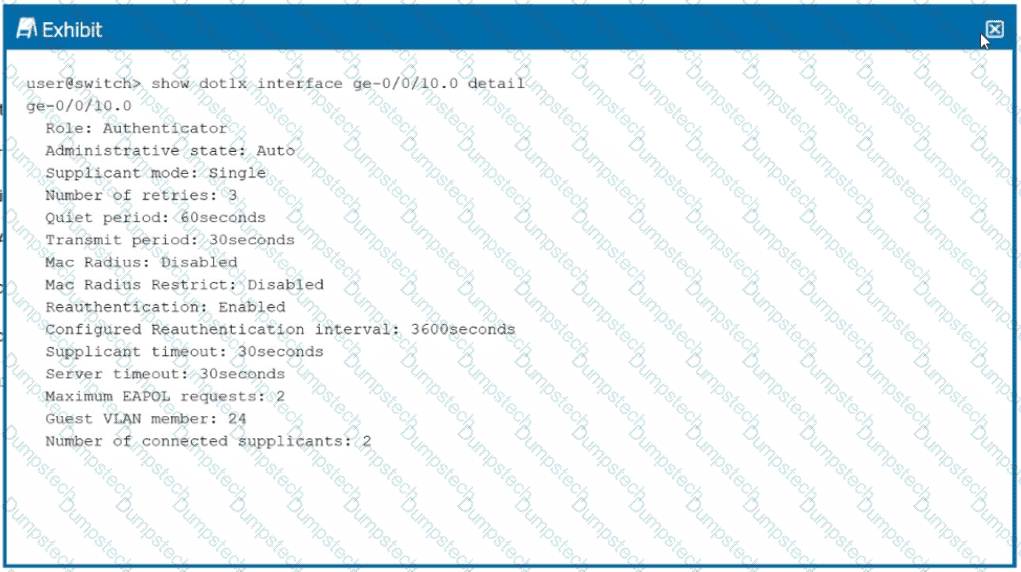
Exhibit.Question # 6

You want to limit port access to only one device at a time.

Referring to the exhibit, which configuration change will accomplish this task?

Options:

A.

Enable MAC RADIUS restrict.

B.

Change the supplicant mode to multiple.

C.

Change the supplicant mode to single-secure.

D.

Change the maximum EAPOL request to l.

Questions # 7:

You are enabling CoS throughout your enterprise network using the DSCP bits. You plan to use an MF classifier on all edge devices while using BA classifiers on all transit core devices

In this scenario, what should you use to provide consistent handling of traffic?

Options:

A.

You should implement rewrite rules on the edge devices' egress interfaces to rewrite the DSCP bits as it leaves the device toward the core.

B.

You should implement rewrite rules on the edge devices' ingress interfaces to rewrite the DSCP bits as it enters the device.

C.

You should implement rewrite rules on the core devices' ingress interfaces to rewrite the DSCP bits as it enters the device.

D.

You should implement rewrite rules on the core devices' egress interfaces to rewrite the DSCP bits as it leaves the device toward other core devices.

Questions # 8:

You have created a private community VLAN called RND The private community VLAN works fine within switch S1, but traffic in the private RND community VLAN does not reach VLAN members connected to switch S2.

Which statement is correct in this scenario?

Options:

A.

The RND Community VLAN needs to have the same 802.1Q tag as its parent VLAN

B.

The RND community VLAN needs to have an associated 802.1Q tag associated with it.

C.

The RND Community VLAN needs to be stripped of all 802.1Q tags.

D.

The RND community VLAN needs to be defined as an isolated VLAN.

Questions # 9:

Exhibit

You are deploying a new campus switching environment using various EX Series switch models. The devices attached to one of the new EX Senes switches include IP phones, loT devices, and wireless access points (APs) requiring power over Ethernet (PoE) with varying power requirements. A sample output from one of these switches is shown in the exhibit.

In this scenario, which two statements are correct? (Choose two.)

Options:

A.

The switch is capable of supplying up to 60 W of power to attached PoE devices.

B.

Port ge-0/0/0 is enabled and has its maximum power and device class designations statically configured.

C.

Port ge-0/0/0 is enabled and has dynamically learned maximum power and device class designations.

D.

The switch is capable of supplying up to 30 W of power to attached PoE devices.

Questions # 10:

You run a multivendor switching environment where you have configured VSTP. You have 450 VLANs and notice that some of your VLANs do not function properly. How should you change the configuration to get all 450 VLANs working?

Options:

A.

Include the force-version stp; statement in your configuration

B.

Enable RSTP to handle additional VLANs.

C.

Set the VLAN max-age to 3600 or more.

D.

Increase the bridge priority on all VLANs to at least 16k.

Viewing page 1 out of 2 pages
Viewing questions 1-10 out of questions