
75only - Ends in 0d 00h 00m 00s - Coupon code = 75only
Pass the Microsoft Certified: Azure Database Administrator Associate DP-300 Questions and answers with Dumpstech
You have an Azure subscription that contains an Azure SQL database named DB1.
You need to configure Query Store Capture Mode for DB1. The solution must meet the following requirements:
• Ensure that only queries that have significant resource consumption are tracked.
• Minimize administrative effort
To what should you set Query Store Capture Mode?
Options:
None
Custom
Auto
All
Basic Concept: This question tests monitor, configure, and optimize database resources in the DP-300 exam context. The correct choice is determined by the exact service boundary and operational requirement stated in the scenario.
Why C is Correct: Auto matches the expected DP-300 administration action. Auto is related to operational monitoring or tuning, but it must match the exact signal needed: query history, resource utilization, wait/blocking detail, or automatic remediation. The question is not asking for a general Azure capability; it is asking for the feature that produces this result: You need to configure Query Store Capture Mode for DB1.
Why A is Wrong: None is related to operational monitoring or tuning, but it must match the exact signal needed: query history, resource utilization, wait/blocking detail, or automatic remediation. It would produce a different operational signal than the one needed to investigate, alert, or tune the workload in this question.
Why B is Wrong: Custom is related to operational monitoring or tuning, but it must match the exact signal needed: query history, resource utilization, wait/blocking detail, or automatic remediation. It does not expose the required metric, query history, wait/blocking signal, or tuning mechanism; using it would not give the administrator the evidence requested.
Why D is Wrong: All is related to operational monitoring or tuning, but it must match the exact signal needed: query history, resource utilization, wait/blocking detail, or automatic remediation. It would produce a different operational signal than the one needed to investigate, alert, or tune the workload in this question.
You have an Azure SQL Database failover group named AzFG1.
You plan to run the following CLI command.
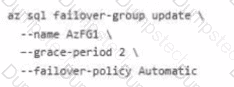
How will this affect AzFG1?
Options:
Up to two hours of data will be lost during an automatic failover.
Automatic failover will occur after a minimum of two hours.
A forced failover cannot be initiated during the grace period.
AzFG1 will attempt to fail back within two hours.
Basic Concept: This question tests high availability and disaster recovery design for Azure SQL, SQL Server on Azure VMs, and regional failure scenarios.
Why B is Correct: Automatic failover will occur after a minimum of two hours. is part of the availability or recovery design space, but the correct choice must satisfy the specified failover, restore, quorum, RPO, or RTO requirement. In this scenario, the important constraint is: You have an Azure SQL Database failover group named AzFG1. Automatic failover will occur after a minimum of two hours. satisfies that constraint without adding an unrelated service or manual process.
Why A is Wrong: Up to two hours of data will be lost during an automatic failover. is part of the availability or recovery design space, but the correct choice must satisfy the specified failover, restore, quorum, RPO, or RTO requirement. It is not wrong technology in general, but it is the wrong HA/DR control for this scenario ' s failure model.
Why C is Wrong: A forced failover cannot be initiated during the grace period. is part of the availability or recovery design space, but the correct choice must satisfy the specified failover, restore, quorum, RPO, or RTO requirement. It handles a different resilience pattern and would not deliver the failover or recovery behavior required here.
Why D is Wrong: AzFG1 will attempt to fail back within two hours. is part of the availability or recovery design space, but the correct choice must satisfy the specified failover, restore, quorum, RPO, or RTO requirement. It is not wrong technology in general, but it is the wrong HA/DR control for this scenario ' s failure model.
Task 12
You need to configure high availability for dbl. The solution must tolerate the loss of an Azure datacenter without data loss or the need to modify application connection strings.
Options:
See the explanation part for the complete Solution.
To configure high availability for dbl, you can use the failover groups feature of Azure SQL Database. Failover groups allow you to manage the replication and failover of a group of databases across different regions with the same connection strings1. You can choose all, or a subset of, user databases in a logical server to be replicated to another logical server in a different region. You can also specify the failover policy, such as manual or automatic, and the grace period for data loss.
Here are the steps to create a failover group for dbl:
Using the Azure portal:
Go to the Azure portal and select your Azure SQL Database server that hosts dbl.
Select Failover groups in the left menu and click on Add group.
Enter a name for the failover group and select a secondary region that is different from the primary region.
Click on Create a new server and enter the details for the secondary server, such as server name, admin login, password, and subscription.
Click on Select existing database(s) and choose dbl from the list of databases on the primary server.
Click on Configure failover policy and select the failover mode, grace period, and read-write failover endpoint mode according to your preferences.
Click on Create to create the failover group and start the replication of dbl to the secondary server.
Using PowerShell commands:
Install the Azure PowerShell module and log in with your Azure account.
Run the following command to create a new server in the secondary region: New-AzSqlServer -ResourceGroupName < your-resource-group-name > -ServerName < your-secondary-server-name > -Location " < secondary-region-name > " -SqlAdministratorCredentials $(New-Object -TypeName System.Management.Automation.PSCredential -ArgumentList " < your-admin-login > " , $(ConvertTo-SecureString -String " < your-password > " -AsPlainText -Force))
Run the following command to create a new failover group with dbl: New-AzSqlDatabaseFailoverGroup -ResourceGroupName < your-resource-group-name > -ServerName < your-primary-server-name > -PartnerResourceGroupName < your-resource-group-name > -PartnerServerName < your-secondary-server-name > -FailoverGroupName < your-failover-group-name > -Database dbl -FailoverPolicy < manual-or-automatic > -GracePeriodWithDataLossHours < grace-period-in-hours > -ReadWriteFailoverEndpoint " < enabled-or-disabled > "
You can modify the parameters of the command according to your preferences, such as the failover policy, grace period, and read-write failover endpoint mode.
These are the steps to create a failover group for dbl
Task 5
You need to generate an email alert for db1 if the average CPU percentage utilization is greater than 50 percent for five minutes sampled at one-minute intervals. The alert must be sent to admin@contoso.com.
You may need to use SQL Server Management Studio and the Azure portal.
Options:
See the explanation part for the complete Solution.
Create an Azure Monitor metric alert rule on database db1 using the metric:
CPU percentage
Configure the condition as:
Aggregation: Average
Operator: Greater than
Threshold: 50
Aggregation granularity / Period: 1 minute
Frequency of evaluation: 1 minute
Evaluation period / Lookback window: 5 minutes
Action group email: admin@contoso.com
Azure SQL Database exposes CPU percentage as a platform metric, and Azure Monitor metric alerts can send notifications through action groups such as email. Microsoft describes SQL Database alerts as metric-based alerts that can send email when metrics such as CPU usage reach a defined threshold.
Azure Portal Method — Recommended for Simulation
Step 1: Open the db1 Azure SQL database
Sign in to the Azure portal.
Search for SQL databases.
Open the database named:
db1
Do not open the SQL logical server unless the alert needs to apply to all databases. This task is specifically for db1, so the alert scope must be the db1 database resource.
Step 2: Create a new alert rule
From the db1 database page:
In the left menu, select Alerts.
Select Create.
Select Alert rule.
Microsoft’s Azure Monitor workflow allows you to create an alert rule directly from the target resource. When you create it from a resource, the resource is automatically set as the alert scope.
Step 3: Confirm the alert scope
On the alert rule page, confirm the scope is the Azure SQL database:
db1
The resource type should be similar to:
SQL database
Microsoft.Sql/servers/databases
If the scope is the SQL server instead of the database, remove it and select the db1 database resource.
Step 4: Add the alert condition
Under Condition, select Add condition.
Choose the metric:
CPU percentage
Sometimes it appears as:
CPU percent
or metric name:
cpu_percent
For Azure SQL Database, CPU percentage represents CPU consumption toward the database workload limit, expressed as a percentage.
Step 5: Configure the signal logic
Configure the alert logic exactly like this:
Setting
Value
Threshold type
Static
Aggregation type
Average
Operator
Greater than
Threshold value
50
Unit
Percent
Aggregation granularity / Period
1 minute
Frequency of evaluation
1 minute
Evaluation period / Lookback window
5 minutes
This means Azure Monitor evaluates the CPU metric every minute, using one-minute metric samples, and fires the alert only when the average CPU percentage is greater than 50% across the five-minute evaluation window.
Be precise here. The task says:
average CPU percentage utilization is greater than 50 percent for five minutes sampled at one-minute intervals
So the correct choices are:
Average
Greater than 50
Every 1 minute
Over the last 5 minutes
Azure Monitor metric alert rules combine the monitored resource, the metric condition, and action groups that run when the condition is met.
Step 6: Create the email action group
Under Actions, select:
Create action group
Configure the basics:
Setting
Value
Subscription
Use the current subscription
Resource group
Use the lab resource group
Action group name
AG-db1-CPU-Email
Display name
db1CPU
Then go to Notifications.
Add a notification:
Setting
Value
Notification type
Email/SMS message/Push/Voice
Name
EmailAdmin
admin@contoso.com
Select OK, then Review + create, then Create.
Action groups define the notification or automation action that runs when an alert fires. Microsoft documents email as a supported action group notification type.
Step 7: Configure alert rule details
Under Details, configure:
Setting
Value
Severity
2 or 3
Alert rule name
db1 CPU greater than 50 percent
Description
Alert when average CPU percentage for db1 is greater than 50 percent for 5 minutes.
Enable upon creation
Yes
Severity is usually not specified by the task, so any reasonable severity is acceptable. In an exam lab, I would use Severity 2 for CPU performance impact.
Step 8: Review and create
Select Review + create.
Confirm the condition says something equivalent to:
Whenever the average CPU percentage is greater than 50
Confirm the evaluation settings are:
Check every 1 minute
Lookback period 5 minutes
Confirm the action group sends email to:
admin@contoso.com
Select Create.
Verification
After creation:
Open db1.
Go to Alerts.
Select Alert rules.
Confirm the alert rule exists and is enabled.
Open the rule and verify:
Scope: db1
Signal: CPU percentage
Aggregation: Average
Operator: Greater than
Threshold: 50
Evaluation frequency: 1 minute
Window size: 5 minutes
Action group: admin@contoso.com
Azure CLI Method
Use this only if the simulation gives you Cloud Shell.
First get the database resource ID:
az sql db show \
--resource-group < resource-group-name > \
--server < sql-server-name > \
--name db1 \
--query id \
--output tsv
Create the action group:
az monitor action-group create \
--resource-group < resource-group-name > \
--name AG-db1-CPU-Email \
--short-name db1CPU \
--action email EmailAdmin admin@contoso.com
Create the metric alert:
az monitor metrics alert create \
--name " db1 CPU greater than 50 percent " \
--resource-group < resource-group-name > \
--scopes < db1-resource-id > \
--condition " avg cpu_percent > 50 " \
--window-size 5m \
--evaluation-frequency 1m \
--action AG-db1-CPU-Email \
--description " Alert when average CPU percentage for db1 is greater than 50 percent for 5 minutes. "
The metric name commonly used for Azure SQL Database CPU percentage in CLI/ARM contexts is:
cpu_percent
SSMS Clarification
SSMS is not the correct tool for this task.
Do not configure Database Mail. Azure SQL Database does not use SQL Server Agent/Database Mail in the same way as SQL Server on a VM or SQL Managed Instance. This requirement is an Azure Monitor metric alert requirement.
Correct tool:
Azure portal > db1 > Alerts > Create alert rule
Wrong tool:
SSMS Database Mail
Final Exam-Lab Configuration
Use this exact configuration:
Resource: db1
Alert type: Metric alert
Metric: CPU percentage
Aggregation: Average
Operator: Greater than
Threshold: 50
Aggregation granularity: 1 minute
Evaluation frequency: 1 minute
Evaluation period/window: 5 minutes
Action group notification: Email
Email recipient: admin@contoso.com
That completes the task.
Task 1
In an Azure SQL database named db1, you need to enable page compression on the PK_SalesOrderHeader_SalesOrderlD clustered index of the SalesLT.SalesOrderHeader table.
Options:
See the explanation part for the complete Solution.
To enable page compression on the PK_SalesOrderHeader_SalesOrderlD clustered index of the SalesLT.SalesOrderHeader table in db1, you can use the following Transact-SQL script:
-- Connect to the Azure SQL database named db1
USE db1;
GO
-- Enable page compression on the clustered index
ALTER INDEX PK_SalesOrderHeader_SalesOrderlD ON SalesLT.SalesOrderHeader
REBUILD WITH (DATA_COMPRESSION = PAGE);
GO
This script will rebuild the clustered index with page compression, which can reduce the storage space and improve the query performance
The script solution consists of three parts:
The first part is USE db1; GO. This part connects to the Azure SQL database named db1, where the SalesLT.SalesOrderHeader table is located. The GO command separates the batches of Transact-SQL statements and sends them to the server.
The second part is ALTER INDEX PK_SalesOrderHeader_SalesOrderlD ON SalesLT.SalesOrderHeader REBUILD WITH (DATA_COMPRESSION = PAGE); GO. This part enables page compression on the clustered index named PK_SalesOrderHeader_SalesOrderlD, which is defined on the SalesLT.SalesOrderHeader table. The ALTER INDEX statement modifies the properties of an existing index. The REBUILD option rebuilds the index from scratch, which is required to change the compression setting. The DATA_COMPRESSION = PAGE option specifies that page compression is applied to the index, which means that both row and prefix compression are used. Page compression can reduce the storage space and improve the query performance by compressing the data at the page level. The GO command ends the batch of statements.
The third part is optional, but it can be useful to verify the compression status of the index. It is SELECT name, index_id, data_compression_desc FROM sys.indexes WHERE object_id = OBJECT_ID( ' SalesLT.SalesOrderHeader ' );. This part queries the sys.indexes catalog view, which contains information about the indexes in the database. The SELECT statement returns the name, index_id, and data_compression_desc columns for the indexes that belong to the SalesLT.SalesOrderHeader table. The OBJECT_ID function returns the object identification number for the table name. The data_compression_desc column shows the compression type of the index, which should be PAGE for the clustered index after the script is executed.
These are the steps of the script solution for enabling page compression on the clustered index of the SalesLT.SalesOrderHeader table in db1.
Task 11
You have a legacy application written for Microsoft SQL Server 2012. The application will be the only application that accesses db1 You need to ensure that db1 is compatible with all the features and syntax of SQL Server 2012.
Options:
See the explanation part for the complete Solution.
To ensure that db1 is compatible with all the features and syntax of SQL Server 2012, you need to set the compatibility level of the database to 110, which is the compatibility level for SQL Server 20121. The compatibility level affects the behavior of certain Transact-SQL statements and features, and determines how the database engine interprets the SQL code2.
You can set the compatibility level of db1 by using the Azure portal or Transact-SQL statements. Here are the steps for both methods:
Using the Azure portal:
Go to the Azure portal and select your Azure SQL Database server that hosts db1.
Select the database db1 and click on Query Performance Insight in the left menu.
Click on Configure Query Store and select 110 from the Compatibility level dropdown list.
Click on Save to apply the change.
Using Transact-SQL statements:
Connect to db1 using SQL Server Management Studio, Azure Data Studio, or any other tool that supports Transact-SQL statements.
Open a new query window and run the following command: ALTER DATABASE db1 SET COMPATIBILITY_LEVEL = 110; GO
This command will set the compatibility level of db1 to 110, which is equivalent to SQL Server 2012.
These are the steps to set the compatibility level of db1 to 110.
Task 8
You plan to perform performance testing of db1.
You need prevent db1 from reverting to the last known good query plan.
Options:
See the explanation part for the complete Solution.
To prevent db1 from reverting to the last known good query plan, you need to disable the automatic plan correction feature for the database. This feature is enabled by default and allows the Query Store to detect and fix plan performance regressions by forcing the last good plan1. However, if you want to test the performance of different plans without interference from the Query Store, you can turn off this feature by using the ALTER DATABASE SCOPED CONFIGURATION statement2.
Here are the steps to disable the automatic plan correction feature for db1:
Connect to db1 using SQL Server Management Studio, Azure Data Studio, or any other tool that supports Transact-SQL statements.
Open a new query window and run the following command: ALTER DATABASE SCOPED CONFIGURATION SET AUTOMATIC_TUNING (FORCE_LAST_GOOD_PLAN = OFF); GO
This command will disable the automatic plan correction feature for db1 and allow the Query Optimizer to choose the best plan based on the current statistics and parameters3.
To verify that the automatic plan correction feature is disabled for db1, you can query the sys.database_scoped_configurations catalog view. The value of the force_last_good_plan column should be 0 for db1.
These are the steps to disable the automatic plan correction feature for db1.
Task 6
You need to ensure that you can connect to db1 by using a private IP address on a virtual network named VNET1 You may need to use SQL Server Management Studio and the Azure portal.
Options:
See the explanation part for the complete Solution.
Create an Azure Private Endpoint for the Azure SQL logical server that hosts db1, place the private endpoint in VNET1, and integrate it with the private DNS zone:
privatelink.database.windows.net
This is the correct solution because Azure SQL Database is a PaaS service. You do not assign a private IP directly to db1. Instead, Azure creates a private endpoint network interface in the virtual network. That private endpoint receives a private IP address from a subnet in VNET1, and clients in VNET1 use that private IP path to reach the SQL server. Microsoft defines a private endpoint as a network interface that uses a private IP address from your virtual network to connect privately to a Private Link resource such as Azure SQL Database.
Azure Portal Method — Recommended for Simulation
Step 1: Identify the SQL logical server that hosts db1
Sign in to the Azure portal.
Search for SQL databases.
Open db1.
On the database overview page, identify the Server name.
The private endpoint is created for the Azure SQL logical server, not for the database object alone. For Azure SQL Database, the Private Link resource type is:
Microsoft.Sql/servers
and the target subresource is:
sqlServer
Microsoft lists Azure SQL Database private endpoint DNS configuration under Microsoft.Sql/servers with subresource sqlServer.
Step 2: Open the SQL server networking page
Open the Azure SQL logical server that hosts db1.
In the left menu, go to:
Security > Networking
Select the Private access tab.
Select Create a private endpoint.
Microsoft’s Azure SQL private endpoint workflow is performed from the SQL server resource under Networking > Private access, where you can create or manage private endpoint connections.
Step 3: Configure the private endpoint basics
On the Create private endpoint page:
Setting
Value
Subscription
Use the lab subscription
Resource group
Use the lab resource group
Name
pe-db1-sql
Region
Same region as VNET1, if possible
The name is not exam-critical. The critical part is that the endpoint is associated with VNET1 and the SQL server that hosts db1.
Step 4: Configure the target resource
On the Resource tab, configure:
Setting
Value
Connection method
Connect to an Azure resource in my directory
Resource type
Microsoft.Sql/servers
Resource
SQL logical server that hosts db1
Target sub-resource
sqlServer
Do not choose storage, VM, managed instance, or any unrelated resource type. This is Azure SQL Database, so the target subresource must be sqlServer.
Step 5: Configure VNET1 and subnet
On the Virtual Network tab:
Setting
Value
Virtual network
VNET1
Subnet
Select an available subnet in VNET1
Private IP configuration
Dynamic is fine unless the lab requires static
Azure will create a network interface for the private endpoint and assign it a private IP address from the selected subnet. Microsoft notes that the network interface page for the private endpoint shows the private IP address assigned to the private endpoint connection.
Step 6: Configure private DNS integration
On the DNS tab:
Enable private DNS zone integration.
Use or create the private DNS zone:
privatelink.database.windows.net
Link the private DNS zone to:
VNET1
This is not optional in a clean exam solution. Without DNS integration, clients may still resolve the SQL server name to the public endpoint instead of the private endpoint. Microsoft states that DNS is critical because it resolves the private endpoint IP address, and for Azure SQL Database the recommended private DNS zone is privatelink.database.windows.net.
Step 7: Review and create
Select Review + create.
Confirm:
Resource: SQL logical server hosting db1
Target subresource: sqlServer
Virtual network: VNET1
Private DNS zone: privatelink.database.windows.net
Select Create.
After deployment, the SQL server will have a private endpoint connection associated with VNET1.
Step 8: Approve the private endpoint connection if required
In most same-directory deployments, approval may be automatic. If approval is pending:
Open the SQL logical server.
Go to:
Networking > Private access
Select the pending private endpoint connection.
Select Approve.
Microsoft documents that SQL administrators can approve or reject private endpoint connections from the SQL server private access page.
Step 9: Optional but recommended — Disable public network access
The task only says you need to connect by private IP from VNET1. It does not explicitly say to block public access. But if the exam expects private-only access, then disable public access after the private endpoint works.
On the SQL logical server:
Go to:
Security > Networking > Public access
Set Public network access to:
Disabled
or select:
Deny public network access
Save.
Be careful: Microsoft states that adding a private endpoint does not automatically block public routing to the logical server. Public access must be denied separately if you want private-only access.
How to Connect from SSMS
You should connect from a machine that is inside VNET1, such as an Azure VM joined to VNET1.
Step 1: Test DNS from a VM in VNET1
From a VM in VNET1, run:
nslookup < sql-server-name > .database.windows.net
Expected result: the name should resolve through the private endpoint path and return a private IP address from VNET1’s address space.
Microsoft explains that connection URLs do not change; DNS resolution is overridden so the existing service FQDN resolves to the private endpoint private IP address.
Step 2: Connect with SSMS
In SSMS, connect using the normal Azure SQL server name:
< sql-server-name > .database.windows.net
Then select database:
db1
Use normal SQL authentication or Microsoft Entra authentication.
Do not type the raw private IP address into SSMS unless the lab specifically forces it. For Azure SQL, the correct operational pattern is to connect to the SQL server FQDN and allow private DNS to resolve that FQDN to the private endpoint IP. Direct IP connection can cause TLS/certificate name problems because the server certificate matches the DNS name, not the private IP.
Verification
The task is complete when all of these are true:
Private endpoint exists for the SQL logical server hosting db1.
Target subresource is sqlServer.
The private endpoint is deployed into VNET1.
A private IP address is assigned to the private endpoint NIC.
Private DNS zone privatelink.database.windows.net exists.
The private DNS zone is linked to VNET1.
The SQL server FQDN resolves to the private endpoint private IP from inside VNET1.
SSMS can connect to db1 from a VM or client connected to VNET1.
Final Exam-Lab Action
Use the Azure portal and configure:
SQL server hosting db1
> Networking
> Private access
> Create private endpoint
Resource type: Microsoft.Sql/servers
Target subresource: sqlServer
Virtual network: VNET1
Private DNS zone: privatelink.database.windows.net
Then connect from a VM or client in VNET1 using:
< sql-server-name > .database.windows.net
That is the correct way to ensure db1 is reachable through a private IP address on VNET1.
Task 6
You need to ensure that any enhancements made to the Query Optimizer through patches are available to dbl and db2 on sql37006895.
Options:
See the explanation part for the complete Solution.
To ensure that any enhancements made to the Query Optimizer through patches are available to dbl and db2 on sql37006895, you need to enable the query optimizer hotfixes option for each database. This option allows you to use the latest query optimization improvements that are not enabled by default1. You can enable this option by using the ALTER DATABASE SCOPED CONFIGURATION statement2.
Here are the steps to enable the query optimizer hotfixes option for dbl and db2 on sql37006895:
Connect to sql37006895 using SQL Server Management Studio, Azure Data Studio, or any other tool that supports Transact-SQL statements.
Open a new query window and run the following commands for each database:
-- Switch to the database context
USE dbl;
GO
-- Enable the query optimizer hotfixes option
ALTER DATABASE SCOPED CONFIGURATION SET QUERY_OPTIMIZER_HOTFIXES = ON;
GO
Repeat the same commands for db2, replacing dbl with db2 in the USE statement.
To verify that the query optimizer hotfixes option is enabled for each database, you can query the sys.database_scoped_configurations catalog view. The value of the query_optimizer_hotfixes column should be 1 for both databases.
These are the steps to enable the query optimizer hotfixes option for dbl and db2 on sql37006895.
Task 3
You need to prevent users from accidentally deleting db1 from the Azure portal. You may need to use SQL Server Management Studio and the Azure portal.
Options:
See the explanation part for the complete Solution.
Apply an Azure Resource Manager Delete lock / CanNotDelete lock directly to the Azure SQL database resource db1.
Microsoft states that Azure resource locks can be applied at subscription, resource group, or resource scope to protect resources from accidental deletion or modification. In the Azure portal, the lock types are shown as Delete and Read-only; in CLI/PowerShell, they are called CanNotDelete and ReadOnly. A CanNotDelete/Delete lock allows users to read and modify the resource, but prevents deletion.
Azure Portal Method — Recommended for Simulation
Step 1: Open the database resource
Sign in to the Azure portal.
In the search bar, search for SQL databases.
Select the database named db1.
Make sure you select the database resource itself, not only the SQL logical server.
Step 2: Open Locks
In the left menu of db1, scroll to Settings.
Select Locks.
Select Add.
Step 3: Create the delete lock
Configure the lock as follows:
Setting
Value
Lock name
PreventDelete-db1
Lock type
Delete
Notes
Prevent accidental deletion of db1
Then select OK or Save.
In the portal, choose Delete, not Read-only. A Read-only lock is too restrictive because it can block management updates. For this task, the requirement is only to stop accidental deletion, so Delete / CanNotDelete is the correct lock type. Microsoft confirms that CanNotDelete prevents deletion but still permits reading and modifying the resource.
Step 4: Verify the lock
Stay on the db1 database page.
Go back to Locks.
Confirm the lock exists with:
Name: PreventDelete-db1
Lock type: Delete
The task is complete once db1 has a Delete lock applied.
PowerShell Method
Use this if the lab provides Azure PowerShell.
New-AzResourceLock `
-LockLevel CanNotDelete `
-LockName " PreventDelete-db1 " `
-LockNotes " Prevent accidental deletion of db1 " `
-ResourceGroupName " < resource-group-name > " `
-ResourceName " < sql-server-name > /db1 " `
-ResourceType " Microsoft.Sql/servers/databases "
Microsoft’s New-AzResourceLock documentation includes an Azure SQL Database example using resource type Microsoft.Sql/servers/databases and resource name format serverName/databaseName.
Example format:
New-AzResourceLock `
-LockLevel CanNotDelete `
-LockName " PreventDelete-db1 " `
-LockNotes " Prevent accidental deletion of db1 " `
-ResourceGroupName " RG1 " `
-ResourceName " sql60152867/db1 " `
-ResourceType " Microsoft.Sql/servers/databases "
Replace RG1 and sql60152867 with the actual resource group and SQL logical server that hosts db1.
Azure CLI Method
Use Azure CLI only if the lab gives Cloud Shell and you know the full resource ID.
First get the database resource ID:
az sql db show \
--resource-group < resource-group-name > \
--server < sql-server-name > \
--name db1 \
--query id \
--output tsv
Then create the lock:
az resource lock create \
--name PreventDelete-db1 \
--lock-type CanNotDelete \
--resource < database-resource-id > \
--notes " Prevent accidental deletion of db1 "
Azure CLI supports resource-level lock creation with --lock-type CanNotDelete or ReadOnly.
SSMS / T-SQL Clarification
SSMS is not the correct tool for this task.
A delete lock is an Azure Resource Manager control-plane setting, not a SQL data-plane setting. SQL Server Management Studio can manage database objects and run T-SQL, but it cannot create Azure portal deletion protection locks for an Azure SQL Database.
Modal title
