Pre-Winter Sale Limited Time 75% Discount Offer - Ends in 0d 00h 00m 00s - Coupon code = simple75
Pass the Microsoft Certified: Fabric Analytics Engineer Associate DP-600 Questions and answers with Dumpstech
You have a Fabric tenant that contains two lakehouses.
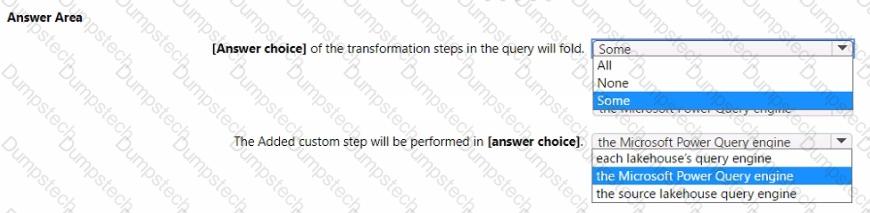
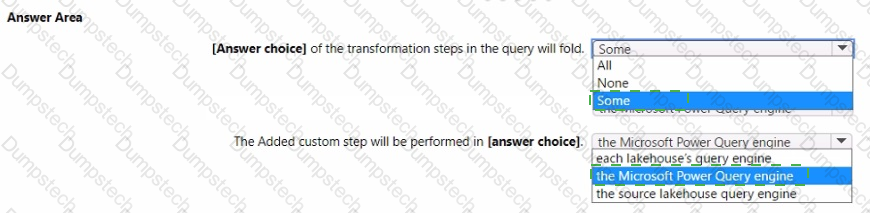
You are building a dataflow that will combine data from the lakehouses. The applied steps from one of the queries in the dataflow is shown in the following exhibit.
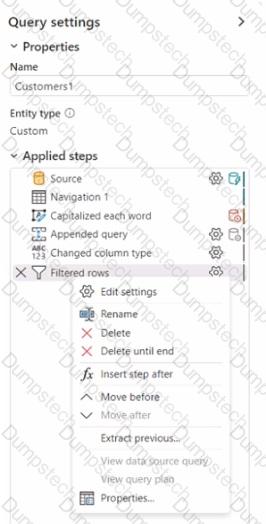
Use the drop-down menus to select the answer choice that completes each statement based on the information presented in the graphic. NOTE: Each correct selection is worth one point.

Note: This question is part of a series of questions that present the same scenario. Each question in the series contains a unique solution that might meet the stated goals. Some question sets might have more than one correct solution, while others might not have a correct solution.
After you answer a question in this section, you will NOT be able to return to it. As a result, these questions will not appear in the review screen.
You have a Fabric tenant that contains a semantic model named Model1.
You discover that the following query performs slowly against Model1.
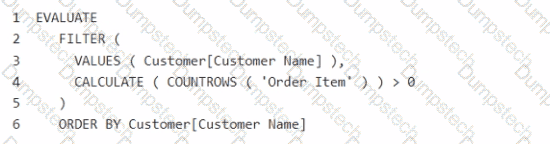
You need to reduce the execution time of the query.
Solution: You replace line 4 by using the following code:

Does this meet the goal?
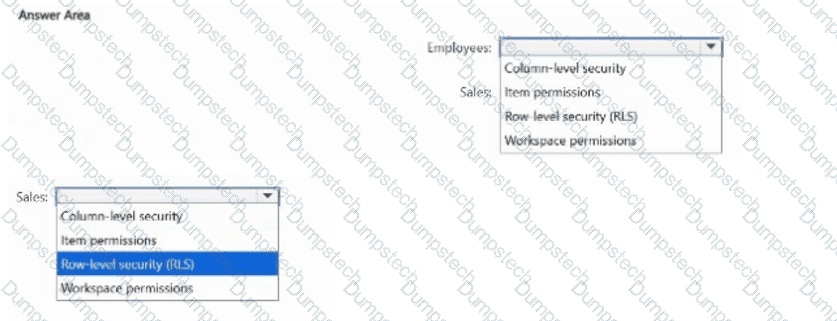
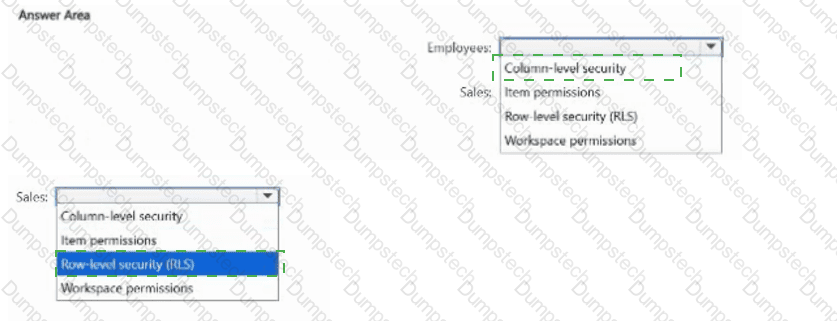
You have a Fabric tenant that contains a workspace named Workspace1. Workspace1 contains a warehouse named DW1. DW1 contains two tables named Employees and Sales. All users have read access to
DW1.
You need to implement access controls to meet the following requirements:
For the Sales table, ensure that the users can see only the sales data from their respective region.
For the Employees table, restrict access to all Personally Identifiable Information (PII).
Maintain access to unrestricted data for all the users.
What should you use for each table? To answer, select the appropriate options in the answer area.
NOTE: Each correct selection is worth one point.

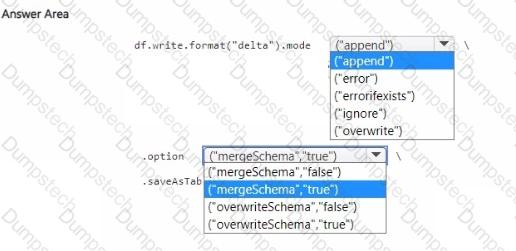
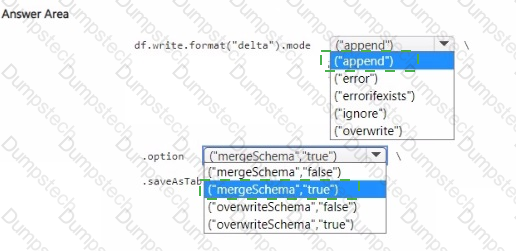
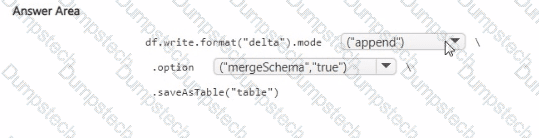
You have a Fabric tenant that contains lakehouse named Lakehousel. Lakehousel contains a Delta table with eight columns. You receive new data that contains the same eight columns and two additional columns.
You create a Spark DataFrame and assign the DataFrame to a variable named df. The DataFrame contains the new data. You need to add the new data to the Delta table to meet the following requirements:
• Keep all the existing rows.
• Ensure that all the new data is added to the table.
How should you complete the code? To answer, select the appropriate options in the answer area.
You have a Fabric tenant that contains a machine learning model registered in a Fabric workspace. You need to use the model to generate predictions by using the predict function in a fabric notebook. Which two languages can you use to perform model scoring? Each correct answer presents a complete solution. NOTE: Each correct answer is worth one point.
You have a Microsoft Power Bl report named Report1 that uses a Fabric semantic model.
Users discover that Report1 renders slowly.
You open Performance analyzer and identify that a visual named Orders By Date is the slowest to render. The duration breakdown for Orders By Date is shown in the following table.
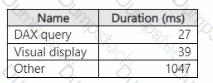
What will provide the greatest reduction in the rendering duration of Report1?
You have a Fabric tenant that contains a workspace named Workspace1. Workspace1 contains a data pipeline named Pipeline1 and a lakehouse named Lakehouse1.
You perform the following actions:
Create a workspace named Workspace2.
Create a deployment pipeline named DeployPipeline1 that will deploy items from Workspace1 to Workspace2.
Add a folder named Folder1 to Workspace1.
Move Lakehouse1 to Folder1.
Run DeployPipeline1.
Which structure will Workspace2 have when DeployPipeline1 is complete?
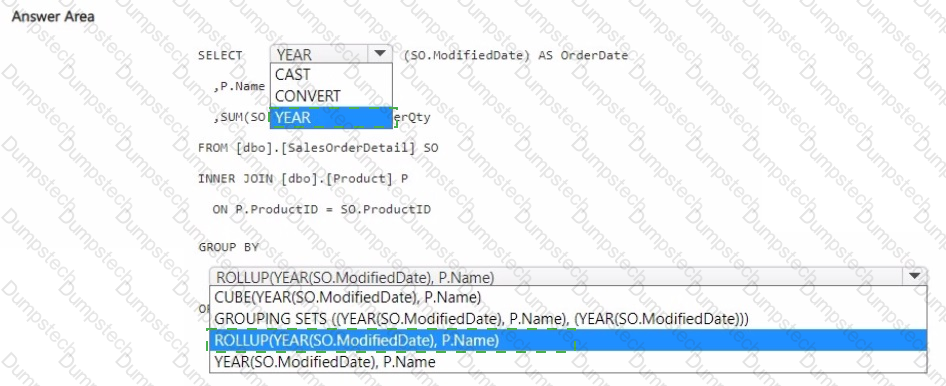
You have a Fabric workspace that contains a warehouse named DW1. DW1 contains the following tables and columns.
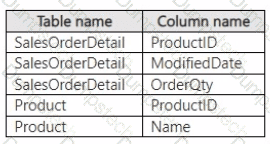
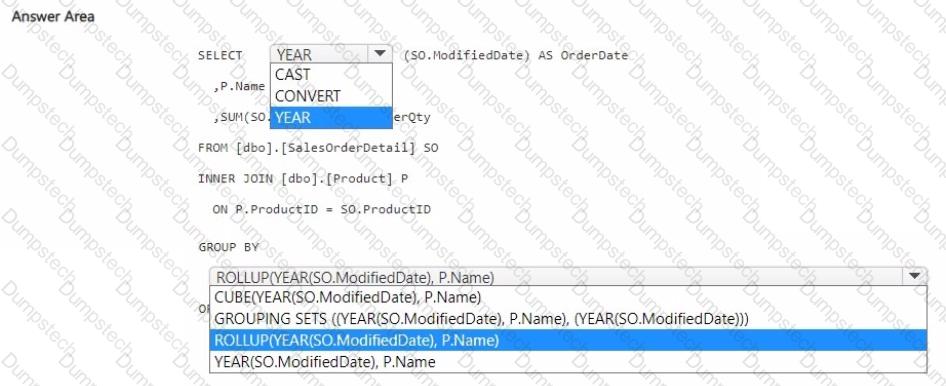
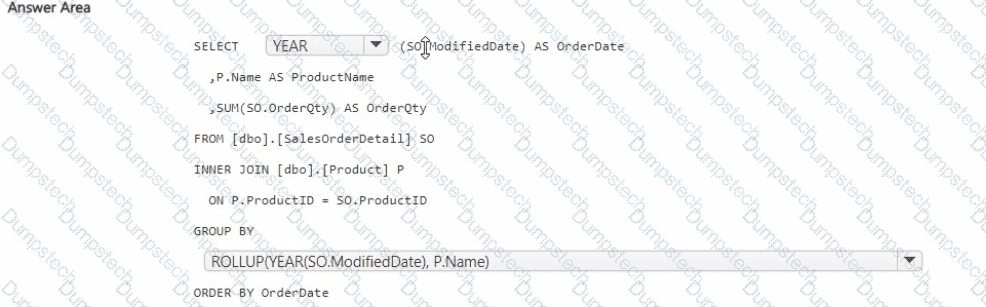
You need to summarize order quantities by year and product. The solution must include the yearly sum of order quantities for all the products in each row.
How should you complete the T-SQL statement? To answer, select the appropriate options in the answer area.
NOTE: Each correct selection is worth one point.
You have source data in a folder on a local computer.
You need to create a solution that will use Fabric to populate a data store. The solution must meet the following requirements:
• Support the use of dataflows to load and append data to the data store.
• Ensure that Delta tables are V-Order optimized and compacted automatically.
Which type of data store should you use?
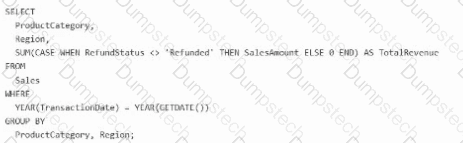
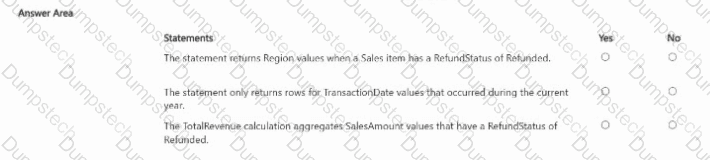
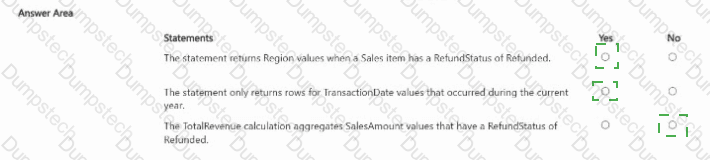
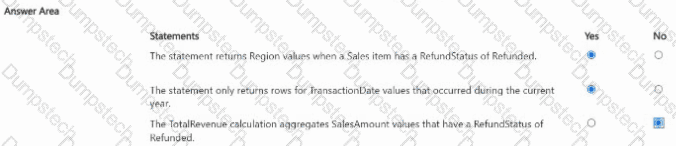
You have the following T-SQI statement.