
75only - Ends in 0d 00h 00m 00s - Coupon code = 75only
Pass the NCCT Surgical Technology TS-C Questions and answers with Dumpstech
A pregnant patient presents to the emergency department with right upper quadrant abdominal pain and is scheduled for surgery. She is currently in the third trimester of pregnancy. Which of the following procedures should the surgical technologist anticipate?
Options:
Splenectomy
Gastrectomy
Bowel resection
Appendectomy
Appendectomy is the most appropriate examination answer because acute appendicitis may present with right upper quadrant abdominal pain during advanced pregnancy.
During pregnancy, enlargement of the uterus alters the position and relationships of abdominal organs. The appendix may be displaced upward, resulting in pain outside the conventional right lower quadrant location.
Acute appendicitis remains an important nonobstetric surgical emergency during pregnancy. Delayed diagnosis or treatment may increase the risk of appendiceal perforation, peritonitis, maternal sepsis, and adverse fetal outcomes.
The British Journal of Surgery ' s guidelines on general surgical emergencies in pregnancy recognize that the enlarging uterus can alter appendiceal position and produce right upper quadrant pain. However, right lower quadrant pain remains common, and diagnosis requires appropriate clinical assessment and imaging.
OUP Academic+1
Option A is incorrect because splenectomy primarily concerns the spleen, which lies in the left upper abdomen.
Option B is incorrect because gastrectomy involves removal of all or part of the stomach.
Option C is incorrect because bowel resection cannot be predicted from pain location alone.
The surgical technologist should anticipate appropriate appendectomy instrumentation, laparoscopic or open surgical equipment, and pregnancy-specific positioning requirements.
Clinical qualification: Right upper quadrant pain during pregnancy has several possible causes, including gallbladder disease and preeclampsia-related hepatic complications. Appendectomy is the best answer among those provided, not a diagnosis established by the symptom alone.
Applying a wound dressing at the end of a surgical procedure helps prevent which of the following?
Options:
Dehiscence
Surgical site infection (SSI)
Adhesion
Hemostasis
Applying an appropriate sterile wound dressing at the completion of surgery provides a protective barrier that reduces exposure of the surgical incision to environmental contamination and supports the prevention of surgical site infection.
Following surgical closure, the incision remains vulnerable to microorganisms from the patient ' s skin, healthcare personnel, clothing, bedding, and surrounding environment. A properly applied dressing protects the wound, absorbs drainage, and helps maintain conditions favorable to tissue healing.
The National Institute for Health and Care Excellence (NICE) recommends covering surgical incisions with an appropriate interactive dressing at the end of an operation.
NICE
Option A is incorrect because wound dehiscence is the separation of previously approximated wound edges. It is principally influenced by factors such as wound tension, closure integrity, infection, and impaired healing. A dressing alone does not reliably prevent dehiscence.
Option C is incorrect because adhesions generally involve fibrous connections between internal tissues and are not prevented by external wound dressings.
Option D is incorrect because hemostasis refers to stopping bleeding, usually through coagulation, ligation, cauterization, or other established techniques. A dressing may absorb drainage or apply limited pressure but is not a substitute for surgical hemostasis.
The surgical technologist must prepare the prescribed dressing, maintain aseptic technique during application, and protect drains or other devices associated with the incision.
What is the MINIMUM distance a sterile field should be maintained from any nonsterile object?
Options:
6 inches
18 inches
12 inches
24 inches
A minimum separation of 12 inches is a commonly taught surgical asepsis requirement for maintaining an appropriate distance between a sterile field and nonsterile personnel, furniture, or equipment.
The Association of Surgical Technologists (AST), in its guidelines for establishing the sterile field, recommends positioning furniture intended for sterile setup approximately 12–18 inches from walls and other nonsterile objects. This separation helps prevent accidental contact and limits contamination risks associated with operating room traffic.
Association of Surgical Technologists+1
Option A is incorrect because six inches provides insufficient separation from potentially contaminating surfaces under the referenced conventional guideline.
Option B represents an acceptable distance but is not the minimum specified in the question.
Option D provides greater separation than necessary under the conventional minimum-distance requirement.
The surgical technologist must maintain awareness of nonsterile surfaces, recognize the boundaries of sterile equipment, and prevent nonsterile personnel from reaching over or making contact with the sterile field.
Additional precautions include maintaining sufficient clearance around the back table, positioning sterile equipment away from excessive operating room traffic, and protecting sterile drapes against accidental contact.
The 12-inch requirement is an operational safety guideline rather than a guarantee against airborne or contact contamination. Sterility depends on maintaining the entire aseptic environment.
Which of the following is considered a sterile area?
Options:
The front of the surgical gown, just below the waistline
Any item located 1/2 inch from the outer edge of the sterile wrapper
The sides of the sterile-draped back table
The underside of the draped Mayo stand
The underside of a properly sterile-draped Mayo stand is considered sterile according to the Association of Surgical Technologists (AST) Guidelines for Best Practices for Sterility of the Underside of the Mayo Stand.
The Mayo stand is covered with a sterile cylindrical drape that encloses its upper portion. Unlike a conventional back table, the correctly draped Mayo stand may be positioned over the surgical field while maintaining sterile integrity.
AST Guideline I specifically recognizes the underside of the sterile-draped Mayo stand as sterile, provided the drape has been applied correctly and no contamination has occurred.
ast.org
Option A is incorrect because the sterile front of a surgical gown extends from the chest to the level of the sterile field; the area below the waistline is generally considered nonsterile.
Option B is incorrect because the outer approximately one-inch border of a sterile wrapper is traditionally considered nonsterile.
Option C is incorrect because only the upper horizontal surface of a conventional sterile-draped back table is considered sterile. Draping material extending below the table edge is not sterile.
The surgical technologist must distinguish the sterile boundaries of gowns, instrument tables, Mayo stands, and wrapped packages to prevent cross-contamination during surgery.
With regard to the use of a fire extinguisher, what does PASS stand for?
Options:
Pull, Aim, Squeeze, and Swipe
Pull, Alert, Squeeze, and Sweep
Pull, Aim, Squeeze, and Sweep
Push, Aim, Squeeze, and Sweep
PASS stands for Pull, Aim, Squeeze, and Sweep , a standardized technique for operating a portable fire extinguisher during a fire emergency.
The Occupational Safety and Health Administration (OSHA) identifies PASS as the recommended operational sequence for portable fire extinguishers.
Occupational Safety and Health Administration
Pull: Remove the safety pin to unlock the extinguisher ' s operating mechanism.
Aim: Direct the nozzle or hose toward the base of the fire rather than the upper flames.
Squeeze: Compress the operating handle to release the extinguishing agent.
Sweep: Move the nozzle from side to side across the base of the fire until the flames are extinguished.
Option A is incorrect because the final step is Sweep, not Swipe. Option B is incorrect because Alert is not the second step of PASS. Option D is incorrect because the initial action is Pull rather than Push.
Operating room fire safety additionally requires recognition of the fire triangle: an ignition source, an oxidizer, and fuel. Lasers and electrosurgical devices can provide ignition, supplemental oxygen can intensify combustion, and surgical drapes or preparation solutions may act as fuel.
The surgical technologist must understand both PASS and the institution ' s emergency response procedures, including immediate communication, removal of burning materials when appropriate, and protection of the patient.
Who is responsible for initiating the preoperative surgical Time Out?
Options:
Certified Registered Nurse Anesthetist (CRNA)
Anesthesiologist
Surgical technologist
Nurse
The circulating nurse is commonly responsible for initiating and coordinating the surgical Time Out immediately before incision.
The Time Out is a formal communication process intended to verify the correct patient, operative procedure, surgical site, and other critical safety requirements. It requires active participation from every member of the surgical team.
The circulating nurse generally announces the Time Out, facilitates verification of the relevant information, and documents completion according to institutional policy.
The Joint Commission requires a designated team member to initiate the Time Out, while AORN identifies the circulating nurse as the person who most often performs this function.
Aorn.org+1
Option A is incorrect as the conventional examination answer because the CRNA primarily manages anesthetic care and participates in the verification process.
Option B is incorrect because the anesthesiologist participates in confirming readiness and relevant anesthetic considerations but is not universally responsible for initiating the Time Out.
Option C is incorrect because the surgical technologist participates in the verification process but does not ordinarily coordinate it.
The surgical team must resolve discrepancies before proceeding. No individual should remain silent when an inconsistency involving patient identity, surgical site, procedure, or equipment is identified.
A surgical technologist is opening the operating room for a surgical procedure. Arrange the following steps for opening the sterile back-table pack in the correct sequence.
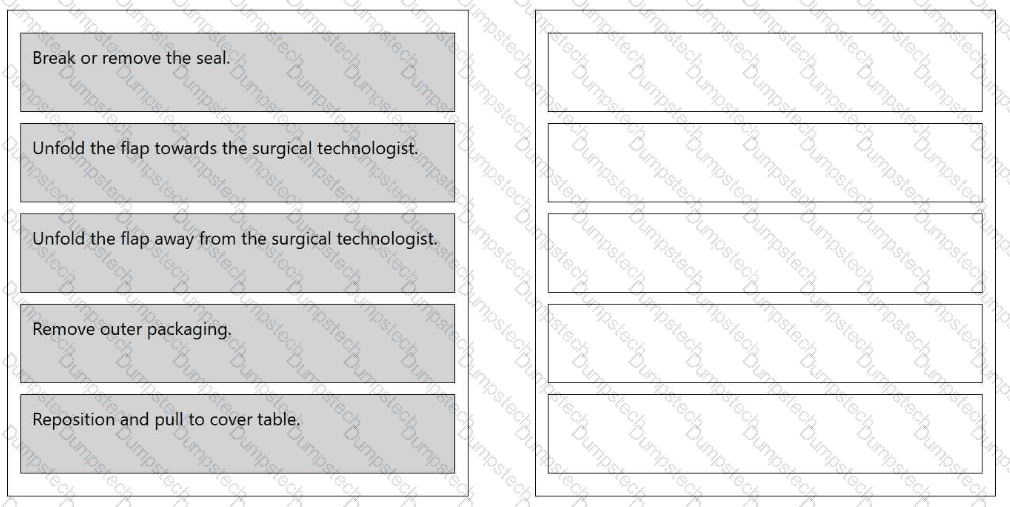
Options:

1
Remove outer packaging.
2
Break or remove the seal.
3
Unfold the flap away from the surgical technologist.
4
Unfold the flap toward the surgical technologist.
5
Reposition and pull to cover the table.
Establishing the sterile back table requires a systematic opening sequence that preserves packaging integrity and prevents contamination. The surgical technologist must follow aseptic technique while ensuring that the sterile table covering is fully extended before instruments and supplies are introduced.
First, remove the outer packaging after inspecting it for damage, moisture, and expiration information. The protective outer covering is considered nonsterile and must be discarded without contaminating the inner sterile package.
Second, break or remove the seal securing the inner package. The seal should be opened carefully to avoid tearing the sterile material.
Third, unfold the flap away from the surgical technologist. This prevents the operator from reaching across exposed sterile surfaces.
Fourth, unfold the flap toward the surgical technologist, handling only the designated nonsterile edges of the wrapper.
Fifth, reposition and pull the remaining covering over the table. The technologist moves around the table as necessary, extending the drape over its surfaces without reaching across the sterile field or allowing the drape to contact unsterile objects.
The Association of Surgical Technologists emphasizes inspection of packaging integrity, correct placement of sterile supplies, and strict aseptic technique when establishing the sterile field.
ast.org+1
Following this sequence helps maintain sterile-field integrity and minimizes the risk of surgical site contamination.
For which of the following procedures should an intraluminal (circular) stapler be used?
Options:
Laparoscopic cholecystectomy
Inguinal hernia repair
Craniotomy
Sigmoid colon resection
An intraluminal circular stapler is commonly used during sigmoid colon resection to create an anastomosis between the remaining segments of the large intestine. The device facilitates restoration of intestinal continuity after removal of diseased or damaged bowel.
Circular staplers are designed to approximate two hollow-organ ends and deploy concentric circular rows of staples while simultaneously excising excess tissue to create a patent lumen. During colorectal surgery, the stapler may be introduced transanally, with its anvil secured in the proximal bowel segment. When the instrument is correctly positioned and fired, it creates a stapled colorectal anastomosis.
Published colorectal surgical techniques describe the use of circular intraluminal staplers for intestinal reconstruction following sigmoid and rectosigmoid resections.
PubMed+1
Option A is incorrect because laparoscopic cholecystectomy generally involves removal of the gallbladder using clips, energy devices, and dissection instruments.
Option B is incorrect because inguinal hernia repair typically involves tissue approximation or mesh reinforcement.
Option C is incorrect because craniotomy involves opening the skull and does not require a circular gastrointestinal stapler.
The surgical technologist must verify stapler size, cartridge compatibility, device integrity, and availability of the appropriate anvil. Following firing, the surgeon evaluates the anastomotic tissue rings and confirms anastomotic integrity.
One factor used to determine tourniquet inflation pressure is:
Options:
Systolic blood pressure
Diastolic blood pressure
Circulating nurse ' s preference
Anesthesiologist ' s preference
Systolic blood pressure is an important physiological parameter used to determine appropriate pneumatic tourniquet inflation pressure during extremity surgery.
A pneumatic tourniquet temporarily restricts arterial blood flow to an extremity, creating a relatively bloodless operative field. The inflation pressure must be sufficient to occlude arterial circulation while minimizing the risk of pressure-related injury to nerves, muscles, and vascular structures.
Historically, tourniquet inflation pressures were calculated by adding a predetermined pressure margin to the patient ' s systolic blood pressure. However, contemporary recommendations favor determining the individual ' s limb occlusion pressure (LOP) and adding an appropriate safety margin.
The Association of Surgical Technologists identifies systolic blood pressure, limb circumference, cuff width, and limb occlusion pressure as relevant considerations for tourniquet pressure selection.
ast.org
Option B is incorrect because diastolic pressure does not provide the principal physiological basis for determining arterial occlusion.
Option C is incorrect because the circulating nurse ' s personal preference is not a valid determinant of tourniquet pressure.
Option D is incorrect because the anesthesia provider participates in patient management, but inflation pressure must be based on clinical assessment and approved protocols rather than personal preference.
The surgical technologist should verify the prescribed pressure, inspect the equipment, and communicate any concerns regarding cuff placement or prolonged inflation.
Which of the following information would be found on a surgeon ' s preference card? (Select the three correct answers.)
Options:
Anesthesia medications needed for the case
Supplies needed for the case
Sutures needed for the case
Surgical instruments needed for the case
Patient preferences needed for the case
The surgeon ' s preference card provides procedure-specific information used to prepare the operating room and establish an efficient surgical setup.
Option B — Supplies needed for the case: Preference cards identify required disposable supplies, sterile drapes, sponges, irrigation materials, dressings, and specialty items.
Option C — Sutures needed for the case: The card may specify preferred suture materials, sizes, needle configurations, quantities, and other wound closure requirements.
Option D — Surgical instruments needed for the case: Instrument trays, specialized retractors, clamps, powered equipment, and other procedure-specific instruments are commonly listed.
AORN identifies preference cards as essential preparation tools that support standardized equipment selection, accurate supply preparation, and efficient surgical workflow.
Aorn.org+1
Option A is not one of the intended responses because anesthetic medication selection and administration are primarily directed by the anesthesia provider. Although some preference cards contain information concerning local medications or other medications used by the surgeon, anesthesia drug requirements are managed separately.
Option E is incorrect because individual patient preferences are documented through patient assessment, consent, and other clinical records rather than the surgeon ' s standard procedural preference card.
Accurate preference cards reduce unnecessary interruptions, prevent missing supplies, and support appropriate surgical preparation.
Modal title
