
Pre-Winter Sale Limited Time 75% Discount Offer - Ends in 0d 00h 00m 00s - Coupon code = simple75
Pass the Netapp NCSE NS0-194 Questions and answers with Dumpstech
Exam NS0-194 Premium Access
View all detail and faqs for the NS0-194 exam
A customer asks what is the correct way to configure an ONTAP system for multi-tenancy. The customer wants to serve data and also protect data using SnapMirror from tenant A using network A and from tenant B using network B.
In this scenario, which statement is correct?
You need to provide a customer an action plan to update an ONTAP system after a security bulletin has been issued.
In this scenario, how do you accomplish this task?
Test user "LAB\tester" can perform an operation in the CIFS share "HR" from the SVM "svm1". However, the rest of the users from the HR department cannot perform the same operation. You want to determine why only "LAB\tester" can perform the operation.
In this scenario, which security trace filter accomplishes this task?
Your Windows clients were able to access your CIFS SVM yesterday. Today they are no longer able to access the CIFS SVM on your NetApp cluster. Your IT security team just pushed out a new group policy to enhance security.
In this scenario, which statement is true?
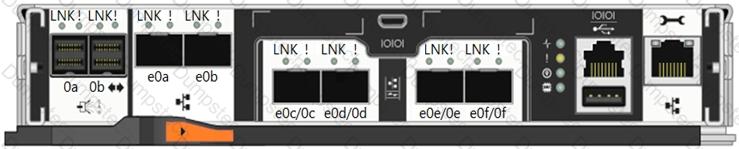
In the AFF A200 shown in the exhibit, which port is a CNA port?
You want to set up a FabricPool between an ONTAP cluster and Google Cloud Storage.
In this scenario, which two components are required to accomplish this task? (Choose two.)
Which NetApp technology enables a volume to span across one or more aggregates and one or more NetApp nodes?
You are working on a fabric MetroCluster. After a site failure, the plex starts to resync automatically to the aggregate mirror of Aggr1. The plex now shows a status of resyncing. During this process, you experience a slow resync of the SyncMirror plex.
In this scenario, how do you solve the problem?
You want to update your storage system and are concerned about the compatibility of the SAN components and the host environment.
In this scenario, which two actions should you take to verify compatibility? (Choose two.)
Source Path Destination Path Relationship ID Relationship Type
msgld: msragld: 78e304e0-9781-1234-abcd-00a098d771bd XDP
msxpgld: msraxpgld: 3ca42ab4-9782-1234-abcd-00a098d771bd XDP
na_docavgld: ndradocavgld: a4b233b2-9783-1234-abcd-00a098d771bd XDP
na_dr: ndradr: c97d36a0-6d7c-11e8-83fb-00a098d771bd XDP
na_gld: ndragld: 9e7e034d-9782-1234-abcd-00a098d771bd XDP
na_mpgld: ndrampgld: 16e52e0d-9783-1234-abcd-00a098d771bd XDP
na_opengld: ndraopengld: dabb1813-9780-1234-abcd-00a098d771bd XDP
na_poc: ndrapoc: c1d632d7-977b-1234-abcd-00a098d771bd XDP
na_pubgld: ndrapubgld: 1a3f866c-9780-1234-abcd-00a098d771bd XDP
Referring to the output, which type of SnapMirror destination relationship is being used?
