Summer Sale Limited Time 75% Discount Offer - Ends in 0d 00h 00m 00s - Coupon code = simple75

Pass the Netskope NCCSI NSK200 Questions and answers with Dumpstech

Exam NSK200 Premium Access

View all detail and faqs for the NSK200 exam

Practice at least 50% of the questions to maximize your chances of passing.
Viewing page 2 out of 3 pages
Viewing questions 11-20 out of questions
Questions # 11:

Your company has many users that are remote and travel often. You want to provide the greatest visibility into their activities, even while traveling. Using Netskope. which deployment method would be used in this scenario?

Options:

A.

Use proxy chaining.

B.

Use a Netskope client.

C.

Use an IPsec tunnel.

D.

Use a GRE tunnel.

Questions # 12:

Your small company of 10 people wants to deploy the Netskope client to all company users without requiring users to be imported using Active Directory, LDAP, or an IdP.

Options:

A.

Deploy the Netskope client using SCCM.

B.

Deploy the Netskope client using JAMF.

C.

Deploy the Netskope client using Microsoft GPO.

D.

Deploy the Netskope client using an email invitation.

Questions # 13:

A customer wants to deploy the Netskope client on all their employee laptops to protect all Web traffic when users are working from home. However, users are required to work from their local offices at least one day per week. Management requests that users returning to the office be able to transparently leverage the local security stack without any user intervention.

Which two statements are correct in this scenario? (Choose two.)

Options:

A.

You must enable On-premises Detection in the client configuration.

B.

You must allow users to unenroll In the client configuration.

C.

You must disable Dynamic Steering in the traffic steering profile.

D.

You must configure IPsec/GRE tunnels on the local network to steer traffic to Netskope.

Questions # 14:

The risk team at your company has determined that traffic from the sales team to a custom Web application should not be inspected by Netskope. All other traffic to the Web application should continue to be inspected. In this scenario, how would you accomplish this task?

Options:

A.

Create a Do Not Decrypt Policy using User Group and Domain in the policy page.

B.

Create a Do Not Decrypt Policy using Application in the policy page and a Steering Exception for Group

C.

Create a Do Not Decrypt Policy using Destination IP and Application in the policy page.

D.

Create a Do Not Decrypt Policy using Source IP and Application in the policy page.

Questions # 15:

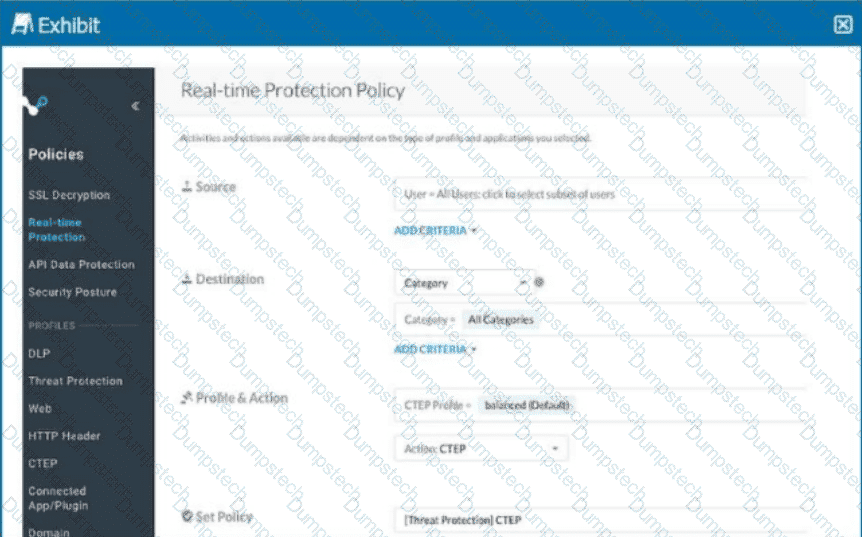
Review the exhibit.

Question # 15

Your Real-time Protection policy contains some rules with only a browse activity. The exhibit shows a new policy rule.

Where is the correct location to place this rule?

Options:

A.

at the bottom

B.

before browse activity

C.

after browse activity

D.

at the top

Questions # 16:

You have deployed Netskope Secure Web Gateway (SWG). Users are accessing new URLs that need to be allowed on a daily basis. As an SWG administrator, you are spending a lot of time updating Web policies. You want to automate this process without having to log into the Netskope tenant

Which solution would accomplish this task?

Options:

A.

You can use Cloud Log Shipper.

B.

You can minimize your work by sharing URLs with Netskope support.

C.

You can use Cloud Risk Exchange.

D.

You can use REST API to update the URL list.

Questions # 17:

While most Web and SaaS traffic is decrypted for inspection, you are asked to prevent a certain host on the network from SSL decryption for privacy purposes.

Options:

A.

Create a steering exception for the host.

B.

Create a Real-time Protection policy, select the host, and choose to block SSL decryption.

C.

Create a Source Network Location for a Do Not Decrypt SSL policy.

D.

Add the host to the certificate-pinned application list.

Questions # 18:

You are using the Netskope DLP solution. You notice flies containing test data for credit cards are not triggering DLP events when uploaded to Dropbox. There are corresponding page events. Which two scenarios would cause this behavior? (Choose two.)

Options:

A.

The Netskope client Is not steering Dropbox traffic.

B.

The DLP rule has the severity threshold set to a value higher than the number of occurrences.

C.

The credit card numbers in your test data are Invalid 16-dlglt numbers.

D.

There is no API protection configured for Dropbox.

Questions # 19:

Your organization has three main locations with 30.000 hosts in each location. You are planning to deploy Netskope using iPsec tunnels for security.

What are two considerations to make a successful connection in this scenario? (Choose two.)

Options:

A.

browsers in use

B.

operating systems

C.

redundant POPs

D.

number of hosts

Questions # 20:

You want the ability to perform automated remediation of misconfigurations on GitHub, Microsoft 365, Salesforce, ServiceNow, and Zoom.

Options:

A.

Netskope Infrastructure as a Service

B.

Netskope Remote Browser Isolation

C.

Netskope Cloud Firewall

D.

Netskope SaaS Security Posture Management

Viewing page 2 out of 3 pages
Viewing questions 11-20 out of questions